Uploaded: 05 Dec 2016 (10 years ago) · Shared: 01 Aug 2017
Duration: 40:53
Video Description
In this compelling exploration of early history, renowned investigative journalist Simcha Jacobovici dives deep into the origins of the Christian Church and the historical formation of biblical canon. The video examines the controversial journey of the Book of Revelation, tracing its early rejection by prominent scholars, its alleged connections to Gnostic teachings, and its ultimate inclusion in the Bible following centuries of intense theological debate.
By analyzing the influence of Roman Emperor Constantine, early Church fathers like Eusebius, and historical pagan traditions, Jacobovici uncovers how ancient political motives and mystery cults shaped foundational religious doctrine. Perfect for believers, scholars, and seekers interested in scriptures, faith, and ancient history, this insightful discussion offers a thought-provoking look at how pivotal historical decisions molded modern Christian theology and influenced our collective understanding of sacred texts.
Explore More
Simcha Jacobovici Constantine Mithras Church Pagan ONSSearch Google Search Explore Topics
 Who is Simcha Jacobovici?
Simcha Jacobovici (born 1953, Petah Tikva, Israel) is an Israeli-Canadian film director, producer, freelance journalist, and writer. He earned a B.A. in Philosophy and Political Science (with honors) from McGill University and an M.A. in International Relations from the University of Toronto. Jacobovici is an Adjunct Professor of Religious Studies at Huntington University, an affiliate of Laurentian University in Sudbury, Ontario. Jacobovici has been a guest lecturer at numerous conferences and on various campuses including Yale University, Johns Hopkins University, McGill University, UCLA and York University.
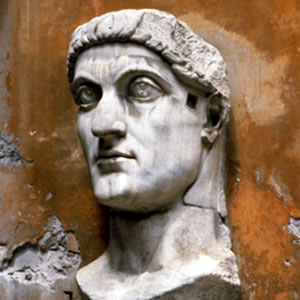 Who was Constantine?
Constantine the Great (27 February 272 AD-22 May 337 AD) was a Roman Emperor who ruled between 306 and 337 AD. Born on the territory now known as Nis, located in Serbia, he was the son of Flavius Valerius Constantius, a Roman Army officer of Illyrian origins. His mother Helena was Greek. His father became Caesar, the deputy emperor in the west, in 293 AD. Constantine was sent east, where he rose through the ranks to become a military tribune under Emperors Diocletian and Galerius. Constantine was the first Roman emperor to convert to Christianity. Although he lived most of his life as a pagan, he joined the Christian faith on his deathbed, being baptised by Eusebius of Nicomedia. He played an influential role in the proclamation of the Edict of Milan in 313, which declared religious tolerance for Christianity in the Roman empire. He called the First Council of Nicaea in 325 AD that produced the statement of Christian belief known as the Nicene Creed.
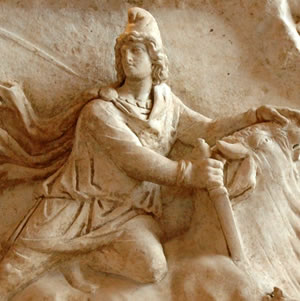 Who was Mithras?
Mithraism, was a mystery religion centered on the god Mithras that was practised in the Roman Empire from about the 1st to the 4th century CE. The religion was inspired by Persian worship of the god Mithra (Proto-Indo-Iranian/Vedic Mitra), though the Greek Mithras was linked to a new and distinctive imagery, and the level of continuity between Persian and Greco-Roman practice is debated. Worshippers of Mithras had a complex system of seven grades of initiation and communal ritual meals. Initiates called themselves syndexioi, those "united by the handshake". They met in underground temples, called mithraea, which survive in large numbers. The cult appears to have had its centre in Rome.
 What is the Church?
A church is a building used for Christian worship services and Christian activities. The earliest identified Christian church is a house church founded between 233 AD and 256 AD. The word church also describes a body or assembly of Christian believers, while "the Church" refers to the worldwide Christian religious community.
 What is Pagan?
Paganism is a term first used in the fourth century by early Christians. It was applied on populations of the Roman Empire who practiced polytheism, either because they were increasingly rural and provincial relative to the Christian population or because they were not milites Christi (soldiers of Christ). Alternate terms in Christian texts for the same group were hellene, gentile, and heathen. Pagan and paganism were pejorative terms for the same polytheistic group, implying its inferiority. Paganism has broadly connoted the "religion of the peasantry", and for much of its history was a derogatory term. Both during and after the Middle Ages, pagan was a pejorative term that was applied to any non-Abrahamic or unfamiliar religion, and the term presumed a belief in false god(s).
 Who are ONS?
The Office for National Statistics (ONS) is the official national statistical institute of the United Kingdom.