Codex Sinaiticus is the earliest complete New Testament manuscript. It is dated to 312 years after Jesus' Crucifixion.
The original, handwritten 27 books of the New Testament most likely disappeared within a few decades after being written. We are left with thousands of manuscripts, papyri and handwritten copies in many different languages.The earliest complete copy of the New Testament is found in the Codex Sinaiticus which dates to 330-360 AD, or 345 AD median year. As Jesus was crucified in 33 AD, Christianity is left with a gap of 312 years in its scriptural evidences.
NOTE: Earlier Biblical Manuscripts than the Codex Sinaiticus are available (i.e. papyrus P52), but these are incomplete, fragmentary, and only have a few words or verses of the originals.
1. MARK
| DATING | % | Mid |
| Traditional: 65-75 AD 2 | 0% (not available) | 70 AD |
| Papyrus: P45 (Egypt) 250 AD 4 | x% (y words, parchment) | 250 AD (180 yr gap) |
| Manuscript: Codex Sinaiticus (Egypt) 330-360 AD 3 | 100% | 345 AD (275 yr gap) |
2 TRADITIONAL dating is widely acknowledged by Christians
3 MANUSCRIPT is earliest complete copy of text
4 PAPYRUS is earliest fragment of text (i.e. few words, verses)
2. MATTHEW
| DATING |
| Traditional: 75-100 AD |
| Manuscript: Codex Sinaiticus (Egypt) 330-360 AD |
| Papyrus: P104 (Egypt) 150-200 AD |
3. LUKE
| DATING |
| Traditional: 75-100 AD |
| Manuscript: Codex Sinaiticus (Egypt) 330-360 AD |
| Papyrus: P4 (Egypt) 150-200 AD |
4. JOHN
| DATING |
| Traditional: 90-110 AD |
| Manuscript: Codex Sinaiticus (Egypt) 330-360 AD |
| Papyrus: P52 (Egypt) 200 AD |
5. ACTS
| DATING |
| Traditional: 80-90 AD |
| Manuscript: Codex Sinaiticus (Egypt) 330-360 AD |
| Papyrus: 0189 200 AD |
6. ROMANS
| DATING |
| Traditional: 56-58 AD |
| Manuscript: Codex Sinaiticus (Egypt) 330-360 AD |
| Papyrus: P46 175-225 AD |
7. 1 CORINTHIANS
| DATING |
| Traditional: 50-60 AD |
| Manuscript: Codex Sinaiticus (Egypt) 330-360 AD |
| Papyrus: P46 175-225 AD |
8. 2 CORINTHIANS
| DATING |
| Traditional: 55-57 AD |
| Manuscript: Codex Sinaiticus (Egypt) 330-360 AD |
| Papyrus: P46 175-225 AD |
9. GALATIANS
| DATING |
| Traditional: 48-55 AD |
| Manuscript: Codex Sinaiticus (Egypt) 330-360 AD |
| Papyrus: P46 175-225 AD |
10. EPHESIANS
| DATING |
| Traditional: 80-95 AD |
| Manuscript: Codex Sinaiticus (Egypt) 330-360 AD |
| Papyrus: P46 175-225 AD |
11. PHILIPPIANS
| DATING |
| Traditional: 50-60 AD |
| Manuscript: Codex Sinaiticus (Egypt) 330-360 AD |
| Papyrus: P46 175-225 AD |
12. COLOSSIANS
| DATING |
| Traditional: 80-95 AD |
| Manuscript: Codex Sinaiticus (Egypt) 330-360 AD |
| Papyrus: P46 175-225 AD |
13. 1 THESSALONIANS
| DATING |
| Traditional: 50-60 AD |
| Manuscript: Codex Sinaiticus (Egypt) 330-360 AD |
| Papyrus: P46 175-225 AD |
14. 2 THESSALONIANS
| DATING |
| Traditional: 80-95 AD |
| Manuscript: Codex Sinaiticus (Egypt) 330-360 AD |
| Papyrus: P92 (Egypt) 300 AD |
15. 1 TIMOTHY
| DATING |
| Traditional: 62 AD |
| Manuscript: Codex Sinaiticus (Egypt) 330-360 AD |
| Papyrus: P32 (Egypt) 100-300 AD |
16. 2 TIMOTHY
| DATING |
| Traditional: 67 AD |
| Manuscript: Codex Sinaiticus (Egypt) 330-360 AD |
| Papyrus: P32 (Egypt) 100-300 AD |
17. TITUS
| DATING |
| Traditional: 62 AD |
| Manuscript: Codex Sinaiticus (Egypt) 330-360 AD |
| Papyrus: P32 (Egypt) 100-300 AD |
18. PHILEMON
| DATING |
| Traditional: 50-60 AD |
| Manuscript: Codex Sinaiticus (Egypt) 330-360 AD |
| Papyrus: P87 250 AD |
19. HEBREWS
| DATING |
| Traditional: 70-90 AD |
| Manuscript: Codex Sinaiticus (Egypt) 330-360 AD |
| Papyrus: P46 175-225 AD |
20. JAMES
| DATING |
| Traditional: 90-140 AD |
| Manuscript: Codex Sinaiticus (Egypt) 330-360 AD |
| Papyrus: P20 (Egypt) 250-300 AD |
21. 1 PETER
| DATING |
| Traditional: 90-95 AD |
| Manuscript: Codex Sinaiticus (Egypt) 330-360 AD |
| Papyrus: P72 250-350 AD |
22. 2 PETER
| DATING |
| Traditional: 125-150 AD |
| Manuscript: Codex Sinaiticus (Egypt) 330-360 AD |
| Papyrus: P72 250-350 AD |
23. 1 JOHN
| DATING |
| Traditional: 90-110 AD |
| Manuscript: Codex Sinaiticus (Egypt) 330-360 AD |
| Papyrus: P9 (Egypt) 250-300 AD |
24. 2 JOHN
| DATING |
| Traditional: 90-110 AD |
| Manuscript: Codex Sinaiticus (Egypt) 330-360 AD |
| Papyrus: - |
25. 3 JOHN
| DATING |
| Traditional: 90-110 AD |
| Manuscript: Codex Sinaiticus (Egypt) 330-360 AD |
| Papyrus: - |
26. JUDE
| DATING |
| Traditional: 90-140 AD |
| Manuscript: Codex Sinaiticus (Egypt) 330-360 AD |
| Papyrus: P72 250-350 AD |
27. REVELATION
| DATING |
| Traditional: 90-95 AD |
| Manuscript: Codex Sinaiticus (Egypt) 330-360 AD |
| Papyrus: P98 150-200 AD |
QURAN
The test was carried out in a laboratory at the University of Oxford. The result places the leaves close to the time of the Prophet Muhammad, who is generally thought to have lived between 570 and 632 AD.
 The tests carried out on the parchment of the Birmingham folios yield the strong probability that the animal from which it was taken was alive during the lifetime of the Prophet Muhammad or shortly afterwards.
These portions must have been in a form that is very close to the form of the Quran read today, supporting the view that the [Quran] text has undergone little or no alteration and that it can be dated to a point very close to the time it was believed to be revealed.
David Thomas, Professor of Christianity and Islam. University of Birmingham
CREDIT
https://www.biblequery.org/ntmss.html
https://library.duke.edu/rubenstein/scriptorium/papyrus/texts/manuscripts.html
http://www.codexsinaiticus.org/en/
https://callingchristians.com/2017/04/05/a-brief-insight-into-the-new-testaments-prototyping
https://www.birmingham.ac.uk/news/latest/2015/07/quran-manuscript-22-07-15.aspx
https://en.wikipedia.org/wiki/Birmingham_Quran_manuscript
https://en.wikipedia.org/wiki/Dating_the_Bible
139-biblent-manuscript-dating
| Author: Guest • Updated: 05 Sep 2026 • 21,421 views | 50 mins ago |
Explore More
New Testament Codex SinSearch Google Search Explore Topics
 What is New Testament?
The New Testament is the second part of the Christian biblical canon. The first part being the Old Testament, based on the Hebrew Bible. The New Testament discusses the teachings and person of Jesus, as well as events in first-century Christianity. Christians regard both the Old and New Testaments together as sacred scripture. The New Testament (in whole or in part) has frequently accompanied the spread of Christianity around the world. It reflects and serves as a source for Christian theology and morality.
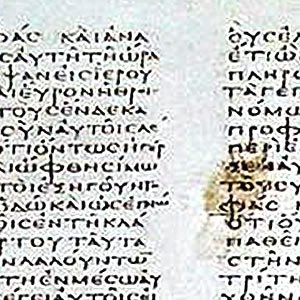 What is Codex?
A codex is a book constructed of a number of sheets of paper, vellum, papyrus, or similar materials. The term is now usually only used of manuscript books, with hand-written contents, but describes the format that is now near-universal for printed books in the Western world.
 What is Sin?
In Abrahamic contexts, sin is the act of violating God's will. Sin can also be viewed as anything that violates the ideal relationship between an individual and God; or as any diversion from the ideal order for human living. To sin has been defined as "to miss the mark". Sins fall in a spectrum from minor errors to deadly misdeeds. Catholicism regards the least corrupt sins as venial sins which are part of human living and carry immediate consequences on earth, and, if unrepented for, more painful purgation, assuming the person is destined to heaven, as it is written in the formation letter "Purgatory", "most of the early Fathers of the Church speak of a cleansing fire, though we cannot tell whether this means actual or spiritual fire." Conversely, sins of great evil are mortal sins which bring the consequence of hell if they are not addressed either through an act of perfect contrition or going to confession about them.