Youtube Description:
One of the most enduring myths today about the Council of Nicaea is that the council members voted on which books to include in the Bible. This myth is sometimes expanded to include Emperor Constantine as some driving political force behind the formation of the canon. This, in actuality, is almost certainly a fable. Dive into the historical evidence to see why.
Patreon:
Blog:
Bibliography:
20 Canon Laws from Nicaea:
Theodoret Ecclesiastical History:
Athanasius De Decretis:
Athanasius Festal Letter info:
Voltaire Dictionnaire Philosophique Section 3: (see edition: Oeuvres Completes de Voltaire, 1874, p. 357).
Synodicon Vetus (out of print):
Thanks especially to our Patrons on Patreon!:
Brian B.
Daniel D.
Kalei W.
Alex B.
Mark H.
Alice C.
Wilson
Cain D.
One of the most enduring myths today about the Council of Nicaea is that the council members voted on which books to include in the Bible. This myth is sometimes expanded to include Emperor Constantine as some driving political force behind the formation of the canon. This, in actuality, is almost certainly a fable. Dive into the historical evidence to see why.
Patreon:
Blog:
Bibliography:
20 Canon Laws from Nicaea:
Theodoret Ecclesiastical History:
Athanasius De Decretis:
Athanasius Festal Letter info:
Voltaire Dictionnaire Philosophique Section 3: (see edition: Oeuvres Completes de Voltaire, 1874, p. 357).
Synodicon Vetus (out of print):
Thanks especially to our Patrons on Patreon!:
Brian B.
Daniel D.
Kalei W.
Alex B.
Mark H.
Alice C.
Wilson
Cain D.
Explore More
 Who are ReligionForBreakfast?
ReligionForBreakfast is an educational channel dedicated to the academic, nonsectarian study of religion. We strive to raise the level of conversation about religion on YouTube by exploring surprising facts about humanity's beliefs and rituals
through an anthropological, sociological, and archaeological lens. Here at RFB we respect everyone: religious, non-religious, and everyone in between.
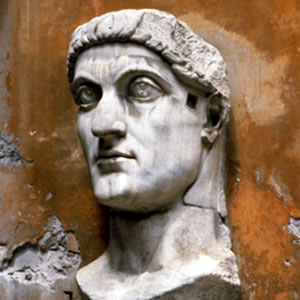 Who was Constantine?
Constantine the Great (27 February 272 AD-22 May 337 AD) was a Roman Emperor who ruled between 306 and 337 AD. Born on the territory now known as Nis, located in Serbia, he was the son of Flavius Valerius Constantius, a Roman Army officer of Illyrian
origins. His mother Helena was Greek. His father became Caesar, the deputy emperor in the west, in 293 AD. Constantine was sent east, where he rose through the ranks to become a military tribune under Emperors Diocletian and Galerius. Constantine was the first Roman emperor to convert to Christianity. Although he lived most of his life as a pagan, he joined the Christian faith on his deathbed, being baptised by Eusebius of Nicomedia. He played an influential role in the proclamation of the Edict of Milan in 313, which declared religious tolerance for Christianity in the Roman empire. He called the First Council of Nicaea in 325 AD that produced the statement of Christian belief known as the Nicene Creed.
 What is The Bible?
The Bible is a canonical collection of texts sacred in Judaism and Christianity. There is no single "Bible" and many Bibles with varying contents exist. The term Bible is shared between Judaism and Christianity, although the contents of each of their
collections of canonical texts is not the same.
Different religious groups include different books within their Biblical canons, in different orders, and sometimes divide or combine books, or incorporate additional material into canonical books.
The Hebrew Bible, or Tanakh, contains 24 books. Christian Bibles range from the 66 books of the Protestant canon to the 81 books of the Ethiopian Orthodox Church canon.
The first part of Christian Bibles is the Old Testament, which contains, at minimum, the 24 books of the Hebrew Bible divided into 39 books and ordered differently from the Hebrew Bible. The Catholic Church and Eastern Christian churches also hold certain deuterocanonical books and passages to be part of the Old Testament canon.
The second part is the New Testament, containing 27 books: the 4 Canonical gospels, Acts of the Apostles, 21 Epistles or didactic letters, and the Book of Revelation.
![Video: Prophet Adam [The First Human]](https://img.youtube.com/vi/NhbHHN-Y1fM/mqdefault.jpg)