What are Religions?
Religion is a range of social-cultural systems, including designated behaviors and practices, ethics, morals, beliefs, worldviews, texts, sanctified places, prophecies, or organizations, that generally relate humanity to supernatural, transcendental, and spiritual elements.
There is no scholarly consensus over what precisely constitutes a religion. It is an essentially contested concept. Different religions may or may not contain various elements ranging from the divine, sacredness, faith, and a supernatural being or beings.
The origin of religious belief is an open question, with possible explanations including awareness of individual death, a sense of community, and dreams. Religions have sacred histories, narratives, and mythologies, preserved in oral traditions, sacred texts, symbols, and holy places, that may attempt to explain the origin of life, the universe, and other phenomena. Religious practice may include rituals, sermons, commemoration or veneration (of deities or saints), sacrifices, festivals, feasts, trances, initiations, matrimonial and funerary services, meditation, prayer, music, art, dance, or public service.
There are an estimated 10,000 distinct religions worldwide, though nearly all of them have regionally based, relatively small followings. Four religions: Christianity, Islam, Hinduism, and Buddhism account for over 77% of the world's population, and 92% of the world either follows one of those four religions or identifies as non-religious, meaning that the vast majority of remaining religions account for only 8% of the population combined.
Search Result on Religions (27 total)
Youtube Videos on Religions (15)
 Who is God in the World
  Bridging World
  Reverend Moon, of the Unification Movement tried to bring all
  Reverend Moon, of the Unification Movement tried to bring all
  The Quran in Abrahamic
  Mithraism, like other Ancient Near East pagan
  Muslims must respect other
  All
All  Belief in One God is what sets Islam apart from other
  Palestine-Israel War - The solution is all
  'The World is full of Opinions. So I'm retired from ALL
 All
All  Why
Why  Did Governments Create the World's Major
 News on Religions (5)
Articles on Religions (3)
Abrahamic Religions

29,596 views
|
Angels - 41 Angels from the Abrahamic Religions
32,940 views
|
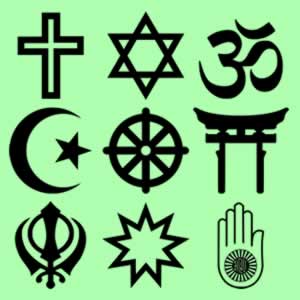
Religions
95 views
|
FAQ on Religions (3)
| 1. How did Islam come into the world? |
| 2. Other religions also teach the existence of God. Is there any difference between their teaching and the Islamic concept of God? |
| 3. What is a Scripture? |
Topics with Religions (1)
What are Religions?

Religion is a range of social-cultural systems including designated behaviors and practices, ethics, morals, beliefs, worldviews, texts, sanctified places, prophecies, or organizations, that generally relate humanity to supernatural, transcendental, and spiritual elements. There is no scholarly consensus over what precisely constitutes a religion. It is an essentially contested concept. Different religions may or may not contain various elements ranging from the divine, sacredness, faith, and a supernatural being or beings. The origin of religious belief is an open question, with possible explanations including awareness of individual death, a sense of community, and dreams. Religions have sacred histories, narratives, and mythologies, preserved in oral traditions, sacred texts, symbols, and holy places, that may attempt to explain the origin of life, the universe, and other phenomena. Religious practice may include rituals, sermons, commemoration or veneration (of deities or saints), sacrifices, festivals, feasts, trances, initiations, matrimonial and funerary services, meditation, prayer, music, art, dance, or public service. <br><br> There are an estimated 10,000 distinct religions worldwide, though nearly all of them have regionally based, relatively small followings. Four religions: Christianity, Islam, Hinduism, and Buddhism account for over 77% of the world's population, and 92% of the world either follows one of those four religions or identifies as non-religious, meaning that the vast majority of remaining religions account for only 8% of the population combined. |