Live Screenshot
Source link:
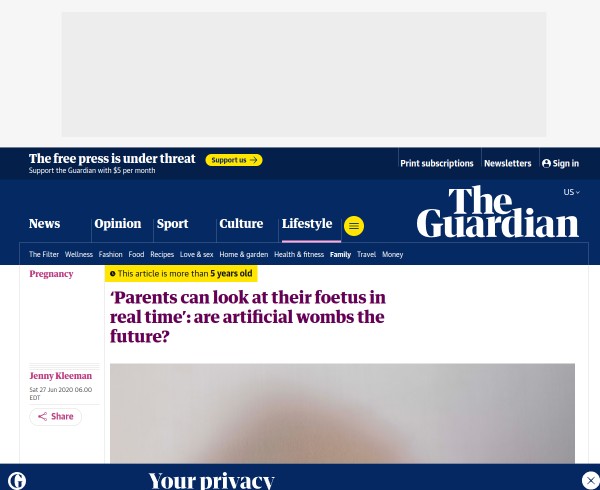
https://www.theguardian.com/lifeandstyle/2020/jun/27/parents-can-look-foetus-real-time-artificial-wombs-futurePublished by: THE GUARDIAN on 27 Jun 2020
898 views · Last view: 1 day ago
News Text (from THE GUARDIAN)
Scientists are currently pushing on an ethical boundary. Will out of body gestation ever replace the experience of human birth? The lamb is sleeping. It lies on its side, eyes shut, ears folded back and twitching. It swallows, wriggles and shuffles its gangly legs. Its crooked half-smile makes itlook content, as if dreaming about gambolling in a grassy field. But this lamb is too tiny to venture out. Its eyes cannot open. It is hairless; its skin gathers in pink rolls at its neck. It hasn’t been born yet, but here it is, at 111 days’ gestation, totally separate from its mother, alive and kicking in a research lab in Philadelphia. It is submerged in fluid, floating inside a transparent plastic bag, its umbilical cord connected to a nexus of bright blood-filled tubes. This is a foetus growing inside an artificial womb. In another four weeks, the bag will be unzipped and the lamb will be born.
When I first see images of the Philadelphia lambs on my laptop, I think of the foetus [...]
To view the original News article, click here
Search Results on 'Can a Human Foetus grow inside an Artificial Womb, and replace a Mother? - The Guardian'
SCROLL TO :TOPICS | 1NEWS | 102ARTICLES | 0FAQ | 0VIDEO | 10LINKS | 0TOPICS #THE GUARDIAN Google Search
Topics include The Guardian (1)
Who are The Guardian?

The Guardian is a British daily newspaper. It was founded in 1821 as The Manchester Guardian, and changed its name in 1959. Along with its sister papers The Observer and The Guardian Weekly, The Guardian is part of the Guardian Media Group, owned by the Scott Trust. The trust was created in 1936 to "secure the financial and editorial independence of The Guardian in perpetuity and to safeguard the journalistic freedom and liberal values of The Guardian free from commercial or political interference". |
News on The Guardian (102)
Youtube Videos on The Guardian (10)
 Pretty Radical: Inside Poland's Far-Right -
  Battle For Mosul, Iraq -
  Coronavirus leads to violence against 'Tablighi Jamaat' Muslims in divided India -
  'Palestinian Lives Matter' to
  'God gave us Israel. All of Jerusalem is Jewish' |
  'Even Refugee Camps are not safe from Israeli soldiers' |
  'I gave you Life, you chose Death', Israeli settler claims |
  Extremist Israeli settlers make living in Gaza impossible |
  Israeli Settlers destroy what
 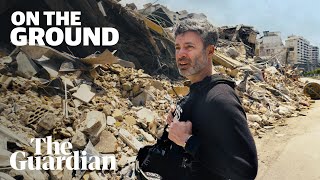 Lebanon pays 'a big price' for resisting Israel |
DISCLAIMER
All news articles are shared for educational purposes only. The news content is hosted on the external news website. News articles titles are derived from the original news title, news content, dialogue, speech or general content theme. The news title may be edited and optimized for SEO, keyword density, information and internal website search purposes. You are advised to view the original news article for a better understanding. If you spot any mistakes, errors or omissions kindly contact us.
All news articles are shared for educational purposes only. The news content is hosted on the external news website. News articles titles are derived from the original news title, news content, dialogue, speech or general content theme. The news title may be edited and optimized for SEO, keyword density, information and internal website search purposes. You are advised to view the original news article for a better understanding. If you spot any mistakes, errors or omissions kindly contact us.