Live Screenshot
Source link:
https://www.theguardian.com/commentisfree/belief/2015/apr/03/christianity-when-properly-understood-religion-losersPublished by: THE GUARDIAN on 3 Apr 2015
1790 views · Last view: 1 day ago
 JESUS
News Text (from THE GUARDIAN)
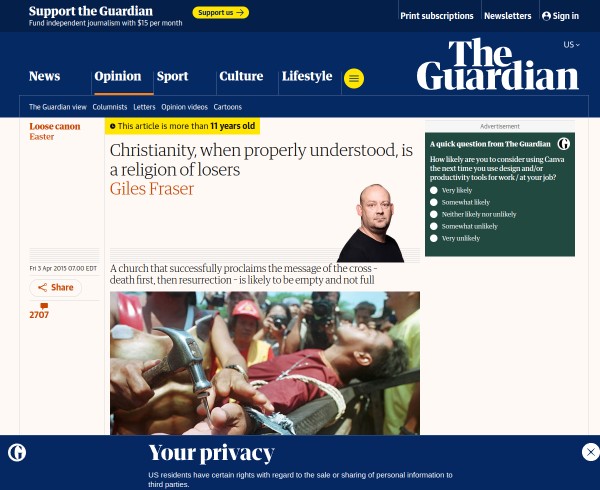
A church that successfully proclaims the message of the cross – death first, then resurrection – is likely to be empty and not full When he was nothing but a suspended carcass, dripping with his own blood and other people’s spit, there were no worshippers around clapping their hands and singingtheir hymns. They were long gone. At the very end, ironically at the moment of greatest triumph, he had no followers left. That says something profoundly counterintuitive about what a successful church looks like. For if the core of the Christian message – death first, then resurrection – is so existentially full-on that nobody can possibly endure it, then a church that successfully proclaims that message is likely to be empty and not full. Which is also why, quite possibly, a successful priest ought to be hated rather than feted. For here, as elsewhere in the Christian story, success and failure are inverted. The first will be last and the last first. The rich are cast down and the poor are exulted. The true king is crowned with mockery and thorns not with gold and ermine.
Christianity, properly understood, is a religion of losers – the worst of playground insults. For not only do we not want to be a loser, we don’t want to associate with them either. We pointedly shun losers, as if some of their loser-ness might rub off on us. Or rather, more honestly, we shun them because others might recognise us as among their number. And because we secretly fear that this might actually be true, we shun them all the more viciously, thus to distance ourselves all the more emphatically. And so the cock crows three times.
But it is true. Deep failure, the failure of our lives, is something we occasionally contemplate in the middle of the night, in those moments of terrifying honesty before we get up and dress for success. Ecce homo, said Pilate. Behold, the man. This is humanity. And the facade of success we present to the world is commonly a desperate attempt to ward off this knowledge. At the beginning of Lent, Christians are reminded of this in the most emphatic of ways: know that you are dust and to dust you shall return. Those who used the period of Lent to give things up are invited to live life stripped bare, experiencing humanity in the raw, without the familiar props to our ego. This has nothing to do with the avoidance of chocolate and everything to do with facing the unvarnished truth about human failure. There is no way 100 top business leaders would endorse the cross. It is life without the advertising, without the accoutrements of success. It is life on a zero-hours contract, where at any moment we can be told we are not needed.
But here’s the thing. The Christian story, like the best sort of terrifying psychoanalysis, strips you down to nothing in order for you to face yourself anew. For it turns out that losers are not despised or rejected, not ultimately. In fact, losers can discover something about themselves that winners cannot ever appreciate – that they are loved and wanted simply because of who they are and not because of what they achieve. That despite it all, raw humanity is glorious and wonderful, entirely worthy of love. This is revealed precisely at the greatest point of dejection. The resurrection is not a conjuring trick with bones. It is a revelation that love is stronger than death, that human worth is not indexed to worldly success.
In a world where we semaphore our successes to each other at every possible opportunity, churches cannot be blamed for failing to live up to this austere and wonderful message. The worst of them judge their success in entirely worldly terms, by counting their followers. Their websites show images of happy, uncomplicated people doing good improving stuff in the big community. But if I am right about the meaning of Christ’s passion, then a church is at its best when it fails, when it gives up on all the ecclesiastical glitter, when the weeds start to break through the floor, and when it shows others that failure is absolutely nothing of the sort. This is the site of real triumph, the moment of success. Failure is redeemed. Hallelujah.
@giles_fraser
Explore More
Christianity The Guardian
JESUS
Search Google Search Explore Topics
 What is Christianity?
Christianity is a global religion centered on the life and teachings of Jesus Christ, who followers believe is the Son of God. It's a monotheistic faith, meaning Christians believe in one God who exists in three co-equal persons: God the Father, God the Son (Jesus Christ), and the Holy Spirit. Christianity is based on the Bible, with the Old Testament and New Testament serving as sacred texts.
 Who are The Guardian?
The Guardian is a British daily newspaper. It was founded in 1821 as The Manchester Guardian, and changed its name in 1959. Along with its sister papers The Observer and The Guardian Weekly, The Guardian is part of the Guardian Media Group, owned by the Scott Trust. The trust was created in 1936 to "secure the financial and editorial independence of The Guardian in perpetuity and to safeguard the journalistic freedom and liberal values of The Guardian free from commercial or political interference".