729 views
·
Last viewed: 2 days ago
Uploaded: 16 Feb 2016 (11 years ago) · Shared: 13 Sep 2022
Duration: 3:32
Uploaded: 16 Feb 2016 (11 years ago) · Shared: 13 Sep 2022
Duration: 3:32
Youtube Description
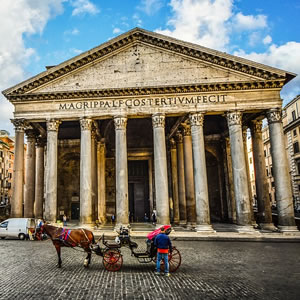
The Roman Pantheon is the most preserved and influential building of ancient Rome. It is a Roman temple dedicated to all the gods of pagan Rome. Asthe brick stamps on the side of the building reveal it was built and dedicated between A.D 118 and 125.
The emperor Hadrian (A.D 117-138) built the Pantheon to replace Augustus’ friend and Commander Marcus Agrippa’s Pantheon of 27 B.C. which burnt to the ground in 80 A.D.
When approaching the front of the Pantheon one can see the inscription above still reads in Latin the original dedication by Marcus Agrippa. The inscription reads:
'M. AGRIPPA.L.F.COSTERTIUM.FECIT”
“Marcus Agrippa son of Lucius, having been consul three times made it”.
Despite all the marvelous building projects that the emperor Hadrian produced during his reign, he never inscribed his name to any, but one, the temple of his father Trajan. That is why the Roman Pantheon bears the inscription of Marcus Agrippa, and not the emperor Hadrian.
The pediment,(the triangle section above the inscription) is blank today, but there would have been sculpture that acted out the battle of the Titans. Great bronze doors guard the entrance to the cella and would have been covered in gold, but it has long since disappeared.
Explore More
Polytheism Pagan Roman GODSearch Google Search Explore Topics
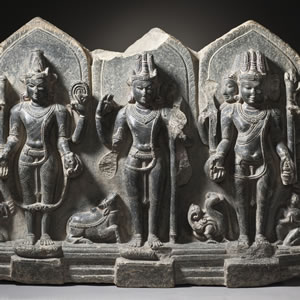 What is Polytheism?
Polytheism is the worship of or belief in multiple deities, usually as a pantheon of gods and goddesses. In most religions which accept polytheism, the different gods and goddesses are representations of forces of nature or ancestral principles, and can be viewed either as autonomous or as aspects or emanations of a creator deity or transcendental absolute principle (monistic theologies), which manifests immanently in nature (panentheistic and pantheistic theologies). Most of the polytheistic deities of ancient religions, with the notable exceptions of the Ancient Egyptian and Hindu deities, were conceived as having physical bodies. Polytheism is a type of theism. Within theism, it contrasts with monotheism, the belief in a singular God, in most cases transcendent. Important polytheistic religions practiced today include Chinese traditional religion, Hinduism, Japanese Shinto, and various neopagan faiths.
 What is Pagan?
Paganism is a term first used in the fourth century by early Christians. It was applied on populations of the Roman Empire who practiced polytheism, either because they were increasingly rural and provincial relative to the Christian population or because they were not milites Christi (soldiers of Christ). Alternate terms in Christian texts for the same group were hellene, gentile, and heathen. Pagan and paganism were pejorative terms for the same polytheistic group, implying its inferiority. Paganism has broadly connoted the "religion of the peasantry", and for much of its history was a derogatory term. Both during and after the Middle Ages, pagan was a pejorative term that was applied to any non-Abrahamic or unfamiliar religion, and the term presumed a belief in false god(s).
 What is Roman?
In historiography, ancient Rome is Roman civilization. From the founding of the city of Rome in the 8th century BC to the collapse of the Western Roman Empire in the 5th century AD, encompassing the Roman Kingdom, Roman Republic and Roman Empire until the fall of the western empire. The civilization began as an Italic settlement in the Italian peninsula, dating from the 8th century BC, that grew into the city of Rome and which subsequently gave its name to the empire over which it ruled and to the widespread civilisation the empire developed. The Roman empire expanded to become one of the largest empires in the ancient world, though still ruled from the city, with an estimated 50 to 90 million inhabitants (roughly 20% of the world's population) and covering 5.0 million square kilometres at its height in AD 117.
 Who is GOD?
In monotheism and henotheism, God is conceived as the Supreme Being and principal object of faith. The concept of God as described by theologians commonly includes the attributes of omniscience (infinite knowledge), omnipotence (unlimited power), omnipresence (present everywhere), omnibenevolence (perfect goodness), divine simplicity, and eternal and necessary existence. In theism, God is the creator and sustainer of the universe In deism, God is the creator, but not the sustainer, of the universe Monotheism is the belief in the existence of one God or in the oneness of God In pantheism, God is the universe itself In atheism, God is purported not to exist, while deemed unknown or unknowable within the context of agnosticism.