Live Screenshot
Source link:
https://www.theguardian.com/world/2019/jun/06/aung-san-suu-kyi-finds-common-ground-with-viktor-orban-over-islamPublished by: THE GUARDIAN on 6 Jun 2019
1144 views · Last view: 1 day ago
News Text (from THE GUARDIAN)
On a rare trip to Europe, Myanmar leader and Hungary PM discuss issue of ‘growing Muslim populations’ From her failure to speak out against ethnic cleansing to imprisoning journalists, the reputation of Aung San Suu Kyi in the west has taken a battering in recent months. But the leader of Myanmarhas found a new ally in far-right, staunchly anti-immigrant Hungarian prime minister Viktor Orbán.
In a rare trip to Europe, state counsellor Aung San Suu Kyi, the Nobel peace prize laureate who was once the figurehead of the fight for democracy in Myanmar, met Orbán in Budapest. There, the two leaders found common ground on the subject of immigration and Islam .
“The two leaders highlighted that one of the greatest challenges at present for both countries and their respective regions – south-east Asia and Europe – is migration,” read a statement released after their meeting.
“They noted that both regions have seen the emergence of the issue of co-existence with continuously growing Muslim populations.”
Once lauded as the great democratic hope for Myanmar, Aung San Suu Kyi, who was elected as civilian leader in 2015 after living under house arrest by the military for 15 years, has proved a marked disappointment to most western governments who were her champions.
Her failure to condemn the military’s violent crackdown on the Muslim Rohingya minority in 2017 – which saw thousands of Rohingya raped and killed in what the UN described as an exercise in ethnic cleansing – and her defence of the military’s brutal actions against Myanmar’s Muslims have proved particularly contentious.
Aung San Suu Kyi’s government has since repeatedly failed to offer assurances to the million Rohingya now living in refugee camps in Bangladesh, where they fled over the border for safety, that if they return their security and pathway to citizenship would be guaranteed.
Orban, meanwhile, has an equally bad track record. His government declared a “a crisis situation due to mass immigration” in 2015, stirring up fear in Hungary over an alleged threat of migrants. The Council of Europe’s commissioner for human rights released a recent report accusing Orbán’s government of using anti-migrant rhetoric that fuels “xenophobic attitudes, fear and hatred”.
Born in 1963 in Székesfehérvár in central Hungary, Viktor Orbán has been leader of the Fidesz national conservative party in two long stints since 1993. He has been Hungary’s prime minister between 1998 and 2002, and again since 2010. After two years of military service he studied law in Budapest, and then political science at Pembroke College, Oxford.
For nationalists across Europe, Orbán has become a hero, the embodiment of a nativist leader willing to eschew liberal political correctness and speak aggressively about the need to defend so-called Christian Europe. Steve Bannon has called him Trump before Trump, and Nigel Farage and Italy’s Matteo Salvini are admirers.
For many liberals, and increasingly for some of his supposed allies in the EPP, he signifies all that is rotten, corrupt and downright scary in contemporary politics on the continent.
“The age of liberal democracy is at an end,” Orbán told the Hungarian parliament shortly after Fidesz won a third successive electoral victory in 2018. “It is no longer able to protect people’s dignity, provide freedom, guarantee physical security or maintain Christian culture.”
His messaging, repeated in speeches and interviews ad nauseam, is that he is on a mission to protect Hungary and the rest of Europe from the evils of migration from the Middle East and Africa. He has frequently accused the Hungarian-born financier George Soros of a conspiracy to overrun Europe with Muslim migrants.
Orbán’s Fidesz party has a two-thirds majority in the Hungarian parliament, which gives him leeway to make sweeping constitutional changes, and he has spoken of a plan to reshape the country over the next decade. He has installed loyalists in previously independent institutions, put a vast media network under the control of cronies and brushed off protests from the disgruntled urban elites.
One thing Orbán’s admirers and detractors agree on is that he has become symbolic of something bigger than the fate of a smallish central European state with a population of fewer than 10 million. The man himself clearly relishes his increasingly large role in European political discourse.
Frustrated with Brussels and other European critics, Orbán has built alliances with neighbouring countries, notably throughout the V4, which comprises Hungary, Poland, the Czech Republic and Slovakia, all of whose leaders have at times expressed varying degrees of unhappiness with the EU, and whose unity in messaging is growing.
For Orbán, the idea that he is up against an exhausted, decaying vision of Europe is one that he has returned to again and again in his speeches. In October 2018, he implicitly compared today’s EU to the Nazis, Soviets and other imperial powers.
Shaun Walker in Budapest
Aung San Suu Kyi has increasingly spoken out against the imposition of western ideas and principles in Myanmar, a view which was reflected by Orbán in the statement released after their meeting, where he emphasised his rejection of the “export of democracy” from other western countries.
“Aung San Suu Kyi has fallen so astonishingly far from being the darling of the EU that she now counts a meeting with Orban, the pariah of Europe, as an important accomplishment,” said Phil Robertson, deputy Asia director of Human Rights Watch. “After shamefully helping the Myanmar military cover up their genocide against Rohingya Muslims, now she’s glad-handing and making friends with Europe’s most xenophobic, anti-democratic leader.”
Robertson added: “The message of this meeting to Brussels should be clear: Myanmar is not listening to your quiet diplomatic niceties.”
A spokesperson for the Myanmar government could not be reached for comment.
Aung San Suu Kyi’s trip to central Europe was with the aim to strengthen economic ties in the region. Prior to Hungary, she visted the Czech Republic where she met with Prime Minister Andrej Babiš.
Explore More
The Guardian IslamSearch Google Search Explore Topics
 Who are The Guardian?
The Guardian is a British daily newspaper. It was founded in 1821 as The Manchester Guardian, and changed its name in 1959. Along with its sister papers The Observer and The Guardian Weekly, The Guardian is part of the Guardian Media Group, owned by the Scott Trust. The trust was created in 1936 to "secure the financial and editorial independence of The Guardian in perpetuity and to safeguard the journalistic freedom and liberal values of The Guardian free from commercial or political interference".
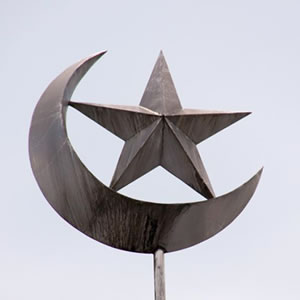 What is Islam?
One of the major religions of the world, Islam literally translates to "submission," as a follower of Islam (Muslims) devotes their life to that of their God. The religion began with the teachings of Muhammad in the 7th century. The theology of Islam is based on the Qur'an, which was given to Muhammad by God. Some of the major fundamental principles of Islam include the Five Pillars, which hope to unite all Muslims into a community. Two different factions of Muslims exist - the majority are known as Sunni, with a small percentage known as Shi'a - both predominantly reside throughout the Middle East. Muhammad died in 632 AD and the religion of Islam formally started after his death. The Quran was formally compiled and finalised in 650 AD, prior to which it was 'memorised' and written across many parchments.