Live Screenshot
Source link:
https://www.theguardian.com/commentisfree/2015/nov/09/many-non-religious-people-believe-in-godPublished by: THE GUARDIAN on 9 Nov 2015
1583 views · Last view: 1 day ago
News Text (from THE GUARDIAN)
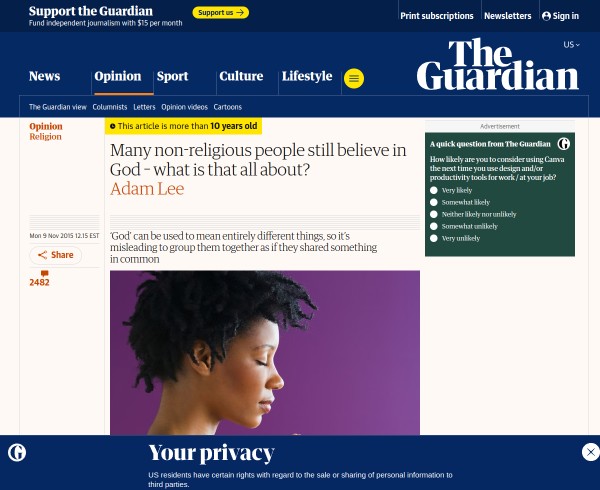
‘God’ can be used to mean entirely different things, so it’s misleading to group them together as if they shared something in common Americans are becoming less religious, but what are we to make of the fact that so many still believe in God? A recent Pew report found that the share of those whothink there is a divine power has declined only slightly, from 92% to 89%, since 2007. But we shouldn’t be viewing this as a counterweight to the rising tide of secular millennials. The bare percentage of people who profess belief in a god has never been a good way of defining religious commitment.
To make the flattening statement that 89% of Americans profess “belief in God” does a disservice to the country’s bewildering tangle of theological complexity. Some people believe in a personal, intervening god as defined by a religious creed. Others believe in a deist god, a cosmic watchmaker who wound up the universe and then stepped back. Still others think of God as an impersonal [...]
To view the original News article, click here
DISCLAIMER All news articles are shared for educational purposes only. The news content is hosted on the external news website. News articles titles are derived from the original news title, news content, dialogue, speech or general content theme. The news title may be edited and optimized for SEO, keyword density, information and internal website search purposes. You are advised to view the original news article for a better understanding. If you spot any mistakes, errors or omissions kindly contact us.
Search Results on 'Many non-religious people still believe in God? - Adam Lee - The Guardian'
SCROLL TO: TOPICS | 1 NEWS | 102 ARTICLES | 0 FAQ | 0 VIDEO | 10 LINKS | 0Topics include The Guardian (1)
Who are The Guardian? The Guardian is a British daily newspaper. It was founded in 1821 as The Manchester Guardian, and changed its name in 1959. Along with its sister papers The Observer and The Guardian Weekly, The Guardian is part of the Guardian Media Group, owned by the Scott Trust. The trust was created in 1936 to
"secure the financial and editorial independence of The Guardian in perpetuity and to safeguard the journalistic freedom and liberal values of The Guardian free from commercial or political interference". |
 Pretty Radical: Inside Poland's Far-Right -
  Battle For Mosul, Iraq -
  Coronavirus leads to violence against 'Tablighi Jamaat' Muslims in divided India -
  'Palestinian Lives Matter' to
  'God gave us Israel. All of Jerusalem is Jewish' |
  'Even Refugee Camps are not safe from Israeli soldiers' |
  'I gave you Life, you chose Death', Israeli settler claims |
  Extremist Israeli settlers make living in Gaza impossible |
  Israeli Settlers destroy what
  Lebanon pays 'a big price' for resisting Israel |