Live Screenshot
Source link:
https://www.theguardian.com/science/2018/feb/07/first-modern-britons-dark-black-skin-cheddar-man-dna-analysis-revealsPublished by: THE GUARDIAN on 7 Feb 2018
1506 views · Last view: 20 hrs ago
News Text (from THE GUARDIAN)
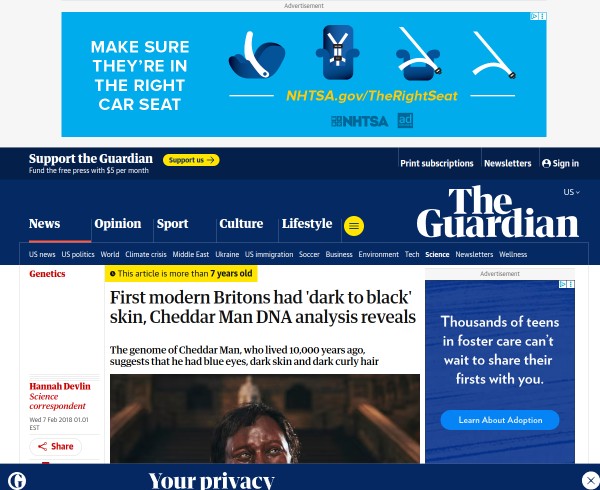
The genome of Cheddar Man, who lived 10,000 years ago, suggests that he had blue eyes, dark skin and dark curly hair The first modern Britons, who lived about 10,000 years ago, had “dark to black” skin, a groundbreaking DNA analysis of Britain’s oldest complete skeleton has revealed. The fossilknown as Cheddar Man, was unearthed more than a century ago in Gough’s Cave in Somerset. Intense speculation has built up around Cheddar Man’s origins and appearance because he lived shortly after the first settlers crossed from continental Europe to Britain at the end of the last ice age. People of white British ancestry alive today are descendants of this population.
It was initially assumed that Cheddar Man had pale skin and fair hair, but his DNA paints a different picture, strongly suggesting he had blue eyes, a very dark brown to black complexion and dark curly hair.
The discovery shows that the genes for lighter skin became widespread in European populations far later than [...]
To view the original News article, click here
DISCLAIMER All news articles are shared for educational purposes only. The news content is hosted on the external news website. News articles titles are derived from the original news title, news content, dialogue, speech or general content theme. The news title may be edited and optimized for SEO, keyword density, information and internal website search purposes. You are advised to view the original news article for a better understanding. If you spot any mistakes, errors or omissions kindly contact us.
Search Results on '10,000 year old Early Britons had 'dark to black' skin, Cheddar Man DNA reveals - The Guardian'
SCROLL TO: TOPICS | 1 NEWS | 102 ARTICLES | 0 FAQ | 0 VIDEO | 10 LINKS | 0Topics include The Guardian (1)
Who are The Guardian? The Guardian is a British daily newspaper. It was founded in 1821 as The Manchester Guardian, and changed its name in 1959. Along with its sister papers The Observer and The Guardian Weekly, The Guardian is part of the Guardian Media Group, owned by the Scott Trust. The trust was created in 1936 to
"secure the financial and editorial independence of The Guardian in perpetuity and to safeguard the journalistic freedom and liberal values of The Guardian free from commercial or political interference". |
 Pretty Radical: Inside Poland's Far-Right -
  Battle For Mosul, Iraq -
  Coronavirus leads to violence against 'Tablighi Jamaat' Muslims in divided India -
  'Palestinian Lives Matter' to
  'God gave us Israel. All of Jerusalem is Jewish' |
  'Even Refugee Camps are not safe from Israeli soldiers' |
  'I gave you Life, you chose Death', Israeli settler claims |
  Extremist Israeli settlers make living in Gaza impossible |
  Israeli Settlers destroy what
  Lebanon pays 'a big price' for resisting Israel |