Belief in Jesus' Crucifixion & Resurrection determine our Salvation, not the New Testament - Mohammed Hijab vs Builder Bob
6:34
1176 views
·
Last viewed: 1 day ago Uploaded:
24 Feb 2019 (7 years ago)
·
Shared: 26 Feb 2019
Video Description (from Youtube)
Bob the Builder tells Brother Muhammad Hijab that the New Testament is Not Needed for Salvation.
#ConsiderIslamDISCLAIMER
All videos are shared for educational and information purposes only. All videos are hosted and viewable on Youtube servers. Video titles are generated using the original video title; overall content theme including actual dialogue and speech (Transcript); and A.I-based recommendations with a focus on SEO, keyword density, and internal search functions. The video title does not represent the views held by the Youtube video uploader, or any individual, organisation or business.
A Speakers' Corner is an area where open-air public speaking, debate, and discussion are allowed. The original and most noted is in the north-east
corner of Hyde Park in London, England. Speakers here may talk on any subject, as long as the police consider their speeches lawful, although this right is not restricted to Speakers' Corner only. Contrary to popular belief, there is no immunity from the law, nor are any subjects proscribed, but in practice the police intervene only when they receive a complaint. Speakers' Corner is often held up to demonstrate freedom of speech, as anyone can turn up unannounced and talk on almost any subject, although always at the risk of being heckled by regulars.
The New Testament is the second part of the Christian biblical canon. The first part being the Old Testament, based on the Hebrew Bible. The New
Testament discusses the teachings and person of Jesus, as well as events in first-century Christianity. Christians regard both the Old and New Testaments together as sacred scripture. The New Testament (in whole or in part) has frequently accompanied the spread of Christianity around the world. It reflects and serves as a source for Christian theology and morality.
Resurrection is the concept of coming back to life after death. In a number of ancient religions, a dying-and-rising god is a deity which dies and
resurrects. The death and resurrection of Jesus, an example of resurrection, is the central focus of Christianity. As a religious concept, it is used in two distinct respects: a belief in the resurrection of individual souls that is current and ongoing (Christian idealism, realized eschatology), or else a belief in a singular resurrection of the dead at the end of the world. The resurrection of the dead is a standard eschatological belief in the Abrahamic religions.
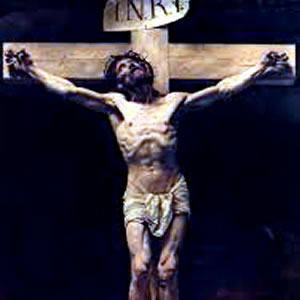
Crucifixion is a method of capital punishment in which the victim is tied or nailed to a large wooden beam. The victim is left to hang for several
days until eventual death from exhaustion and asphyxiation. The crucifixion of Jesus is a central narrative in Christianity, and the cross (sometimes depicting Jesus nailed onto it) is the main religious symbol for many Christian churches. The English term cross derives from the Latin word crux. The Latin term crux classically referred to a tree or any construction of wood used to hang criminals as a form of execution. The term later came to refer specifically to a cross.
Salvation is being saved or protected from harm or being saved or delivered from a dire situation. In religion, salvation is saving of the soul from
sin and its consequences. The academic study of salvation is called soteriology. In religion, salvation is the saving of the soul from sin and its consequences. It may also be called "deliverance" or "redemption" from sin and its effects. Historically, salvation is considered to be caused either by the grace of a deity (i.e. unmerited and unearned); by the independent choices of a free will and personal effort (i.e. earned and/or merited); or by some combination of the two.
In the Synoptic Gospels (such as Matthew 19:16-17, Mark 10:17-18, and Luke 18:18-19), when a rich young ruler explicitly asks Jesus what good deed he must do to inherit eternal life, Jesus directly answers: 'If you want to enter life, keep the commandments.' He then proceeds to list foundational moral laws from the Mosaic Torah, such as prohibitions against murder, adultery, and theft. Academic historians emphasize that this shows the historical Jesus operated firmly within a 1st-century Jewish framework, instructing his followers to achieve salvation by keeping the covenantal laws of God.
No. Jesus himself raised people after their death:
1. Jairus' daughter (Mark 5:35-43)
2. Son of a widow at Nain (Luke 11:11-17)
3. Lazarus, who was dead for four days (John 11-1-44)
4. Women received their dead by resurrection (Hebrews 11:35)
5. Elijah raised a widows son from death (I Kings 17:17-24)
Therefore, the resurrection itself would not make Jesus unique or divine even.
The earliest Jewish-Christians did not believe that the resurrection meant Jesus was God, but rather that he was a righteous man approved by God through miracles, wonders, and signs. Based on texts like Acts 2:22-24, they maintained the theological view that Jesus had been raised by God, not that he was the Creator himself.
The resurrection of Jesus is of crucial importance to Christian doctrine. The Christian religion was founded many years after the death of Jesus based on the beliefs in his resurrection. Put simply, if there was no resurrection story, their would be no Christianity.
The reported resurrection of Jesus serves as the absolute foundational cornerstone of orthodox Christian theology and identity. Historical scholars note that institutional Christianity was organized years after Jesus' death primarily upon the early community's collective belief that he had triumphed over death. Academic consensus agrees that without the preservation and widespread propagation of this resurrection narrative, Christianity as an independent world religion would not exist.
Yes, the New Testament canonical records openly document that even members of Jesus' inner circle of chosen followers struggled to accept his physical resurrection. In the Gospel of Matthew (Matthew 28:17), the text captures his final appearance on a mountain in Galilee, explicitly stating that when the disciples saw him, they worshipped him, 'but some doubted'. Modern historians view this candid admission as highly credible, showing that belief in the resurrection was complex even for early eyewitnesses.
The resurrection is the most controversial creed issue facing Christianity today. There are numerous explanations for the resurrection, all of which are contested. There is no concensus if Jesus' tomb was found empty or not; whether disciples saw anything or not; even if anything happened or not.
In his surviving epistles, the Apostle Paul demonstrates almost no interest in the day-to-day earthly life, chronological career, or specific moral parables of Jesus of Nazareth. Instead, his extensive theology is completely fixated on the cosmic, atoning meaning of the crucifixion and subsequent resurrection of the figure he addresses as 'the Lord'. Secular historians analyze this focus to illustrate how early Christian theology transformed from an inward-looking Jewish prophetic movement into a universal savior faith.
Following the crucifixion, leadership of the primary community of believers in Jerusalem fell to Jesus' biological brother, James the Just. Mainstream historical and biblical scholarship confirms that James directed the mother church as an observant Jew, maintaining that followers must continue upholding traditional Mosaic customs and temple practices.
There is no doubt the Jewish religious leaders of Israel were responsible for Jesus' death. The Romans carried out the actuall crucifixion under the authority of Pontius Pilate.
In Jerusalem, the disciple James, who acted as the primary leader of Jesus' immediate followers, strongly believed that their movement's future lay as a distinct religious group operating firmly within the confines of the traditional Judaism religion.
The King James Version (KJV) of the New Testament was completed in 1611 by 8 members of the Church of England.
There were (and still are) no original texts to translate. The oldest manuscripts we have were written down hundreds of years after the last Apostle died. There are over 8000 of these old manuscripts, with no two alike.
The King James translators chose to use none of the texts. Instead, they edited previous translations to create the New Testament their king and parliament would approve.
So today, 21st century Christians believe the 'Word of God' is a book edited in the 17th century from 16th century translations of 8000 contradictory copies of 4th century scrolls that claim to copies of lost letters written in the 1st century by unknown authors.
Textual critics note that the original autographs of the New Testament books no longer exist, leaving thousands of handwritten Greek manuscripts that contain thousands of minor variants, mostly consisting of spelling or word order differences. Despite these historical copy changes, scholars emphasize that modern textual reconstruction methods allow historians to confidently identify the original 1st-century text, ensuring no essential historical narrative or Christian doctrine is left in doubt.
It is of enormous importance in establishing the biblical text. There are three earliest manuscripts of the Bible New Testament:
1. Codex Alexandrinus is one of the earliest and most important manuscripts of the entire Bible in Greek
2. Codex Sinaiticus is one of the most important books in the world and is kept in the British Library. Handwritten well over 1600 years ago, the manuscript contains the Christian Bible in Greek, including the oldest complete copy of the New Testament.
The earliest New Testament manuscripts are in Koine Greek. But there are Aramaic phrases in the Gospels. Therefore, Scholars believe an Aramaic layer lies beneath the written Greek of the New Testament, one which may never have been written down.
If true, the Greek text is itself a translation, and English text would be a translation of a translation, which raises textual inerrancy and corruption issue.
Since every translation is a personal judgement of which word to best use, made at the translators discretion.
In Zechariah 12:10, They will look on me, the one they have pierced, and they will mourn for him as one mourns for an only child - Is this about Jesus' Crucifixion? - Tovia Singer