4:13
677 views
·
Last viewed: 2 days ago
Uploaded: 30 Aug 2019 (7 years ago) · Shared: 12 Sep 2019
Video Description (from Youtube)
Robert W. Sullivan IV delves into the astrological understandings of the Bible and other Myths. All of Robert's books are here at his websitehttps://robertwsullivaniv.com/buy-the-book/ SHOW LUTHERAND I SOME LOVE HERE!!https://www.patreon.com/user?u=13948035 (Dr. Luther G. Williams)
https://www.patreon.com/DerekLambert ( Derek Lambert)
Help financially Support MythVision@ our Paypal accounts. Much appreciated!
https://www.paypal.me/luthergwilliams (Dr. Luther G. Williams)
https://www.paypal.me/dereklambert7 . (Derek Lambert)
DISCLAIMER
All videos are shared for educational and information purposes only. All videos are hosted and viewable on Youtube servers. Video titles are generated using the original video title; overall content theme including actual dialogue and speech (Transcript); and A.I-based recommendations with a focus on SEO, keyword density, and internal search functions. The video title does not represent the views held by the Youtube video uploader, or any individual, organisation or business.
If you spot any mistake, omission or give feedback, kindly Contact Us with details
Overview & Key Concepts
Who is Robert Sullivan IV?
 Robert Sullivan IV is a philosopher, historian, antiquarian, jurist, mystic, lay theologian, radio-TV personality, writer and lawyer. He is the
best-selling author of the books "The Royal Arch of Enoch: The Impact of Masonic Ritual, Philosophy, and Symbolism" and "Cinema Symbolism: A Guide to Esoteric Imagery in Popular Movies".
What is Astrotheology?
 The term Astrotheology is used in the context of 18th century scholarship aiming at the discovery of the original religion, particularly primitive
monotheism. Unlike astrolatry, which usually implies polytheism, frowned upon as idolatrous by Christian authors since Eusebius, Astrotheology is any "religious system founded upon the observation of the heavens", and in particular, may be monotheistic.
<br><br>Astrolatry is the worship of stars and other heavenly bodies as deities, or the association of deities with heavenly bodies. The most common instances of this are Sun gods and Moon gods in polytheistic systems worldwide. Also notable is the association of the planets with deities in Babylonian, and hence in Greco-Roman religion, viz. Mercury, Venus, Mars, Jupiter and Saturn.
What is Pagan?
 Paganism is a term first used in the fourth century by early Christians. It was applied on populations of the Roman Empire who practiced polytheism
either because they were increasingly rural and provincial relative to the Christian population or because they were not milites Christi (soldiers of Christ). Alternate terms in Christian texts for the same group were hellene, gentile, and heathen. Pagan and paganism were pejorative terms for the same polytheistic group, implying its inferiority. Paganism has broadly connoted the "religion of the peasantry", and for much of its history was a derogatory term. Both during and after the Middle Ages, pagan was a pejorative term that was applied to any non-Abrahamic or unfamiliar religion, and the term presumed a belief in false god(s).
Where is Rome?
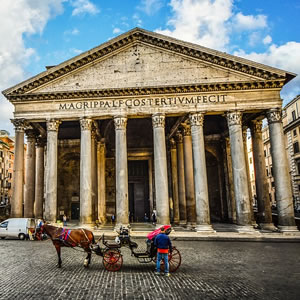 Rome is the capital city of Italy and a special comune (named Comune di Roma Capitale). Rome also serves as the capital of the Lazio region. With
2,872,800 residents in 1,285 km2 (496.1 sq mi), it is also the country's most populated comune. It is the fourth-most populous city in the European Union by population within city limits. It is the centre of the Metropolitan City of Rome, which has a population of 4.3 million residents. Rome is located in the central-western portion of the Italian Peninsula, within Lazio (Latium), along the shores of the Tiber. The Vatican City is an independent country inside the city boundaries of Rome, the only existing example of a country within a city: for this reason Rome has been often defined as capital of two states. Rome's history spans 28 centuries. While Roman mythology dates the founding of Rome at around 753 BC, the site has been inhabited for much longer, making it one of the oldest continuously occupied sites in Europe.
Frequently Asked Questions
1.How was Christianity made appealing to pagan idol worshippers?
2.How was 25th December celebrated by pagans?
3.How were the Triadic or 'Trinity-like' Pagan Gods presented?
4.Does the Christian Trinity come from pagan Triadic dieties?
5.Why are their so many similarities between Jesus Christ and all the pagan Gods?
6.When did Catholic Christianity become official religion of Rome?
7.What happened after Rome chose Christianity as the state religion?
8.What is the 'Lazarus Effect' or 'Lazarus Syndrome' in science?
Snippet Video
This is a Youtube Video Clip. To view full video click here.
This is a Youtube Video Clip. To view full video click here.
Videos on Astrotheology (6)
 4:40
4:40
694
1568328811
1787264728
What is Astrotheology, and its relation to Christianity? - Robert Sullivan IV
000280
1
4:13
677
1568332790
1787264722
Pagan Rome invented Jesus based on ancient Celestial and Astrotheology - Robert Sullivan IV
000253
2
2:03
779
1568332784
1787344668
Four Gospel Icons: Bull, Lion, Man & Eagle originate in the 'Solar Zodiac' Astrotheology: Taurus, Aquarius, Leo & Scorpio - Robert Sullivan IV
000123
3
 26:05
26:05
654
1663069605
1787073043
Astrotheology - Kabah aligns with Lunar Moon Cycles - Robert Sepehr
001565
4
 10:53
10:53
439
1755736274
1787163678
Astrotheology - The Sun's Energy produces Life on Earth. God's Sun Is Our Saviour | Two Old Dudes
000653
5
 13:06
13:06
121
1784246612
1787385826
12 Tribes of Israel are 12 Zodiac Signs | Robert Price on Astrotheology | MythVision
000786
6