550 views
·
Last viewed: 10 hrs ago
Uploaded: 19 Oct 2016 (10 years ago) · Shared: 28 Mar 2017
Duration: 1:18:14
Uploaded: 19 Oct 2016 (10 years ago) · Shared: 28 Mar 2017
Duration: 1:18:14
Youtube Description
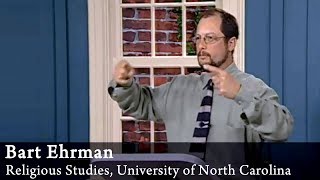
The Department of Near Eastern Studies presented a Mendenhall Symposium at the University of Michigan - Law, Society, and Religion on October 6, 2016at 7:00pm. Professor Bart Ehrman was the Keynote speaker, with the subject title: Jesus, the Law, and a 'New' Covenant. The symposium took place at the Rackham Auditorium in Ann Arbor, Michigan. The Mendenhall Symposium and Keynote Lecture are made possible by the George E. Mendenhall Fund.
Jesus of Nazareth was a Torah-observant Jewish teacher whose followers, after his death, came to adopt a variety of attitudes toward the Law of Moses. Some of them insisted on strict observance; others argued that only parts of the Law needed to be observed; and yet others claimed that Law had never been part of God’s plan. These early Christian groups did, however, agree on one point: Jesus’ own words were to form the basis for his followers’ ethical and communal lives. This lecture will examine how the Christian faith moved from embracing the “old” covenant focused on Torah to adopting a “new” covenant centered on the life, death, and teachings of Jesus.
Program discussed on Bart Ehrman's Foundation Blog: http://ehrmanblog.org/?p=11971
Bart D. Ehrman is the James A. Gray Distinguished Professor at the University of North Carolina at Chapel Hill. He came to UNC in 1988, after four years of teaching at Rutgers University. At UNC he has served as both the Director of Graduate Studies and the Chair of the Department of Religious Studies. A graduate of Wheaton College (Illinois), Professor Ehrman received both his Masters of Divinity and Ph.D. from Princeton Theological Seminary, where his 1985 doctoral dissertation was awarded magna cum laude.
Copyright © Bart D. Ehrman and University of Michigan. All Rights Reserved. Unauthorized use, re-posting and/or duplication of this media without express and written permission from Bart D. Ehrman and the University of Michigan is strictly prohibited.
Explore More
Bart Ehrman Covenant JESUS
Search Google Search Explore Topics
 Who is Bart Ehrman?
Bart Ehrman (born 1955) is an American New Testament scholar focusing on textual criticism of New Testament, historical Jesus, and development of early Christianity. Ehrman has written and edited 30 books, including three college textbooks. He has also authored six New York Times bestsellers. He is currently the James A. Gray Distinguished Professor of Religious Studies at the University of North Carolina at Chapel Hill.
 What is Covenant?
In religion, a covenant is a formal alliance or agreement made by God with a religious community or with humanity in general. It is central to the Abrahamic religions and derived from the biblical covenants, notably the Abrahamic covenant. The Mosaic covenant refers to a biblical covenant between God and the biblical Israelites. The establishment and stipulations of the Mosaic covenant are recorded in the first five books of the Hebrew Bible, which are traditionally attributed to Mosaic authorship and collectively called the Torah, and this covenant is sometimes also referred to as the Law of Moses or Mosaic Law or the 613 Mitzvot.