524 views
·
Last viewed: 18 hrs ago
Uploaded: 20 Jun 2018 (8 years ago) · Shared: 21 Jun 2018
Duration: 1:12
Uploaded: 20 Jun 2018 (8 years ago) · Shared: 21 Jun 2018
Duration: 1:12
Youtube Description
Link to the original video: https://www.youtube.com/watch?v=tr0D7W6zPSs DISCLAIMER We do NOT own the video materials and all credits belong to therespectful owners. In case of copyright issues, please contact us immediately for further credits or clip delete.
COPYRIGHT
Under Section 107 of the Copyright Act 1976, allowance is made for 'fair use' for purposes such as criticism, comment, news reporting, teaching, scholarship and research. Fair use is a use permitted by copyright statute that might otherwise be infringing. Non-profit, educational or personal use tips the balance in favour of fair use.
Explore More
Bart Ehrman Hebrew Israel GODSearch Google Search Explore Topics
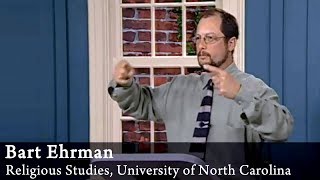
 Who is Bart Ehrman?
Bart Ehrman (born 1955) is an American New Testament scholar focusing on textual criticism of New Testament, historical Jesus, and development of early Christianity. Ehrman has written and edited 30 books, including three college textbooks. He has also authored six New York Times bestsellers. He is currently the James A. Gray Distinguished Professor of Religious Studies at the University of North Carolina at Chapel Hill.
 What is Hebrew?
Hebrew is a Northwest Semitic language within the Afroasiatic language family. A regional dialect of the Canaanite languages, it was natively spoken by the Israelites and remained in regular use as a first language until after 200 CE and as the liturgical language of Judaism (since the Second Temple period) and Samaritanism. The language was revived as a spoken language in the 19th century, and is the only successful large-scale example of linguistic revival. It is the only Canaanite language still spoken today. It is also one of the only two Northwest Semitic languages with contemporary speakers, the other being Aramaic. Nearly all of the Hebrew Bible is written in Biblical Hebrew, with much of its present form in the dialect that scholars believe flourished around the 6th century BCE, during the time of the Babylonian captivity.
 Where is Israel?
Israel, officially the State of Israel, is a country in the Middle East. Located on the southeastern shore of the Mediterranean Sea and the northern shore of the Red Sea. It has land borders with Lebanon to the north, Syria to the northeast, Jordan on the east, the Palestinian territories of the West Bank and Gaza Strip to the east and west, respectively, and Egypt to the southwest.
Who is GOD?In monotheism and henotheism, God is conceived as the Supreme Being and principal object of faith. The concept of God as described by theologians commonly includes the attributes of omniscience (infinite knowledge), omnipotence (unlimited power), omnipresence (present everywhere), omnibenevolence (perfect goodness), divine simplicity, and eternal and necessary existence. In theism, God is the creator and sustainer of the universe In deism, God is the creator, but not the sustainer, of the universe Monotheism is the belief in the existence of one God or in the oneness of God In pantheism, God is the universe itself In atheism, God is purported not to exist, while deemed unknown or unknowable within the context of agnosticism.