30:00
775 views
·
Last viewed: 1 hr ago
Uploaded: 28 Apr 2018 (8 years ago) · Shared: 30 Apr 2018
Video Description (from Youtube)
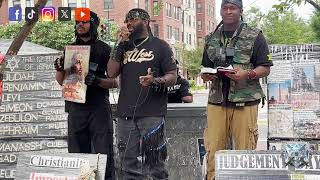
Part two Brother Hashim speaks to christian on the topic of Christianity's core beliefs.DISCLAIMER
All videos are shared for educational and information purposes only. All videos are hosted and viewable on Youtube servers. Video titles are generated using the original video title; overall content theme including actual dialogue and speech (Transcript); and A.I-based recommendations with a focus on SEO, keyword density, and internal search functions. The video title does not represent the views held by the Youtube video uploader, or any individual, organisation or business.
If you spot any mistake, omission or give feedback, kindly Contact Us with details
Overview & Key Concepts
What is Salvation?
 Salvation is being saved or protected from harm or being saved or delivered from a dire situation. In religion, salvation is saving of the soul from
sin and its consequences. The academic study of salvation is called soteriology. In religion, salvation is the saving of the soul from sin and its consequences. It may also be called "deliverance" or "redemption" from sin and its effects. Historically, salvation is considered to be caused either by the grace of a deity (i.e. unmerited and unearned); by the independent choices of a free will and personal effort (i.e. earned and/or merited); or by some combination of the two.
What is Trinity?
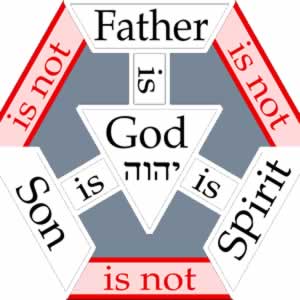 The Christian doctrine of the Trinity (Latin: trinus "threefold") holds that God is one God, but three coeternal consubstantial persons or
hypostases. These being the Father, the Son (Jesus Christ), and the Holy Spirit - as "one God in three Divine Persons". The three Persons are distinct, yet are one "substance, essence or nature" (homoousios).
Who is Jehovah?
 Jehovah is the proper name of the God of Israel in the Hebrew Bible and one of the seven names of God in Judaism. "Jehovah" was popularized in the
English-speaking world by William Tyndale and other pioneer English Protestant translations such as the Geneva Bible and the King James Version. It is still used in some translations, such as the New World Translation, the American Standard Version, and Young's Literal Translation, but it does not appear in most mainstream English translations, as the terms "Lord" or "LORD" are used instead, generally indicating that the corresponding Hebrew is Yahweh or YHWH.
Who is Hashim?
 A Speakers' Corner is an area where open-air public speaking, debate, and discussion are allowed. The original and most noted is in the north-east
corner of Hyde Park in London, England. Speakers here may talk on any subject, as long as the police consider their speeches lawful, although this right is not restricted to Speakers' Corner only. Contrary to popular belief, there is no immunity from the law, nor are any subjects proscribed, but in practice the police intervene only when they receive a complaint. Speakers' Corner is often held up to demonstrate freedom of speech, as anyone can turn up unannounced and talk on almost any subject, although always at the risk of being heckled by regulars.
Frequently Asked Questions
1.What did Jesus tell the person who asked for eternal salvation?
Jesus is telling this person what he needs to do to gain eternal life. He simply needs to keep commandments i.e. observe the Old Testament Law
2.How did Jesus preach salvation and eternal life?
To attain salvation, Jesus insisted on his followers keeping the commandments, by obeying the Old Testament Law.
3.How were the Triadic or 'Trinity-like' Pagan Gods presented?
The pagan Triadic dieties were shown as a single-head with 3 faces, 3 mouths but only 4 mouths. Such images were preserved across the Roman Empire.
4.Does the Christian Trinity come from pagan Triadic dieties?
Does the Christian Trinity come from pagan Triadic dieties?
Yes. The core teachings of the Trinitarian Christian churches
today do not come from Jesus.
The three-in-one Gods are pagan concepts that existed long before
Jesus arrived. Later on, Christians adopted this concept and
instantly made Christian doctrine an appealing alternative to the
pagan God worshipping masses.
5.Why is the Trinity so difficult to understand?
"It is not a biblical doctrine in the sense that any formulation of it can be found in the Bible."
(Illustrated Bible Dictionary)
Trinitarians have been looking for Bible texts and even twisting verses to find support for the Trinity teaching.
6.How did the Christian Trinity come about?
The concept of a dual human and divine nature in the person of Jesus is known as the Hypostatic Union, an essential component of modern Trinitarianism.
Yet it wasn’t until the Council of Chalcedon that we see the emergence of an official doctrine of the Trinity in a form that is recognisable with what Christian Trinitarians believe in today. This took place in the fifth century, over 400 years after Jesus!
The evangelical theologian and Professor Wayne A. Grudem sums this up as follows:
"A precise understanding of how full deity and full humanity" argues Grudem, "could be combined together in one person was formulated only gradually in the church and did not reach the final form until the Chalcedonian Definition in 451 AD
Source: [Grudem, Systematic Theology: Chapter 26 – The Person of Christ, 1994, p. 554.]
7.Does the Bible support the Trinity (3-in-1) God concept?
This verse mentions the Trinity (Father, Son, Holy Ghost) in the King James Version Bible (KJV). Bible critics agree the KJV verse is a forgery that was added into the Bible. More modern, accurate Bibles give different text:
And the Spirit is the witness, because the Spirit is the truth - (RSV Bible)
And it is the Spirit that beareth witness, because the Spirit is the truth - (ASV Bible)
For there are three that testify: the Spirit, the water and the blood; and the three are in agreement. (NIV Bible)
8.Does the Old Testament teach the Christian Trinity?
The Old Testament does not teach the Trinity, or even set forth the Messiah would be God. There is no evidence of anyone knowing about, or believing in, the Trinity in all the Jewish literature before Christ, including the Old Testament, the Jewish targums and commentaries, the Apocrypha or other apocryphal literature, or the Dead Sea Scrolls.
9.What is the Christian Trinity?
Orthodox Christian theologians define the doctrine of the Trinity is that the Father is God, the Son is God, the Holy Spirit is God, and together these 'three Persons' make one God; and these three are co-equal and co-eternal, the Son having been 'eternally begotten' of the Father, and Jesus being simultaneously 100% God and 100% man.
Today, many Christians think they are Trinitarians simply because they believe in the Father, Son, and the Holy Spirit - but that is not the Trinity!
10.What do Christian 'Trinity' scholars say about the Old Testament?
The distinguished Trinitarian scholar Bertrand de Margerie in his book The Christian Trinity in History (p.3) writes:
"…contemporary exegetes [Bible teachers] affirm unanimously that the Old Testament did not bring to the Jewish people a clear and distinct Revelation of the existence of a plurality of persons in God. In this they agree with the clear and frequent affirmation of Fathers such as Irenaeus, Hilary, and Gregory of Nazianzus: that the doctrine of the Trinity is revealed only in the New Testament."
So any person who lived before Jesus' ministry did not have to believe in the Trinity to be saved because the Trinity is not mentioned in the Old Testament.
11.What do Christian scholars say about the Trinity?
Scholars freely admit that the Trinity is never presented as a complete doctrine in the New Testament, but rather is built from scattered Bible verses.
In the NT there is no explicit statement of the doctrine….
Evangelical Dictionary of Theology (p. 1112)
…it is not a Biblical doctrine in the sense that any formulation of it can be found in the Bible….
New Bible Dictionary (p.1221)
The New Testament does not present a systematic presentation of the Trinity. The scattered segments from various writers that appear throughout the New Testament reflect a seemingly accepted understanding that exists without a full-length discussion.
Holman Bible Dictionary (p.1372)
Theologians admit the New Testament does not define the Trinity. Furthermore, there is no clear teaching that salvation depends on the belief in the Trinity.
12.Do Arians and Jehovah Witnesses share the same beliefs?
Jehovah Witnesses (JW) are often referred to as 'modern-day Arians'. While there are similarities in theology and doctrine, the JW differ from Arians in the following ways: