22:01
849 views
·
Last viewed: 2 hrs ago
Uploaded: 06 Jun 2019 (7 years ago) · Shared: 08 Jun 2019
Video Description (from Youtube)
Christian Missionaries would have Jews believe that Christianity the fulfillment of Judaism. Is that true? IS CHRISTIANITY THE FULFILLMENT OF JUDAISM? – narrated by Counter-Missionary and former Jewfor Jesus Julius Ciss, Excecutive Director of Jews for Judaism (Canada) is Part 7 of 9 of CHOOSE LIFE – A COUNTER-MISSIONARY STUDY GUIDE written by Rick Halpern and edited by Rabbi Michael Skobac.
Click here for the complete transcript of the CHOOSE LIFE book https://jewsforjudaism.ca/choose-life-pdf
Today, over 1,000 different Christian missionary organizations specifically target Jews worldwide for conversion. This threat is intensified by the reality that Christianity is the dominant religion throughout North America. Most Jews have had some contact with a fervently Christian friend, neighbour or business associate that is determined to share his or her faith with them.
Unfortunately, most Jewish people are unaware of the nature of these serious challenges and the ways to respond. “Choose Life: A Counter-Missionary Study Guide” is an excellent educational resource because it alerts us to the spiritual threat Christianity poses to our community and provides a critical foundation of essential knowledge to keep our families securely Jewish.
More than just another “Know-How-to-Respond” manual, Choose Life sounds a passionate call to all Jewish people to truly appreciate and embrace our 3,300 year-old spiritual treasure – our “Tree of Life.”
Choose Life is published by JEWS FOR JUDAISM, the world’s leading counter-missionary organization. If you would like to get additional information, receive assistance for you or someone you know, or arrange a speaking engagement, please contact us.
JEWS FOR JUDAISM is an outreach organization whose primary goal is to win back to Judaism those Jews who have been influenced by the following six threats to Jewish survival that are devastating the global Jewish community.
1. Hebrew-Christian missionaries convert thousands of Jews worldwide every year
2. Destructive cults cause many Jews to abandon family, friends and careers
3. Eastern religions, Buddhism and Hinduism are spiritual choices for many Jews
4. Apathy and ignorance leave many Jews unaware, unaffiliated and assimilated
5. Intermarriage is exploding with a 75% rate in some North American cities
6. Anti-Israel BDS on campus inhibits Jewish students from standing up for Israel and Judaism
To assist non-Jews who have left other religions, JEWS FOR JUDAISM also provides educational programs to help them embrace the Torah’s Seven Noachide Laws for Gentiles.
We achieve our goals through our worldwide Internet outreach, Social Media, free educational programs, educational literature and counseling services that connect Jewish people to the spiritual depth, beauty and wisdom of Judaism.
“I am so grateful to have discovered the wonderful Jews for Judaism YouTube lectures by Rabbi Skobac. I am a Jew who converted to Christianity in college, but now, thanks to your online outreach, I have returned to Judaism. Thank you.” – Rebecca G.
In a nutshell, Jews for Judaism saves Jewish lives and keeps Jews Jewish.
PLEASE SUPPORT JEWS FOR JUDAISM’S LIFE-SAVING WORK!
Your help is very much needed and greatly appreciated.
Jews for Judaism never charges for its programs, books and counseling services… ever.
We rely solely on donations from people like you.
To donate click here: https://www.canadahelps.org/dn/24741
Thank you very much.
JEWS FOR JUDAISM
3110 Bathurst St, PO Box 54042,
Toronto, ON, CANADA M6A 3B7
T: 416-789-0020 • F: 416-789-0030
EMAIL: info@jewsforjudaism.ca
VISIT: https://www.jewsforjudaism.ca
FACEBOOK: https://www.facebook.com/jewsforjudaismcanada
YOUTUBE: https://www.youtube.com/user/JewsforJudaismCanada
TWITTER: https://twitter.com/JewsforJudaism1
DONATE: https://www.canadahelps.org/dn/24741
DISCLAIMER
All videos are shared for educational and information purposes only. All videos are hosted and viewable on Youtube servers. Video titles are generated using the original video title; overall content theme including actual dialogue and speech (Transcript); and A.I-based recommendations with a focus on SEO, keyword density, and internal search functions. The video title does not represent the views held by the Youtube video uploader, or any individual, organisation or business.
If you spot any mistake, omission or give feedback, kindly Contact Us with details
EXPLORE TOPICS :
UNITARIAN |
32
UNITERIANISM |
0
TRINITY |
154
TRINITARIAN |
18
JEWS FOR JUDAISM |
2
JEWISH |
224
JEWS |
140
JUDAISM |
74
GOD |
0
JUDAISM |
0
Overview & Key Concepts
Who are Jews For Judaism?
 Jews For Judaism connect Jews to the spiritual depth, wisdom, beauty and truth of Judaism. With educational programs, materials and counseling that
keep Jews Jewish.
What is Trinitarian?
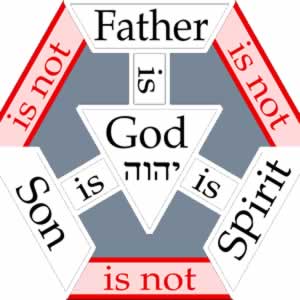 The Christian doctrine of the Trinity (Latin: trinus "threefold") holds that God is one God, but three coeternal consubstantial persons or
hypostases. These being the Father, the Son (Jesus Christ), and the Holy Spirit - as "one God in three Divine Persons". The three Persons are distinct, yet are one "substance, essence or nature" (homoousios).
What is Unitarian?
 Unitarianism can be viewed as a form of Nontrinitarianism which is a form of Christianity that rejects the mainstream Christian doctrine of the
Trinity. The teaching that God is three distinct hypostases or persons who are coeternal, coequal, and indivisibly united in one being, or essence (from the Greek ousia). Certain religious groups that emerged during the Protestant Reformation have historically been known as antitrinitarian, but are not considered Protestant in popular discourse due to their nontrinitarian nature. According to churches that consider the decisions of ecumenical councils final, Trinitarianism was definitively declared to be Christian doctrine at the 4th-century ecumenical councils, that of the First Council of Nicaea (325 AD), which declared the full divinity of the Son, and the First Council of Constantinople (381 AD), which declared the divinity of the Holy Spirit. In terms of number of adherents, nontrinitarian denominations comprise a minority of modern Christianity. The largest nontrinitarian Christian denominations are The Church of Jesus Christ of Latter-day Saints ("Mormons") and Jehovah's Witnesses.
What is Jewish?
 Judaism is an Abrahamic, monotheistic, ethnic religion that comprises the collective spiritual, cultural, and legal traditions of the Jewish people
Religious Jews regard Judaism as their means of observing the Mosaic covenant, which they believe was established between God and the Jewish people. The religion is considered one of the earliest monotheistic religions. Jewish religious doctrine encompasses a wide body of texts, practices, theological positions, and forms of organization. Among Judaism's core texts is the Torah - the first five books of the Hebrew Bible - and a collection of ancient Hebrew scriptures. The Tanakh, known in English as the Hebrew Bible, has the same books as Protestant Christianity's Old Testament, with some differences in order and content.
Who is GOD?
 In monotheism and henotheism, God is conceived as the Supreme Being and principal object of faith. The concept of God as described by theologians
commonly includes the attributes of omniscience (infinite knowledge), omnipotence (unlimited power), omnipresence (present everywhere), omnibenevolence (perfect goodness), divine simplicity, and eternal and necessary existence.
<ul>
<li>In theism, God is the creator and sustainer of the universe</li>
<li>In deism, God is the creator, but not the sustainer, of the universe</li>
<li>Monotheism is the belief in the existence of one God or in the oneness of God</li>
<li>In pantheism, God is the universe itself</li>
<li>In atheism, God is purported not to exist, while deemed unknown or unknowable within the context of agnosticism. </li>
</ul>
Frequently Asked Questions
1.How were the Triadic or 'Trinity-like' Pagan Gods presented?
Ancient triadic deities in the Roman Empire were depicted in art and monuments as a single, unified figure featuring three distinct faces or heads to illustrate their triune nature.
2.Does the Christian Trinity come from pagan Triadic dieties?
The core teachings of modern Trinitarian Christian churches do not come from Jesus, but were pagan three-in-one concepts that existed long before his arrival and were later adopted by Christians to make their doctrine highly appealing to idol-worshipping masses.
3.Why is the Trinity so difficult to understand?
The Trinity is a complex theological doctrine because it describes God as existing as three distinct Persons: Father, Son, and Holy Spirit who are co-equal and co-eternal, yet remain one single, unified divine Being. It requires balancing the concepts of strict monotheism with the distinct actions and relationships of the three divine Persons as revealed across the New Testament text.
4.How did the Christian Trinity come about?
The New Testament gospels show Jesus selecting twelve apostles to lead his immediate followers, but he did not lay down a detailed blueprint for a complex institutional priesthood or administrative hierarchy. The elaborate structures, clerical offices, and distinct liturgical traditions seen in modern churches developed gradually over centuries as the movement adapted to Roman institutional frameworks.
5.Does the Bible support the Trinity (3-in-1) God concept?
Mainstream biblical scholars and historians state that the doctrine of the Trinity is never explicitly laid out as a formal dogma anywhere in the text of the Old or New Testaments. While the New Testament contains early triadic formulas (such as the baptismal command in Matthew 28:19 and apostolic blessings in 2 Corinthians 13:14), the actual systemic theology of a three-in-one God was developed later by early church fathers over centuries. Christian theologians argue that the doctrine is implicitly woven throughout the scriptures, while critics and Islamic scholars point to the lack of clear, direct scriptural definitions to argue it was a later modification of strict biblical monotheism.
6.Does the Old Testament teach the Christian Trinity?
Mainstream biblical scholars and historians agree that the Old Testament does not explicitly teach the doctrine of the Trinity, nor did ancient Jewish communities possess a concept of a triune Godhead. There is no historical evidence in pre-Christian Jewish literature including the Hebrew text, the Dead Sea Scrolls, or ancient commentaries of a belief in a plurality of divine Persons. While Christian theologians retrospectively interpret certain plural expressions (such as "Let us make man" in Genesis 1:26) as hints of the Trinity, ancient Judaism strictly maintained a unitarian monotheistic understanding of God.
7.What is the Christian Trinity?
Orthodox Christian theologians define the doctrine of the Trinity as the belief that the Father is God, the Son is God, and the Holy Spirit is God, existing eternally as three distinct Persons within one single, undivided divine Being. These three Persons are considered entirely co-equal in power and co-eternal in time, with the Son being understood as "eternally begotten" of the Father and existing simultaneously as 100% God and 100% man. The platform notes that many modern Christians mistakenly believe they are practicing Trinitarianism simply by acknowledging the Father, Son, and Holy Spirit, without understanding the complex historical and philosophical mechanics required by the formal church dogma.
8.What do Christian 'Trinity' scholars say about the Old Testament?
Many theologians, including this analysis of Trinity dogma, note that the Old Testament does not explicitly contain the Trinity, which they believe was only fully revealed later.
9.What do Christian scholars say about the Trinity?
Mainstream scholars acknowledge that the Trinity is not explicitly defined in the New Testament but was formulated later by combining various verses and theological concepts.
10.How did the Early Jewish-Christians practise their religion?
The earliest Jewish-Christians strictly followed traditional Hebrew practices, including daily prayers, circumcision, rituals for purity, fasting, dietary laws, and temple, according to the source material.
11.Did Jesus claim to be 'King of the Jews'?
A political placard accusing Jesus of making this claim was nailed to his cross, and this historical artifact can be found today at the Church of Santa Croce in Rome.
12.How was Jesus Jewish?
Jesus fully observed the laws of the Torah, maintained kosher dietary regulations, and never asked his followers to abandon Judaism, as they continued to meet at the Temple and practice circumcision rather than establishing a separate religion or attending a church.
13.What did early Jewish-Christians think of Apostle Paul?
Between 55 and 66 CE, early Jewish-Christian leaders in Jerusalem rejected Paul's teachings and challenged his authority, leading to a significant decline in his popularity.
14.Were the early Christians Jews?
Yes, Jesus and early followers were entirely Jewish, strictly observing traditional laws and customs.
15.Did Saul kill the early Jewish-Christians?
Before his conversion, Saul actively sought to imprison and execute early Jewish-Christians. Saul believed that he was serving God by finding Christians, throwing them into prison, and even executing them.
1 And Saul was consenting unto his death. And at that time there was a great persecution against the church which was at Jerusalem; and they were all scattered abroad throughout the regions of Judaea and Samaria, except the apostles.
2 And devout men carried Stephen to his burial, and made great lamentation over him.
3 As for Saul, he made havock of the church, entering into every house, and haling men and women committed them to prison.
[Acts 8:1-3]
2 And devout men carried Stephen to his burial, and made great lamentation over him.
3 As for Saul, he made havock of the church, entering into every house, and haling men and women committed them to prison.
[Acts 8:1-3]
16.How did the Jews view Apostle Paul?
Faithful Jews viewed Paul's salvation theory as blatant blasphemy because his theological teachings explicitly ridiculed all previous revelations from God, including the sacred Torah, while teaching a doctrine that went against the absolute oneness of God.
17.According to Apostle Paul, why did God give Jews the Torah?
Paul viewed the Torah as a temporary guide, claiming it was given to the Jews until they could be saved through faith in Jesus Christ.
18.How did Apostle Paul differ with the Jewish Rabbis?
The Jewish Rabbis preached a person was saved so long as their intention was to remain within the covenant, and one truly repented and seek forgiveness for their sins.
Paul preached that every person was 'damned' until they was offered salvation. Mans problem was that he was 'in the flesh' in bondage to the Law, sold under Sin, enslaved by the fundamental spirits of the universe (ie. dead).
Paul preached the only cure was liberation from slavery and death by union with Christ, who had conquered death and sin.
19.How did the early Jewish-Christians view Jesus' resurrection?
The earliest Jewish-Christians did not believe that the resurrection meant Jesus was God, but rather that he was a righteous man approved by God through miracles, wonders, and signs. Based on texts like Acts 2:22-24, they maintained the theological view that Jesus had been raised by God, not that he was the Creator himself.
20.Who seperated Christianity from Judaism?
It was Apostle Paul's dramatic conversion and subsequent teachings that directly resulted in the permanent theological separation of Christianity from Judaism. Within mere months of Jesus' departure, the original human-centric and law-abiding message was fundamentally altered into an independent religious system.
21.Why Jews do not accept Jesus as the Messiah?
Mainstream Judaism rejects Jesus's messianic claims because he did not fulfill literal Old Testament prophecies. These expectations include rebuilding the Temple, gathering all exiled Jews back to Israel, and ushering in an era of universal world peace.
22.What does the Quran say about Jews and Christians?
The Quran recognizes Jews and Christians as "People of the Book" (Ahl al-Kitab), acknowledging that they were given previous divine revelations through prophets like Moses and Jesus. While it praises the righteous among them, it also critiques their theological developments, specifically rejecting the Christian doctrine of the Trinity and the divine sonship of Jesus.
23.How was Apostle Paul viewed by the Jews?
Paul was widely viewed by mainstream Jewish communities as a radical apostate and religious heretic because he preached that observance of the Mosaic Torah was no longer required for salvation. This fierce theological conflict frequently resulted in severe public opposition, legal charges before Roman authorities, and physical riots during his travel throughout ancient Mediterranean cities.
24.Does the Quran tell Jews and Christians to refer to their Scriptures (Torah and Bible)?
Yes, the Quran references previous scriptures in passages like Surah Al-Ma'idah (5:47), which tells the followers of the Gospel to judge by what God has revealed in it. From an academic perspective, this reflects the historical context of 7th-century Medina, where Jews and Christians were recognized as "People of the Book" who possessed divine laws. While Islamic theology holds that modern biblical texts have suffered from textual corruption (tahrif), the Quran historically appeals to the core monotheistic truths remaining in those scriptures to validate Muhammad's message.
25.In the time of Jesus, what qualities would identify the Messiah, to the Jews?
First-century Jewish expectations, as discussed in this analysis of Trinity dogma, centered on a human leader, such as a prophet or king from David's line, rather than a divine figure.
26.How did the 1st century Jews view the Holy Spirit?
As explained in this analysis of Trinity dogma, the Holy Spirit was understood as God's active, divine power, rather than a distinct, third person of a Trinity.
27.Jesus claimed to be God. The Jews must have understood this, as they accused him of blasphemy and were ready to stone him?
The platform asserts that Jesus did not claim divinity in this instance, and that his mention of Psalm 82:6 in John 10:34 was a defense noting that human judges are called "gods" in scripture, thus challenging the accusation of blasphemy.
28.Why do Jews let the hair grow on the sides of there head?
In the text of the Torah (Leviticus 19:27), God explicitly forbids cutting or rounding off the corners of the hair on the sides of the head and marring the edges of the beard.
29.How did Jews view the Greek Bible (Septuagint)?
The Jewish community regarded the Septuagint only as a translation of the original Hebrew, never as an independent or authoritative scripture.
30.In the time of Jesus, how were the Jews viewed by the Greeks?
The text suggests that the Greeks perceived Judaism as an insular tradition, weakened by long-term Roman occupation, economic decline, and emigration.
31.Who seperated Christianity from Judaism?
It was Apostle Paul's dramatic conversion and subsequent teachings that directly resulted in the permanent theological separation of Christianity from Judaism. Within mere months of Jesus' departure, the original human-centric and law-abiding message was fundamentally altered into an independent religious system.
Videos on Jews For Judaism (2)
 22:01
22:01
849
1559952657
1787084327
The Jewish God is Unitarian, not Trinitarian - Jews For Judaism
001321
1
 4:24
4:24
941
1609590967
1787031927
Is Christianity against Old Testament teachings? - Jews For Judaism
000264
2
EXPLORE TOPICS :
UNITARIAN |
32
UNITERIANISM |
0
TRINITY |
154
TRINITARIAN |
18
JEWS FOR JUDAISM |
2
JEWISH |
224
JEWS |
140
JUDAISM |
74
GOD |
0
JUDAISM |
0