Hajj & Umrah - Transformation Before and After Islam
Hajj is the annual Islamic pilgrimage to the holy city of Mecca in Saudi Arabia, which serves as the fifth and final pillar of Islam. It is a mandatory religious duty that every adult Muslim must perform at least once in their lifetime, provided they are physically, mentally, and financially capable of undertaking the journey.How does the Hajj today differ from the Pre-Islam Pagan Ritual? What did Muhammad do exactly to make people accept a pre-existing practise?
Beyond the structural overhauls of the Farewell Pilgrimage, Prophet Muhammad enacted several social, legal, legal-commercial, and behavioral changes to Hajj and Umrah. These updates permanently shifted the pilgrimage from a chaotic tribal festival into a highly regulated act of worship.
The exact modifications made to the pilgrimage rituals include:
1. Theological & Spiritual Domain
| Pre-Islamic Pagan Practice (Before Islam) | Post-Conquest Islamic Practice (After Islam) | ||
|---|---|---|---|
1. Purification of the Kaaba, Purging of Idols and Polytheistic Chants |
The Kaaba was surrounded by 360 idols representing different deities. Pilgrims invoked these idols during the Talbiyah (the pilgrimage chant), dedicating their worship to multiple gods. | Having physically destroyed the idols upon his conquest of Mecca, he permanently altered the Talbiyah text to focus solely on uncompromising monotheism (Tawheed) to One God (Allah).
Truth has come, and falsehood has departed |
|
2. The Sacred Chant (Talbiyah) |
Included verses explicitly praising multiple pagan sub-deities. | Modified strictly to declare uncompromising monotheism (Tawheed). Established via Prophetic Sunnah (Hadith) |
|
3. The Hills of Safa & Marwa (Sa'ee) |
Two prominent pagan idols—Isaf on Mount Safa and Na'ila on Mount Marwa—dominated the landscape. Pagans ran between these hills to venerate those specific idols. Early Muslims were initially deeply uncomfortable performing this run, fearing it was an inherently pagan act. | Stripped of idols; he stripped the ritual of its idol associations and reframed the Sa'ee (walking between the hills) exclusively to honor the historical plight and faith of Hagar, Abraham's wife, searching for water.
There is no blame upon him for walking between them |
|
4. Arafat/Muzdalifah Timing |
Rushed from plains at specific times to venerate the sun god. | Inverted the timing to deliberately break solar worship cycles. Established via Prophetic Sunnah (Hadith) |
|
5. Animal Sacrifice (Hady) |
Pagans routinely sacrificed animals on altars directly inside the Kaaba and smeared the blood on the walls of the temple to appease their idols. | He shifted the animal sacrifice (Hady) to the valley of Mina, declaring that it was purely a symbolic commemoration of Abraham's obedience to God. He also formalised the stoning of the pillars (Jamarat) in Mina as a direct rejection of Satan, rather than a pagan pacification ritual.
Their meat will not reach Allah, nor will their blood |
|
6. The Stoning Ritual (Jamarat) |
Performed as a folklore-driven pagan pacification rite. | Formalised as a symbolic rejection and stoning of Satan. Established via Prophetic Sunnah (Hadith) |
|
7. Station of Abraham (Maqam) |
Treated as an independent good-luck idol to physically rub. | Restored as a mandatory location for monotheistic prayer. "And take... the standing place of Abraham a place of prayer |
|
8. Accessing Homes from the Back |
Pagan pilgrims had a bizarre, superstitious tradition: once they put on their pilgrimage clothes (Ihram), they believed it was bad luck or sinful to enter their homes through the front door. If they had to return home for provisions, they would climb over the back walls or cut a hole in the back of their tents. | Superstition banned; commanded to use standard front doors. It is not piety that you enter houses from the back, but piety is to fear God. Enter houses through their proper doors. |
|
2. Social & Egalitarian Domain
| Pre-Islamic Pagan Practice (Before Islam) | Post-Conquest Islamic Practice (After Islam) | ||
|---|---|---|---|
9. Pilgrimage Dress (Ihram) |
Pagan pilgrims dressed according to their tribal status. The elite Quraysh tribe claimed exclusive rights to "sacred" clothing. Pilgrims from outside tribes who could not afford or acquire these clothes were strictly forced to perform the Tawaf (circumambulation) completely naked. | He abolished nakedness and mandated that all male pilgrims wear identical, unstitched white sheets (Ihram), completely erasing any visual distinctions of class, wealth, or tribal hierarchy.
O children of Adam, take your adornment at every masjid |
|
10. Dismantling Class Segregation Around the Kaaba |
The elite Meccan Quraysh tribe practiced extreme segregation. During the pilgrimage, they physically expelled the poor, weak, and lower-class pilgrims from the immediate perimeter of the Kaaba so that wealthy elites could circumambulate without mingling with commoners. | The Prophet eliminated all physical blockades, enforcing a rule of absolute, first-come-first-served equality. The rich and poor, rulers and subjects, were forced to walk shoulder-to-shoulder in the exact same circular path. Established via Prophetic Sunnah (Hadith) |
|
11. Mount Arafat Attendance and Muzdalifah Timeline |
In the pre-Islamic era, the proud Quraysh tribe refused to stand at Mount Arafat with the rest of the Arabian tribes, viewing themselves as too elite to leave the sacred sanctuary boundaries of Mecca. Furthermore, pagan pilgrims would rush from the plains before sunset and depart from Muzdalifah only after sunrise, chanting to the sun god. | He forced everyone, including the Quraysh elite, to stand together at Arafat to demonstrate human equality. He then deliberately inverted the pagan timing to break away from solar worship: he stayed at Arafat until the sun had completely set, and departed from Muzdalifah before the sun rose.
Then depart from the place from which all the people depart |
|
12. Reversing the Architectural Elitism of the Kaaba Door |
The Quraysh had structurally altered the Kaaba building by raising its single doorway high above ground level. They did this deliberately so they could use a removable ladder, allowing them to control entry and exclusively permit their wealthy elite friends inside while locking out the public. | Although the structural door height was left intact due to structural constraints at the time, Muhammad stripped away the elitist access policy. He declared the sanctuary to be spiritually open to all humanity and prohibited using the temple as a tool for social exclusion. The Sacred Mosque, which We made equally for the people |
|
13. Inclusivity for Women |
Pagan customs placed immense restrictions on women during the pilgrimage, often barring those going through biological cycles or pregnancy from participating in holy rites. | During this journey, when his companion's wife (Asma bint Umais) gave birth, Muhammad explicitly instructed her to perform her ritual bath and continue her Hajj rites. He firmly established that women were fully entitled to participate in all core tenets of the pilgrimage.
Established via Prophetic Sunnah (Hadith) |
|
14. Behavioral Environment |
The pagan Hajj carnival was rife with public lewdness, intoxication, explicit sexual banter, and loose behavior in the tent cities. | The pilgrimage was legally redefined as an intense spiritual purification process. Total ban on sexual relations, foul language, and disputes. Whoever undertakes the pilgrimage therein, there shall be no sexual relations, no foul language, and no unjust arguments during the Hajj |
|
3. Economic & Legal Domain
| Pre-Islamic Pagan Practice (Before Islam) | Post-Conquest Islamic Practice (After Islam) | ||
|---|---|---|---|
15. Pilgrimage Economy in the Sacred Months |
Under pagan rule, the system of Ashhur al-Hurum (the four sacred months) banned tribal warfare solely to allow trade to flourish safely during the pilgrimage. | Permitted clean commerce built on global Muslim utility. He kept the peace mandate but elevated its purpose. He transformed the truce into a binding spiritual and moral law, making bloodshed, hunting, cutting down trees, or uprooting native plants within the sacred boundary of Mecca (Haram) a severe religious violation.
There is no blame upon you for seeking bounty from your Lord |
|
16. Abolishing Tribal Fairs and "Ancestral Boasting" |
The pre-Islamic Hajj was treated as a massive carnival. Following their rituals, tribes gathered in the valleys to hold poetry competitions, get drunk, and boast about their wealth, ancestral lineages, and wartime exploits. | He banned poetry-based tribal posturing and carnivals. He redirected this energy entirely, commanding pilgrims to replace the praise of their forefathers with the remembrance of God (Dhikr).
Remember Allah like your [previous] remembrance of your fathers. |
|
17. Elimination of the Intercalary Calendar (Nasi') |
Meccan leaders routinely manipulated the calendar by adding an intercalary month (Nasi') whenever they wanted to shift the sacred pilgrimage months around to favor their own commercial trade seasons or military campaigns. | During his famous Farewell Sermon, he announced that the calendar had officially been reset to its natural cycle, declaring that the year consists strictly of 12 months and that manipulating the sacred months was forbidden.
Indeed, the postponing [of sacred months] is an increase in disbelief |
|
18. Eradicating Extreme "Austerity Vows" |
Many pagan pilgrims practiced bizarre, self-imposed ascetic rituals during Hajj. Some took vows of absolute silence (Hajj al-Musmit), others refused to eat or drink for days, and some refused to seek shade, believing extreme suffering pleased the gods. Additionally, some traveled completely empty-handed without provisions, claiming true reliance on God, which forced them to beg from locals. | He banned harmful self-deprivation vows, asserting that God is not pleased by self-torture. He ordered a man who had vowed to stand in the sun to sit in the shade. Furthermore, the Quran explicitly commanded pilgrims to "take provisions".
And take provisions, but indeed, the best provision is fear of Allah |
|
19. Sanctuary Access Rights-Stripping Away Non-Believer Access |
The Kaaba was a shared regional shrine open to all faiths, polytheistic tribes, and non-believers alike. | In 631 CE (the year before his death), he dispatched his companion Ali to Mecca to deliver a public decree. He announced that no polytheist or non-believer would be permitted to perform the pilgrimage or enter the sacred sanctuary boundaries moving forward. This permanently repurposed Mecca as an exclusive sanctuary for monotheism.
Let them not approach al-Masjid al-Haram after this, their [final] year |
|
4. Environmental & Logistical Domain
| Pre-Islamic Pagan Practice (Before Islam) | Post-Conquest Islamic Practice (After Islam) | ||
|---|---|---|---|
20. Enforcing Geographic Boundaries (Miqats) |
Pagan travelers entered Mecca randomly, without any designated preparation or formal transition into a holy state. | He established five mandatory, formal geographical checkpoints (Miqats) encircling Mecca. Depending on the direction of travel (e.g., from Medina, Syria, or Yemen), every pilgrim was required to stop at these boundaries, change into Ihram, and formalise their intention (Niyyah) before advancing.
Established via Prophetic Sunnah (Hadith) |
|
21. Merging Umrah into the Hajj Season |
Pagan Arabs held a strict superstition that performing Umrah (the lesser, shorter pilgrimage) during the heavy months of Hajj was one of the greatest sins on earth. They believed Umrah could only be performed during separate months, like Rajab. | He shattered this superstition by performing Umrah acts right alongside Hajj, stating that Umrah had entered into Hajj until the Day of Resurrection. He introduced Hajj al-Tamattu, which explicitly allows pilgrims to complete an Umrah, exit the state of Ihram, and then re-enter Ihram for Hajj during the exact same journey.
Whoever performs 'Umrah followed by Hajj [offers] what can be obtained with ease |
|
22. Weaponry & Warfare-Absolute Prohibition of Physical Violence (Jihad Restrictions) |
While the pagan tribes respected a general truce during the sacred months, skirmishes, assassinations, and tribal score-settling still frequently spilled over in Mecca and outskirts of the pilgrimage areas. | Muhammad established a strict legal status for the Meccan sanctuary boundary (Haram). He declared that carrying weapons, shedding blood, or launching military actions within Mecca is completely prohibited, permanently neutralizing the city as a zone of warfare.
They ask you about the sacred month - about fighting therein. Say, 'Fighting therein is great [sin] |
|
23. Environmental Protection-Complete Ban on Hunting and Environmental Disturbance |
Pagan pilgrims routinely hunted local wildlife and uprooted regional vegetation around Mecca to sustain themselves during the long weeks of camping. | Islam introduced strict environmental laws tied directly to the spiritual state of the pilgrimage. Once a person enters Ihram, they are spiritually banned from hunting land animals or assisting others in hunting. Furthermore, damaging trees or cutting native desert plants within the Haram boundaries was made a punishable religious violation.
O you who have believed, do not kill game while you are in the state of ihram |
|
24. Station of Abraham (Maqam) |
Treated as an independent good-luck idol to physically rub. | Restored as a mandatory location for monotheistic prayer. "And take... the standing place of Abraham a place of prayer |
|
CREDIT
| Author: Guest • Updated: 23 Jul 2026 |
Videos on 'Hajj' (14)
 2:43
2:43
356
1514850807
1784795484
Abraham, Hagar and Hajj pilgrimage - Abdullah Hakim Quick
000163
1
 9:58
9:58
427
1545084260
1784824889
#boycottHajj or not? - Shabir Ally
000598
2
 7:20
7:20
547
1565368728
1784750910
What is the Hajj pilgrimage (Kabah)? | ReligionForBreakfast
000440
3
 3:25
3:25
896
1565421859
1784729030
Hajj: Poor People more deserving of Love than the Kabah - Nouman Ali Khan
000205
4
 9:04
9:04
836
1565953292
1784754794
Petra, Jordan was home to pre-Islamic Arab Gods: Lat, Uzza, Hubal; influencing the Hajj, Safa-Marwa etc. - Abu Layth
000544
5
 1:42:37
489
1619471032
1784755394
Early Islam was influenced by Sabians on Worship, Ramadan and Hajj pilgrimage | Tony Costa | DCCI
006157
6
 45:37
45:37
518
1744061249
1784801491
How Quraysh Arabs influenced Muhammad to accept Hajj Pilgrimage | James Howard-Johnston | Skepsislamica
002737
7
 25:57
25:57
518
1749747431
1784667454
Hajj at Kabah is a Pagan Ritual? | Al Hakam
001557
8
 13:00
13:00
802
1755733141
1784807074
Will Israel control the Hajj & Umrah pilgrimage in Saudi Arabia? | Usuli Institute
000780
9
 1:54:55
151
1776112039
1784769822
Muslim & Jew explore religious differences and common ground in 2026 | Bro Hajji vs Israel Horowitz
006895
10
 9:51
9:51
285
1776248726
1784808919
The Hidden Costs of Hajj, Saudi Arabia | Hidden Quran
000591
11
3:40
198
1778500371
1784752420
Why did the post-Islam Hajj pilgrimage continue many polytheist, pre-Islam Hajj rituals? | James Howard-Johnston | Skepsislamica
000220
12
1:30
82
1778511474
1784746583
Hajj was a Local Event which became an inclusive Global Event | James Howard-Johnston | Skepsislamica
000090
13
 30:03
30:03
39
1782176320
1784753388
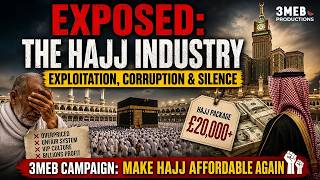
Saudi Arabia's HAJJ Industry EXPOSED - Exploitation, Profit, Corruption & Politics | 3MEB Productions
001803
14