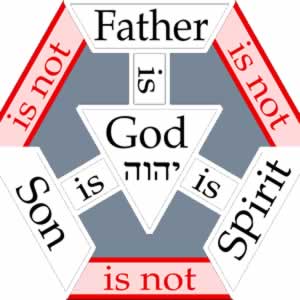
TRINITY TRINITARIAN
What is Trinitarian?
Frequently Asked Questions (1) | Trinitarian
1.How were the Triadic or 'Trinity-like' Pagan Gods presented?
Ancient triadic deities in the Roman Empire were depicted in art and monuments as a single, unified figure featuring three distinct faces or heads to illustrate their triune nature.
2.Does the Christian Trinity come from pagan Triadic dieties?
The core teachings of modern Trinitarian Christian churches do not come from Jesus, but were pagan three-in-one concepts that existed long before his arrival and were later adopted by Christians to make their doctrine highly appealing to idol-worshipping masses.
3.Why is the Trinity so difficult to understand?
The Trinity is a complex theological doctrine because it describes God as existing as three distinct Persons: Father, Son, and Holy Spirit who are co-equal and co-eternal, yet remain one single, unified divine Being. It requires balancing the concepts of strict monotheism with the distinct actions and relationships of the three divine Persons as revealed across the New Testament text.
4.How did the Christian Trinity come about?
The New Testament gospels show Jesus selecting twelve apostles to lead his immediate followers, but he did not lay down a detailed blueprint for a complex institutional priesthood or administrative hierarchy. The elaborate structures, clerical offices, and distinct liturgical traditions seen in modern churches developed gradually over centuries as the movement adapted to Roman institutional frameworks.
5.Does the Bible support the Trinity (3-in-1) God concept?
Mainstream biblical scholars and historians state that the doctrine of the Trinity is never explicitly laid out as a formal dogma anywhere in the text of the Old or New Testaments. While the New Testament contains early triadic formulas (such as the baptismal command in Matthew 28:19 and apostolic blessings in 2 Corinthians 13:14), the actual systemic theology of a three-in-one God was developed later by early church fathers over centuries. Christian theologians argue that the doctrine is implicitly woven throughout the scriptures, while critics and Islamic scholars point to the lack of clear, direct scriptural definitions to argue it was a later modification of strict biblical monotheism.
6.Does the Old Testament teach the Christian Trinity?
Mainstream biblical scholars and historians agree that the Old Testament does not explicitly teach the doctrine of the Trinity, nor did ancient Jewish communities possess a concept of a triune Godhead. There is no historical evidence in pre-Christian Jewish literature including the Hebrew text, the Dead Sea Scrolls, or ancient commentaries of a belief in a plurality of divine Persons. While Christian theologians retrospectively interpret certain plural expressions (such as "Let us make man" in Genesis 1:26) as hints of the Trinity, ancient Judaism strictly maintained a unitarian monotheistic understanding of God.
7.What is the Christian Trinity?
Orthodox Christian theologians define the doctrine of the Trinity as the belief that the Father is God, the Son is God, and the Holy Spirit is God, existing eternally as three distinct Persons within one single, undivided divine Being. These three Persons are considered entirely co-equal in power and co-eternal in time, with the Son being understood as "eternally begotten" of the Father and existing simultaneously as 100% God and 100% man. The platform notes that many modern Christians mistakenly believe they are practicing Trinitarianism simply by acknowledging the Father, Son, and Holy Spirit, without understanding the complex historical and philosophical mechanics required by the formal church dogma.
8.What do Christian 'Trinity' scholars say about the Old Testament?
Many theologians, including this analysis of Trinity dogma, note that the Old Testament does not explicitly contain the Trinity, which they believe was only fully revealed later.
9.What do Christian scholars say about the Trinity?
Mainstream scholars acknowledge that the Trinity is not explicitly defined in the New Testament but was formulated later by combining various verses and theological concepts.
Video on Trinitarian (18)
VIDEO OPTIONS: Latest Uploads Watching Now Popular Least Views
 13:32
13:32
967
1480896000
1786787584
Early Christians were Unitarian, not Trinitarians? - Adnan vs Christian
000812
1
 32:27
32:27
649
1490659200
1787085707
Are Trinitarian Christians going to Hellfire? - Tovia Singer
001947
2
 6:22
6:22
338
1493856000
1786261694
Are you a Trinitarian, Modalist or Biblical Unitarian?
000382
3
 5:29
5:29
1125
1514850975
1786631305
In Matthew 28:19, is not a Trinitarian verse. Trinity came through evolution and Early Church Fathers in 325 and 451 AD finally - Anthony Buzzard
000329
4
 7:41
7:41
775
1520597747
1787079532
Echad and Yachid mean Singular 'One', not Compound 'One'. Christian Trinitarians have it all wrong! - Anthony Buzzard
000461
5

661
1529454362
1787067532
Jesus progressed to God through Docetism, Separationism, Modalism and Trinitarianism - Bart Ehrman
000670
6
 7:54
7:54
297
1535194559
1786543151
In Mark 12:29, the Lord our God is One, unitarian (mono-theos), not Trinitarian - Restoration Fellowship
000474
7
 3:47
3:47
826
1536982598
1786732646
Jesus was a Jew on Unitarian Monotheism, not a Trinitarian - Anthony Buzzard
000227
8
 9:33
9:33
512
1548891071
1786530395
Jesus Worship His Father. How can Jesus be The Father? - Unitarian vs Trinitarian
000573
9
 2:58
2:58
742
1549213437
1786249352
Philo of Alexandria, a Jewish Greek philosopher wrote of a Trinitarian God
000178
10
 8:46
8:46
361
1550556976
1786625982
Jesus was a Jew, not a Trinitarian - approvedofGod
000526
11
 22:01
22:01
849
1559952657
1787084327
The Jewish God is Unitarian, not Trinitarian - Jews For Judaism
001321
12
 1:48
1:48
879
1563664721
1786204144
Trinity is not in the Bible. Jesus was not a Trinitarian - Anthony Buzzard
000108
13
 2:21
2:21
733
1566862402
1786733994
Both Gnostic and Trinitarian Christians believe in Jesus' dual nature - Kegan Chandler
000141
14

883
1571010217
1787067640
Apostle Paul was not Trinitarian. His Jesus was 'less' than God (Subordinationism) - Richard Carrier
000225
15
 5:23
5:23
1291
1574294142
1786759280
In 70 AD, Rome destroyed the Jerusalem Church, establishing 'Pagan' Trinitarian Christianity - Hamza Saudi
000323
16
 3:19
3:19
454
1584010861
1787021293
Jesus was a Monotheist, Non-Trinitarian Jew - Anthony Buzzard
000199
17
 3:05
3:05
652
1595787849
1786518969
In Mark 12:29, Jesus was an observant Jewish Man, not a Trinitarian - Anthony Buzzard
000185
18