540 views
·
Last viewed: 44 mins ago
Uploaded: 23 Apr 2024 (2 years ago) · Shared: 06 May 2026
Duration: 1:26:42
Uploaded: 23 Apr 2024 (2 years ago) · Shared: 06 May 2026
Duration: 1:26:42
Video Description
In this thought-provoking discussion hosted by InspiringPhilosophy, scholar Javad Hashmi explores the complex intersection of Islamic apologetics, modern academic scholarship, and interfaith dialogue.
Explore More
InspiringPhilosophy Javad Hashmi Philosophy The Quran PhiloSearch Google Search Explore Topics
 Who are InspiringPhilosophy?
My name is Michael Jones. I plan on creating a new video for InspiringPhilosophy.org every month dealing with philosophical and apologetic questions.
 Who is Javad Hashmi?
Javad Hashmi is a board-certified emergency physician, Former Fellow of Medical Ethics, and PhD candidate in the Study of Religion (Islamic Studies) at Harvard University. In addition to his medical training, Dr. Hashmi has bachelors and masters degrees in Arabic & Islamic Studies from UC Berkeley and Harvard, respectively. Currently, he is completing his doctoral dissertation on the topic of jihad in the Quran and during the lifetime of the historical Mu?ammad.
 What is Philosophy?
Philosophy is the study of general and fundamental problems concerning matters such as existence, knowledge, values, reason, mind, and language. The term was probably coined by Pythagoras (c. 570-495 BCE). Philosophical methods include questioning, critical discussion, rational argument, and systematic presentation. Classic philosophical questions include: Is it possible to know anything and to prove it? What is most real? Philosophers also pose more practical and concrete questions such as: Is there a best way to live? Is it better to be just or unjust (if one can get away with it)? Do humans have free will?
 What is The Quran?
Quran, literally meaning "the recitation" is the central religious text of Islam, which Muslims believe to be a revelation from God (Allah). It is widely regarded as the finest work in classical Arabic literature. The Quran is divided into chapters (surah in Arabic), which are then divided into verses (ayah). Muslims believe that the Quran was verbally revealed by God to Muhammad through the angel Gabriel (Jibril), gradually over a period of approximately 23 years, beginning on 22 December 609 CE, when Muhammad was 40, and concluding in 632, the year of his death. Muslims regard the Quran as the most important miracle of Muhammad, a proof of his prophethood, and the culmination of a series of divine messages that started with the messages revealed to Adam and ended with Muhammad.
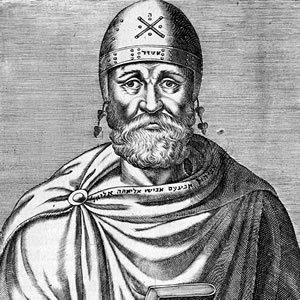 Who was Philo?
Philo of Alexandria (20 BC-50 AD) was a Hellenistic Jewish philosopher who lived in Alexandria, in the Roman province of Egypt. Philo used philosophical allegory to harmonize Jewish scripture, mainly the Torah, with Greek philosophy. His method followed the practices of both Jewish exegesis and Stoic philosophy. His allegorical exegesis was important for some Christian Church Fathers, but he had very little reception history within the Rabbinic Judaism. He adopted allegorical instead of literal interpretations of the Hebrew Bible. Some scholars hold that his concept of the Logos as God's creative principle influenced early Christology.