Youtube Description:
A conversation with Ahmad Al-Jallad about the languages and inscriptions of pre-Islamic Arabia, our main contemporary source for life, death, and worship before the time of the Prophet Muhammad. We talk about field surveys in search of inscriptions and what they tell us about Allah and other Arabian deities in the early centuries of the first millennium.
Ahmad Al-Jallad is Professor in the Sofia Chair in Arabic Studies at Ohio State University, where his research focuses on pre-Islamic Arabian inscriptions. The article on which this conversation is based has not yet been published (its provisional title is 'Ancient Allah: An Epigraphic Reconstruction').
Digital Archive for the Study of pre-Islamic Arabian Inscriptions -
The Digital Corpus of the Nabataean and Developing Arabic Inscriptions -
Byzantium & Friends is hosted by Anthony Kaldellis, a Professor at the University of Chicago.
A conversation with Ahmad Al-Jallad about the languages and inscriptions of pre-Islamic Arabia, our main contemporary source for life, death, and worship before the time of the Prophet Muhammad. We talk about field surveys in search of inscriptions and what they tell us about Allah and other Arabian deities in the early centuries of the first millennium.
Ahmad Al-Jallad is Professor in the Sofia Chair in Arabic Studies at Ohio State University, where his research focuses on pre-Islamic Arabian inscriptions. The article on which this conversation is based has not yet been published (its provisional title is 'Ancient Allah: An Epigraphic Reconstruction').
Digital Archive for the Study of pre-Islamic Arabian Inscriptions -
The Digital Corpus of the Nabataean and Developing Arabic Inscriptions -
Byzantium & Friends is hosted by Anthony Kaldellis, a Professor at the University of Chicago.
Explore More
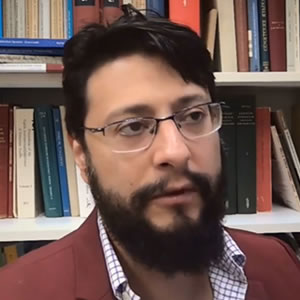 Who is Ahmad Al-Jallad?
Ahmad Al-Jallad is a Jordanian-American philologist, epigraphist, and a historian of language. Some of the areas he has contributed to include Quranic studies and the history of Arabic, including recent work he has done on pre-Islamic Arabian
inscriptions written in Safaitic and Paleo-Arabic.
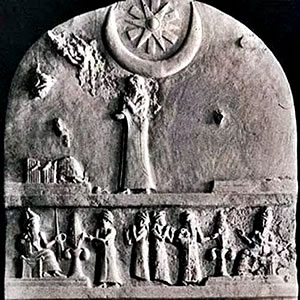 What is Pre-Islam?
Pre-Islam refers to the period in history before the emergence and widespread adoption of Islam. It specifically denotes the time before the Prophet Muhammad's revelations and the establishment of Islamic faith, culture, and civilization.
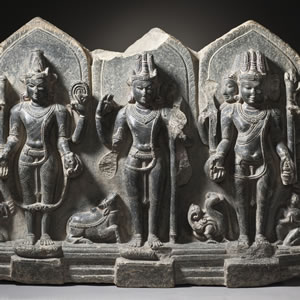 What is The Gods?
Polytheism is the worship of or belief in multiple deities, usually as a pantheon of gods and goddesses. In most religions which accept polytheism, the different gods and goddesses are representations of forces of nature or ancestral principles, and
can be viewed either as autonomous or as aspects or emanations of a creator deity or transcendental absolute principle (monistic theologies), which manifests immanently in nature (panentheistic and pantheistic theologies). Most of the polytheistic deities of ancient religions, with the notable exceptions of the Ancient Egyptian and Hindu deities, were conceived as having physical bodies. Polytheism is a type of theism. Within theism, it contrasts with monotheism, the belief in a singular God, in most cases transcendent. Important polytheistic religions practiced today include Chinese traditional religion, Hinduism, Japanese Shinto, and various neopagan faiths.
 Who is Allah?
Allah is the Arabic word for God in Abrahamic religions. In the English language, the word generally refers to God in Islam. The word is thought to be derived by contraction from al-ilah, which means 'the god', and is related to El and Elah, the
Hebrew and Aramaic words for God. The word Allah has been used by Arabic people of different religions since pre-Islamic times. More specifically, it has been used as a term for God by Muslims (both Arab and non-Arab) and Arab Christians.