355 views
·
Last viewed: 3 days ago
Uploaded: 26 Nov 2013 (13 years ago) · Shared: 24 Apr 2019
Duration: 7:48
Uploaded: 26 Nov 2013 (13 years ago) · Shared: 24 Apr 2019
Duration: 7:48
Youtube Description
Part-1 of this video is @ http://youtu.be/fTT-w6Ai5Rs [select the **show more** control to display additional info] see full video @ Promises andBetrayals - Middle East - History
http://youtu.be/JW2sm0iR0E8
The King of Syria, was the title briefly used following the partitioning of the Ottoman Empire in the aftermath of World War I. Faysal ibn Husayn of the House of Hashim was proclaimed King of Greater Syria on 8 March 1920 in Damascus, following the Arab revolt against the Ottomans of 1916--1918.
His accession was not recognized by France or the United Kingdom, the two new imperial powers in the region, and on 23 July 1920 the French moved 9000 troops towards Damascus resulting in the Battle of Maysalun. Faisal was expelled from Syria on 25 July and took exile in the United Kingdom. On 10 August, the Treaty of Sèvres divided the region into League of Nations mandates governed by France and the United Kingdom. Following mass revolts in Mesopotamia, the British government decided to step back from direct administration and create a monarchy to head Iraq while they maintained the mandate. Faisal agreed to become King following a referendum showing 96% in favour, and on 23 August 1921, Faisal was crowned King of Iraq.
Explore More
Search Google Search Explore Topics Sharif Hussein Sykes-Picot British Ottoman Who is Sharif Hussein?
Hussein ibn Ali al-Hashimi (1854-1931) was a Hashemite Arab leader who was the Sharif and Emir of Mecca from 1908. He was said to be a 37th-generation direct descendant of Muhammad as he belong to the Hashemite family. In 1916, with the promise of British support for Arab independence, he proclaimed the Arab Revolt against the Ottoman Empire. After World War I, Hussein refused to ratify the Treaty of Versailles, in protest at the Balfour Declaration and the establishment of British and French mandates in Syria, Iraq, and Palestine. He later refused to sign the Anglo-Hashemite Treaty and thus deprived himself of British support when his kingdom was invaded by Ibn Saud. In October 1924, facing defeat by Ibn Saud, he abdicated and was succeeded as king by his eldest son Ali.
What is Sykes-Picot?Sykes-Picot Agreement was a secret 1916 agreement between the United Kingdom and France. The agreement allocated to Britain control of areas roughly comprising the coastal strip between the Mediterranean Sea and the River Jordan, Jordan, southern Iraq, and an additional small area that included the ports of Haifa and Acre, to allow access to the Mediterranean. France got control of southeastern Turkey, northern Iraq, Syria and Lebanon. Russia was to get Istanbul, the Turkish Straits and Armenia. The controlling powers were left free to determine state boundaries within their areas. The agreement effectively divided the Ottoman Arab provinces outside the Arabian peninsula into areas of British and French control and influence.
 What is British?
British people or Britons, also known colloquially as Brits, are the citizens and diaspora of the United Kingdom, the British Overseas Territories, and the Crown dependencies. British nationality law governs modern British citizenship and nationality, which can be acquired, for instance, by descent from British nationals. The British are a diverse, multinational, multicultural and multilingual people, with "strong regional accents, expressions and identities". The social structure of the United Kingdom has changed radically since the 19th century, with a decline in religious observance, enlargement of the middle class, and increased ethnic diversity, particularly since the 1950s, when citizens of the British Empire were encouraged to immigrate to Britain to work as part of the recovery from World War II. The population of the UK stands at around 67 million, with around 50 million being White British. This includes 44.4 million in England and Wales as of 2021, and 4.2 million in Scotland as of 2022. 1.8 million identify as White in Northern Ireland, including White British and other White ethnicities, as of 2021.
 Who was the Ottoman?
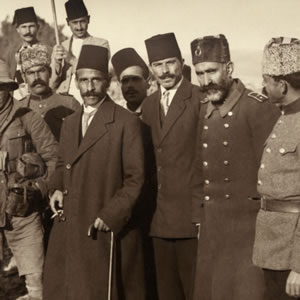
The Ottoman Empire historically known in Western Europe as the Turkish Empire or simply Turkey. This was a state that controlled much of Southeast Europe, Western Asia and North Africa between the 14th and early 20th centuries. After 1354, the Ottomans crossed into Europe, and with the conquest of the Balkans, the Ottoman beylik was transformed into a transcontinental empire. The Ottomans ended the Byzantine Empire with the 1453 conquest of Constantinople by Mehmed the Conqueror.