735 views
·
Last viewed: 2 hrs ago
Uploaded: 06 Mar 2014 (13 years ago) · Shared: 10 Jan 2016
Duration: 2:38
Uploaded: 06 Mar 2014 (13 years ago) · Shared: 10 Jan 2016
Duration: 2:38
Youtube Description
Ahmed Deedat Anis Shorrosh Debate - Royal Albert Hall London 1985 Is Jesus God Allah as Moon-God is a claim put forth by some EvangelicalChristian groups that the Islamic name for God, Allah, derives from a pagan Moon god in local Arabic mythology. The implication is that 'Allah' is a different God from the Judeo-Christian deity and that Muslims are worshipping a 'false god'. The claim is most associated with the Christian apologist author Robert Morey, whose book The moon-god Allah in the archeology of the Middle East is the most cited source of the meme that Allah is a moon-god. It has also been promoted in the cartoon tracts of Jack Chick.[1] The use of a lunar calendar and the prevalence of crescent moon imagery in Islam is said to be the result of this origination.[2]
In 2009 anthropologist Gregory Starrett wrote, 'a recent survey by the Council for American Islamic Relations reports that as many as 10% of Americans believe Muslims are pagans who worship a moon god or goddess, a belief energetically disseminated by some Christian activists.'[3] Islamic and Western scholars have rejected these claims, one even calling them 'insulting'.[4] It is argued that 'Allah' is just the word for 'God' in Arabic, which ultimately derives from the same root as the Hebrew words 'El' and 'Elohim', both used in the Book of Genesis. Sociologist Lori Peek writes that, 'Allah is simply the Arabic word meaning God. In fact people who speak Arabic, be they Christians, Jews or Muslims, often say 'Allah' to describe God, just as God is called 'Gott' in German and 'Dieu' in French.'[1] While other gods were certainly referred to using this epithet, this is equally true of the Hebrew words. The Biblical commandment You shall have no other gods before me uses the same word, 'Elohim', to refer to the 'other' gods that is used for the creator god.[5] It is also true of the English, French and other European-language words for God. Indeed the English word 'God' evolved from pagan Germanic terms for invocation; the Latin word Deus, from which 'Dieu' derives, can be traced to the same root as Dyeus, which gives the names of the ancient Indo-European divinities Zeus, Jove and Dyaus Pitar.
Do you now see why the moon and other GOD Almighty-created astronomical objects were used for determining time?
Do we worship the dawn? No!
Do we worship the moon? No!
Do we worship the sun? No!
Do we worship the night? No!
Do we worship the earth? No!
Do we worship anything other than GOD Almighty? No!
Do we only worship GOD Almighty and nothing but GOD Almighty and associate no partners with Him such as idols and men? Absolutely Yes!
Explore More
Search Google Search Explore Topics The Bible Moon God Allah Myth What is The Bible?
The Bible is a canonical collection of texts sacred in Judaism and Christianity. There is no single "Bible" and many Bibles with varying contents exist. The term Bible is shared between Judaism and Christianity, although the contents of each of their collections of canonical texts is not the same. Different religious groups include different books within their Biblical canons, in different orders, and sometimes divide or combine books, or incorporate additional material into canonical books. The Hebrew Bible, or Tanakh, contains 24 books. Christian Bibles range from the 66 books of the Protestant canon to the 81 books of the Ethiopian Orthodox Church canon. The first part of Christian Bibles is the Old Testament, which contains, at minimum, the 24 books of the Hebrew Bible divided into 39 books and ordered differently from the Hebrew Bible. The Catholic Church and Eastern Christian churches also hold certain deuterocanonical books and passages to be part of the Old Testament canon. The second part is the New Testament, containing 27 books: the 4 Canonical gospels, Acts of the Apostles, 21 Epistles or didactic letters, and the Book of Revelation.
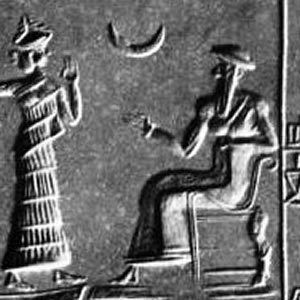 Who is the Moon God?
In modern times it is claimed Allah (God in Islam) historically originates as a Moon God. Therefore this Moon God was worshipped in pre-Islamic Arabia originates in early 20th-century scholarship, most prominently advocated by American evangelicals from the 1990s. The idea was proposed by archeologist Hugo Winckler in 1901. It was proliferated in the USA in the 1990s, first via the publication of Robert Morey's pamphlet The Moon-god Allah: In Archeology of the Middle East (1994). Morey argues that "Allah" was the name of a moon god in pre-Islamic Arabic mythology, the implication being that "Allah" as the term for God in Islam implies that Muslims worship a different deity than the Judeo-Christian one. Joseph Lumbard, a professor of classical Islam, has stated the idea is "not only an insult to Muslims but also an insult to Arab Christians who use the name 'Allah' for God."
 Who is Allah?
Allah is the Arabic word for God in Abrahamic religions. In the English language, the word generally refers to God in Islam. The word is thought to be derived by contraction from al-ilah, which means 'the god', and is related to El and Elah, the Hebrew and Aramaic words for God. The word Allah has been used by Arabic people of different religions since pre-Islamic times. More specifically, it has been used as a term for God by Muslims (both Arab and non-Arab) and Arab Christians.
What is Myth?Mythology refers to a collection of sacred, traditional tales from a specific culture that explain natural phenomena, world origins, and cultural values. This often featuring gods, goddesses, and heroes. It serves as a lens for interpreting shared human experiences through stories, rituals, and art. Myth is a genre of folklore consisting primarily of narratives that play a fundamental role in a society. For scholars, this is totally different from the ordinary sense of the term myth, meaning a belief that is not true, as the veracity of a piece of folklore is entirely irrelevant to determining whether it constitutes a myth. Myths are often endorsed by religious and secular authorities, and may be natural or supernatural in character. Many societies group their myths, legends, and history together, considering myths and legends to be factual accounts of their remote past. In particular, creation myths take place in a primordial age when the world had not achieved its later form. Origin myths explain how a society's customs, institutions, and taboos were established and sanctified. National myths are narratives about a nation's past that symbolize the nation's values. There is a complex relationship between recital of myths and the enactment of rituals.