679 views
·
Last viewed: 1 day ago
Uploaded: 13 Mar 2014 (13 years ago) · Shared: 19 Sep 2017
Duration: 29:58
Uploaded: 13 Mar 2014 (13 years ago) · Shared: 19 Sep 2017
Duration: 29:58
Youtube Description
'Your throne ho theos to the age of the age,' refers to God the Father's throne, 'Your throne the God to the age of the age.' Jesus sat down on hisFather's throne.
Why would anyone want to interpret the Greek words 'ho theos' as 'O God' in verse 8 but the same words as 'the God' (2x) in verse 9?
God's throne represents God's authority. David/Solomon sat on God's throne executing God's authority over Israel (1 Chronicles 29:23). Hebrews 1:8 refers to the fact that Jesus sat down on God's throne which means he executes God's authority in God's name, 'Your throne ho theos to the age of the age.'
The Trinitarian translation results in absurd implications. It results in God's God anointing God so that God could make God above God's peers. It also results in the highly unlikely result of calling an ancient Davidic king 'God,' a king who was contemporaneous with the Psalmist. There are several passages like Psalm 45 in Scripture which refer to both a contemporary figure and to Jesus. Examples:
2 Samuel 7:11-14 - both Solomon and Jesus
Isaiah 7:14 - child born during the reign of Ahaz, and Jesus
Isaiah 42:1ff - both Israel and Jesus
Isaiah 53 - both Israel and Jesus (Isaiah personifies Israel as a single man many times in the book of Isaiah)
Hosea 11:1 - both Israel and Jesus
Explore More
Search Google Search Explore Topics Trinity Delusion Trinity Hebrew GOD Who are Trinity Delusion?
The goal of this project is to maintain and make available these resources to help you grow in faith and understanding; And to expose the delusion of the trinitarian belief. The trinity has come to be recognized as one of Christendom's foundational beliefs, but is it founded on truth? We believe the resources provided will prove otherwise and will lead to to a better understanding of scriptures, and of the true Christian faith. We hope this work will bless you and will bring Glory to God and to our Lord.
 What is Trinity?
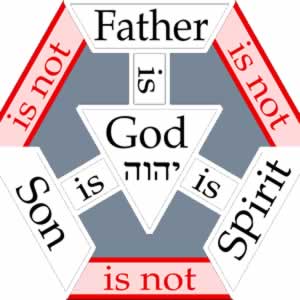
The Christian doctrine of the Trinity (Latin: trinus "threefold") holds that God is one God, but three coeternal consubstantial persons or hypostases. These being the Father, the Son (Jesus Christ), and the Holy Spirit - as "one God in three Divine Persons". The three Persons are distinct, yet are one "substance, essence or nature" (homoousios).
 What is Hebrew?
Hebrew is a Northwest Semitic language within the Afroasiatic language family. A regional dialect of the Canaanite languages, it was natively spoken by the Israelites and remained in regular use as a first language until after 200 CE and as the liturgical language of Judaism (since the Second Temple period) and Samaritanism. The language was revived as a spoken language in the 19th century, and is the only successful large-scale example of linguistic revival. It is the only Canaanite language still spoken today. It is also one of the only two Northwest Semitic languages with contemporary speakers, the other being Aramaic. Nearly all of the Hebrew Bible is written in Biblical Hebrew, with much of its present form in the dialect that scholars believe flourished around the 6th century BCE, during the time of the Babylonian captivity.
Who is GOD?In monotheism and henotheism, God is conceived as the Supreme Being and principal object of faith. The concept of God as described by theologians commonly includes the attributes of omniscience (infinite knowledge), omnipotence (unlimited power), omnipresence (present everywhere), omnibenevolence (perfect goodness), divine simplicity, and eternal and necessary existence. In theism, God is the creator and sustainer of the universe In deism, God is the creator, but not the sustainer, of the universe Monotheism is the belief in the existence of one God or in the oneness of God In pantheism, God is the universe itself In atheism, God is purported not to exist, while deemed unknown or unknowable within the context of agnosticism.