243 views
·
Last viewed: 2 days ago Uploaded:
21 Jul 2026 (2 months ago)
·
Shared: 22 Jul 2026
Video Description (from Youtube)
Links Mentioned in this Episode:
- https://www.bartehrman.com/visions - Visions of the End - How early Jews and Christians imagined the end of the age - is our new course with Dr. Jason Staples
starting on August 13th. Early-bird pricing until August 1st via this link.
*Episode Description*
Most people, whether religious or not, assume that the concepts of heaven and hell—an eternal reward for the soul in paradise or eternal punishment in a fiery pit—were central to the teachings of Jesus and the foundations of Christianity. In this paradigm-shifting episode of Misquoting Jesus, Dr. Bart Ehrman reveals that this popular understanding is a later development, a fascinating synthesis of different ancient worldviews that would have been foreign to Jesus and his first followers.
The conversation begins by dismantling the common assumption that the Old Testament contains a blueprint for heaven and hell. Dr. Ehrman explains that in the Hebrew Bible, there is no concept of a soul separating from the body to live on in a divine realm or a place of torment. The word 'Sheol,' often mistranslated as 'hell,' simply meant the grave—the pit of death where all people, righteous and wicked alike, ceased to exist. In this ancient Israelite view, a human being was a unified body and soul (or 'breath'). When the body died and the breath left, that was the end. Rewards for righteousness and punishments for sin were expected to happen in this life, not the next.
So where did the idea of an afterlife of reward and punishment come from? The key, Bart explains, was the 'problem of justice.' As Jewish thinkers observed the world, they saw a glaring contradiction: righteous people often suffered terribly, while wicked and cruel people prospered. If God is just, how could this be? This theological crisis, which became prominent in the last few centuries before Jesus, led to a new idea: resurrection of the dead. The belief was not in a soul floating up to heaven, but in a future, physical resurrection where God would right the wrongs of this life. The righteous would be raised to an eternal, paradise-like life on a renewed earth, and the wicked would be raised for judgment and then annihilation. This apocalyptic worldview, Bart argues, was the one Jesus himself held.
The modern Christian concept of heaven and hell, as Bart masterfully explains, is the result of a momentous fusion between these two distinct traditions. As Christianity spread from its Jewish roots into the wider, Greek-speaking Roman Empire, new converts brought their Platonic understanding of the immortal soul with them. The Jewish 'horizontal' timeline (this evil age vs. the glorious age to come) was gradually transformed into a 'vertical' one (this world below vs. the world of souls above). The teachings of Jesus were combined with the philosophy of Plato.
The episode then explores the 'afterlife tourism' genre of early Christian literature that expanded on these ideas. In non-canonical texts like the Apocalypse of Peter and the Apocalypse of Paul, we get guided tours of the afterlife. These texts offer lurid, graphic, and terrifying descriptions of the torments of hell—often in far more detail than the descriptions of heaven—serving as powerful tools to scare potential converts into the faith. These writings also introduced concepts like a tiered heaven, where the more righteous a person was on earth, the greater their reward and the higher their status would be in paradise, a concept that fueled ascetic competitions among early monks and echoes even today.
*Three Key Takeaways from the Episode:*
1. *Jesus's Belief Was in a Physical Resurrection, Not a Soul Going to Heaven:* As an apocalyptic Jew, Jesus taught that at the end of the age, God would judge the world. The righteous dead would be physically resurrected to live forever in a renewed kingdom of God on earth, while the wicked would be annihilated. The idea of an immortal soul departing the body for a spiritual realm was a Greek concept, not a Jewish one.
2. *Modern Heaven and Hell are a Synthesis of Jewish Apocalypticism and Greek Philosophy:* The Christian doctrine of the afterlife did not emerge fully formed. It evolved as the early church moved into the Greco-Roman world, blending the Jewish expectation of a final judgment with the Platonic concept of an immortal soul that is rewarded or punished immediately after death.
3. *The 'Problem of Justice' Was the Primary Driver for Developing an Afterlife Theology:* Both ancient Jews and Greeks struggled to reconcile the idea of a just cosmos with the reality of righteous people suffering and wicked people prospering. The need for ultimate justice—for a final reckoning where all accounts are settled—was the fundamental motivation that led to the development of both the resurrection belief in Judaism and the immortal soul's judgment in Greek philosophy.
Early Christianity, the period of Christianity preceding the First Council of Nicaea in 325 AD. This typically divides historically into the Apostolic Age and the Ante-Nicene Period (from the Apostolic Age until Nicea). The first Christians, as described in the first chapters of the Book of Acts, were all Jews either by birth or conversion and historians refer to them as Jewish Christians. The early Gospel message spread orally, probably originally in Aramaic, and later in Greek. The New Testament's Acts of the Apostles and Epistle to the Galatians record that the first Christian community centered on Jerusalem and that its leaders included Peter, James, the brother of Jesus, and John the Apostle.

Christianity is a global religion centered on the life and teachings of Jesus Christ, who followers believe is the Son of God. It's a monotheistic faith, meaning Christians believe in one God who exists in three co-equal persons: God the Father, God the Son (Jesus Christ), and the Holy Spirit. Christianity is based on the Bible, with the Old Testament and New Testament serving as sacred texts.

Bart Ehrman (born 1955) is an American New Testament scholar focusing on textual criticism of New Testament, historical Jesus, and development of early Christianity. Ehrman has written and edited 30 books, including three college textbooks. He has also authored six New York Times bestsellers. He is currently the James A. Gray Distinguished Professor of Religious Studies at the University of North Carolina at Chapel Hill.
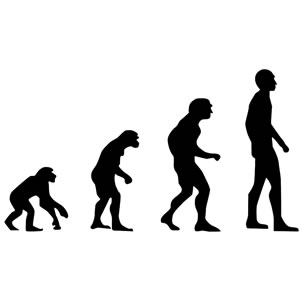
Evolution is change in the heritable characteristics of biological populations over successive generations. Evolutionary processes give rise to bio-diversity at every level of biological organisation, including the levels of species, individual organisms, and molecules. In the mid-19th century, Charles Darwin formulated the scientific theory of evolution by natural selection, published in his book On the Origin of Species (1859). Evolution by natural selection is a process first demonstrated by the observation that often, more offspring are produced than can possibly survive.

Judaism encompasses the religion, philosophy, culture and way of life of the Jewish people. Judaism is a monotheistic religion, with the Torah as its foundational text (part of the larger text known as the Tanakh or Hebrew Bible), and supplemental oral tradition represented by later texts such as the Midrash and the Talmud. Judaism is considered by religious Jews to be the expression of the covenantal relationship that God established with the Children of Israel.
<br><br>
Judaism includes a wide corpus of texts, practices, theological positions, and forms of organization. Within Judaism there are a variety of movements, most of which emerged from Rabbinic Judaism, which holds that God revealed his laws and commandments to Moses on Mount Sinai in the form of both the Written and Oral Torah.
<br><br>
The Jews are an ethnoreligious group and include those born Jewish and converts to Judaism. In 2012, the world Jewish population was estimated at about 14 million, or roughly 0.2% of
the total world population. About 42% of all Jews reside in Israel and about 42% reside in the United States and Canada, with most of the remainder living in Europe.

Heaven, or the Heavens, is a common religious cosmological or supernatural place where beings such as deities, angels, souls, saints, or venerated ancestors are said to originate, be enthroned, or reside. Heaven is often described as a 'highest place', the holiest place, a paradise, in contrast to Hell or the Underworld or the 'low places' and universally or conditionally accessible by earthly beings according to various standards of divinity, goodness, piety, faith, or other virtues or right beliefs or simply divine will.

DISCLAIMER
All videos are shared for educational and information purposes only. All videos are hosted and viewable on Youtube servers. Video titles are generated using the original video title; overall content theme including actual dialogue and speech (Transcript); and A.I-based recommendations with a focus on SEO, keyword density, and internal search functions. The video title does not represent the views held by the Youtube video uploader, or any individual, organisation or business.