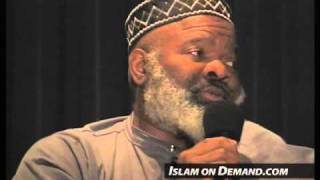
What's the purpose of Blood Sacrifice to God? - Hussein vs Kalam

   13:31
428 views  ·  Last viewed: 7 hrs ago
Uploaded: 11 May 2017   (9 years ago)  ·  Shared: 04 May 2017

Video Description (from Youtube)

Speakers Corner 30th April 2017
DISCLAIMER
All videos are shared for educational and information purposes only. All videos are hosted and viewable on Youtube servers. Video titles are generated using the original video title; overall content theme including actual dialogue and speech (Transcript); and A.I-based recommendations with a focus on SEO, keyword density, and internal search functions. The video title does not represent the views held by the Youtube video uploader, or any individual, organisation or business.

If you spot any mistake, omission or give feedback, kindly Contact Us with details

Overview & Key Concepts


What is a Blood Sacrifice?

Animal sacrifice is the ritual killing and offering of an animal usually as part of a religious ritual or to appease or maintain favour with a deity

Animal sacrifices were common throughout Europe and the Ancient Near East until Late Antiquity, and continue in some cultures or religions today. Human sacrifice, where it existed, was always much more rare. All or only part of a sacrificial animal may be offered; some cultures, like the ancient and modern Greeks, eat most of the edible parts of the sacrifice in a feast, and burnt the rest as an offering. Others, including the ancient Hebrews, burnt the whole animal offering, called a holocaust. Animal sacrifice should generally be distinguished from the religiously-prescribed methods of ritual slaughter of animals for normal consumption as food.

Who is GOD?

In monotheism and henotheism, God is conceived as the Supreme Being and principal object of faith. The concept of God as described by theologians

commonly includes the attributes of omniscience (infinite knowledge), omnipotence (unlimited power), omnipresence (present everywhere), omnibenevolence (perfect goodness), divine simplicity, and eternal and necessary existence.
<ul>
<li>In theism, God is the creator and sustainer of the universe</li>
<li>In deism, God is the creator, but not the sustainer, of the universe</li>
<li>Monotheism is the belief in the existence of one God or in the oneness of God</li>
<li>In pantheism, God is the universe itself</li>
<li>In atheism, God is purported not to exist, while deemed unknown or unknowable within the context of agnosticism. </li>

</ul>

Frequently Asked Questions


1.Were the Gods sacrificed?

* Horus - In Egypt, in the Heb-Sed festival, the powers of Pharaoh (Horus incarnate) were tested. If found weak, Horus was expected to sacrifice himself by donating his blood to the soil

* Kronos - A man was sacrified annually at the Phoenician feast of Kronos. Kronos had a son, Ieoud who he sacrificed. Ieoud was known as 'the only begotten son of his Father'

* Tammuz - A popular Syrian saviour-God born of a virgin was killed and rose again every spring. Wherever Tammuz was worshipped a human victim in royal robes was killed and eaten, so his body and blood might bring salvation to the community.


2.Who did Abraham sacrifice: Ishmael or Isaac?

This question highlights a foundational narrative variance between the Abrahamic scriptures. The Hebrew Bible (Genesis 22) explicitly names Isaac as the son brought to Mount Moriah for the binding sacrifice. In contrast, while the Quranic text (Surah As-Saffat 37:100-113) does not explicitly name the sacrificial son, the vast majority of mainstream Islamic tradition identifies Ishmael as the intended sacrifice, pointing to the narrative timeline where Abraham is promised Isaac only after passing the ultimate test of his willingness to offer his firstborn.


3.Why do Muslims sacrifice livestock (goat, sheep, cow etc.) on Eid Al-Adha?

This annual global ritual commemorates the absolute devotion of Abraham, who was commanded by God in a vision to offer his eldest son as a sacrifice. Mainstream Islamic tradition identifies this son as Ishmael, noting that when Abraham demonstrated his complete willingness to obey, God miraculously substituted a ram in the boy's place. The meat from the sacrificed livestock is systematically divided into three equal parts to be shared with family, neighbors, and the impoverished.


Videos on Blood Sacrifice (4)

Video: In Jeremiah 7:21, does blood sacrifice lead to salvation? - Tovia Singer 8:59
Video: What's the purpose of Blood Sacrifice to God? - Hussein vs Kalam 13:31
Video: Blood Sacrifice: God so loved the smell of burning Animal flesh? - Matt Dillahunty (Unbelievable) 5:32
Video: Does the Israel-Gaza War amount to a 'Human Blood Sacrifice' Ritual? | Jiang Xueqin 9:09

EXPLORE TOPICS : SACRIFICE | 40 BLOOD SACRIFICE | 4 GOD | 0   JESUS

Latest videos  •  6,061 videos  •  0 viewed/24 hour

SUBSCRIBE

Receive the latest news and updates by email - Subscribe Now!
About  |  Q&A  |  Contact Us    •    Terms  |  Privacy  |  Disclaimer  |  Sitemap
Connect:      Facebook  |    Twitter  |    Youtube
MuslimProphets.com is an educational website on the Prophets of God: David, Noah, Abraham, Moses, Jesus and Muhammad, who established the Abrahamic faiths of Judaism, Christianity and Islam. MuslimProphets.com explores contemporary social themes through Scripture, Evidences, Photo, Video, Maps, Current Affairs, Debate and 'alternative' Views held by Theologians, Apologists, Scholars and Street Preachers. Take a Site Tour

In accordance with Islamic etiquette, all prophet names should be followed with 'Peace Be Upon Him (PBUH)'. This is omitted to minimise text.

DISCLAIMER: All website content is for general information and educational purposes only and available in the public domain. Whilst all information comes from sources believed to be reliable, this cannot be guaranteed. External links are provided as a convenience and for informational purposes only. They do not constitute endorsement or approval for any products, services or comments by organizations or individuals. Title and Text links may be edited for external SEO, internal site and keyword search purposes. We bear no responsibility for the accuracy, legality, or content found on any external website or its subsequent links. Unless indicated, all images and content is licensed under a Creative Commons Attribution License distributed by Wikipedia, Wikimedia Commons, Pixabay, Pxhere, Pexels, Unsplash, Flickr and others. All Torah, Psalms, Old and New Testament Bible quotes are from the King James Version (KJV) Holy Bible in the public domain. All Quran quotes are from Taqi-ud-Din al-Hilali/Muhsin Khan English Quran translation.

ALWAYS DO YOUR OWN RESEARCH. If you spot any mistake, error or omission of information, contact us so we can correct it.