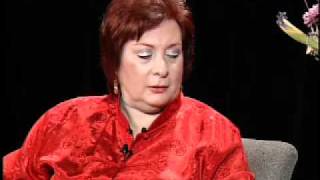
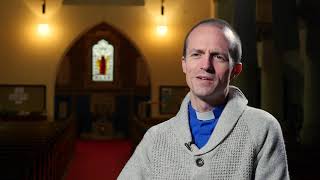
In John 10:30, I and the Father are one - Does this prove the Trinity? - John Schoenheit (BiblicalUnitarian)

   9:12
1191 views  ·  Last viewed: 6 hrs ago
Uploaded: 24 Aug 2011   (15 years ago)  ·  Shared: 28 Mar 2017

Video Description (from Youtube)

John 10:30 - "I and the Father are one." [ See all our videos at http://www.youtube.com/biblicalunitarian] John Schoenheit of Spirit & Truth Fellowship International (http://www.stfonline.org)

shares on "John 10:30."

DISCLAIMER
All videos are shared for educational and information purposes only. All videos are hosted and viewable on Youtube servers. Video titles are generated using the original video title; overall content theme including actual dialogue and speech (Transcript); and A.I-based recommendations with a focus on SEO, keyword density, and internal search functions. The video title does not represent the views held by the Youtube video uploader, or any individual, organisation or business.

If you spot any mistake, omission or give feedback, kindly Contact Us with details

Overview & Key Concepts


Who are BiblicalUnitarian?


Who is John Schoenheit?

John Schoenheit is a teacher, author at Spirit & Truth Fellowship International. He was responsible for printed and online publications, research on

biblical topics, overseeing the translation and publication of the Revised English Version (REV) of the Bible, overseeing a project to produce an online commentary. Schoenheit received his education at the Reformed Theological Seminary.

What is Trinity?

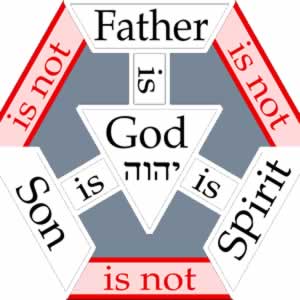
The Christian doctrine of the Trinity (Latin: trinus "threefold") holds that God is one God, but three coeternal consubstantial persons or

hypostases. These being the Father, the Son (Jesus Christ), and the Holy Spirit - as "one God in three Divine Persons". The three Persons are distinct, yet are one "substance, essence or nature" (homoousios).

Frequently Asked Questions


1.How were the Triadic or 'Trinity-like' Pagan Gods presented?

Ancient triadic deities in the Roman Empire were depicted in art and monuments as a single, unified figure featuring three distinct faces or heads to illustrate their triune nature.


2.Does the Christian Trinity come from pagan Triadic dieties?

Yes, the core teachings of modern Trinitarian Christian churches do not come from Jesus, but were pagan three-in-one concepts that existed long before his arrival and were later adopted by Christians to make their doctrine highly appealing to idol-worshipping masses.


3.Why is the Trinity so difficult to understand?

The Trinity is a complex theological doctrine because it describes God as existing as three distinct Persons: Father, Son, and Holy Spirit who are co-equal and co-eternal, yet remain one single, unified divine Being. It requires balancing the concepts of strict monotheism with the distinct actions and relationships of the three divine Persons as revealed across the New Testament text.


4.How did the Christian Trinity come about?

The New Testament gospels show Jesus selecting twelve apostles to lead his immediate followers, but he did not lay down a detailed blueprint for a complex institutional priesthood or administrative hierarchy. The elaborate structures, clerical offices, and distinct liturgical traditions seen in modern churches developed gradually over centuries as the movement adapted to Roman institutional frameworks.

The concept of a dual human and divine nature in the person of Jesus is known as the Hypostatic Union, an essential component of modern Trinitarianism.

Yet it was not until the Council of Chalcedon that we see the emergence of an official doctrine of the Trinity in a form that is recognisable with what Christian Trinitarians believe in today. This took place in the fifth century, over 400 years after Jesus!

The evangelical theologian and Professor Wayne A. Grudem sums this up as follows: 'A precise understanding of how full deity and full humanity' argues Grudem, 'could be combined together in one person was formulated only gradually in the church and did not reach the final form until the Chalcedonian Definition in 451 AD.


5.Does the Bible support the Trinity (3-in-1) God concept?

Mainstream biblical scholars and historians state that the doctrine of the Trinity is never explicitly laid out as a formal dogma anywhere in the text of the Old or New Testaments. While the New Testament contains early triadic formulas (such as the baptismal command in Matthew 28:19 and apostolic blessings in 2 Corinthians 13:14), the actual systemic theology of a three-in-one God was developed later by early church fathers over centuries. Christian theologians argue that the doctrine is implicitly woven throughout the scriptures, while critics and Islamic scholars point to the lack of clear, direct scriptural definitions to argue it was a later modification of strict biblical monotheism.


6.Does the Old Testament teach the Christian Trinity?

Mainstream biblical scholars and historians agree that the Old Testament does not explicitly teach the doctrine of the Trinity, nor did ancient Jewish communities possess a concept of a triune Godhead. There is no historical evidence in pre-Christian Jewish literature including the Hebrew text, the Dead Sea Scrolls, or ancient commentaries of a belief in a plurality of divine Persons. While Christian theologians retrospectively interpret certain plural expressions (such as 'Let us make man' in Genesis 1:26) as hints of the Trinity, ancient Judaism strictly maintained a unitarian monotheistic understanding of God.


7.What is the Christian Trinity?

Orthodox Christian theologians define the doctrine of the Trinity as the belief that the Father is God, the Son is God, and the Holy Spirit is God, existing eternally as three distinct Persons within one single, undivided divine Being. These three Persons are considered entirely co-equal in power and co-eternal in time, with the Son being understood as 'eternally begotten' of the Father and existing simultaneously as 100% God and 100% man. The platform notes that many modern Christians mistakenly believe they are practicing Trinitarianism simply by acknowledging the Father, Son, and Holy Spirit, without understanding the complex historical and philosophical mechanics required by the formal church dogma.


8.What do Christian 'Trinity' scholars say about the Old Testament?

Many theologians, including this analysis of Trinity dogma, note that the Old Testament does not explicitly contain the Trinity, which they believe was only fully revealed later.

The distinguished Trinitarian scholar Bertrand de Margerie in his book The Christian Trinity in History writes:

'Contemporary exegetes [Bible teachers] affirm unanimously that the Old Testament did not bring to the Jewish people a clear and distinct Revelation of the existence of a plurality of persons in God. In this they agree with the clear and frequent affirmation of Fathers such as Irenaeus, Hilary, and Gregory of Nazianzus: that the doctrine of the Trinity is revealed only in the New Testament.'

So any person who lived before Jesus' ministry did not have to believe in the Trinity to be saved because the Trinity is not mentioned in the Old Testament.


9.What do Christian scholars say about the Trinity?

Mainstream scholars acknowledge that the Trinity is not explicitly defined in the New Testament but was formulated later by combining various verses and theological concepts.

Scholars freely admit that the Trinity is never presented as a complete doctrine in the New Testament, but rather is built from scattered Bible verses.

In the New Testament there is no explicit statement of the doctrine
Evangelical Dictionary of Theology (p. 1112)

It is not a Biblical doctrine in the sense that any formulation of it can be found in the Bible
New Bible Dictionary (p.1221)

The New Testament does not present a systematic presentation of the Trinity. The scattered segments from various writers that appear throughout the New Testament reflect a seemingly accepted understanding that exists without a full-length discussion.
Holman Bible Dictionary (p.1372)

Theologians admit the New Testament does not define the Trinity. Furthermore, there is no clear teaching that salvation depends on the belief in the Trinity.


Videos on John Schoenheit (18)

Video: In John 1:1, In the beginning was the Word, and the Word was with God, and the Word was God - John Schoenheit (BiblicalUnitarian) 12:29
Video: In 1 Corinthians 15:45, God speaks   about the  Christian Trinity  - John Schoenheit (BiblicalUnitarian) 10:30
Video: Can we pray to Jesus? - John Schoenheit (BiblicalUnitarian) 12:42
Video: In Luke 10:18, I saw Satan fall like lightning from heaven - John Schoenheit (BiblicalUnitarian) 11:31
Video: In Matthew 12:40, Jesus claims he will be in the Tomb for 3 days and 3 nights - John Schoenheit (BiblicalUnitarian) 10:21
Video: If Jesus is called Lord, does that make him God? - John Schoenheit (BiblicalUnitarian) 11:49
Video: In John 10:30, I and the Father are one - Does this prove the Trinity? - John Schoenheit (BiblicalUnitarian) 9:12
Video: In Jude 1:5, who delivered the People out of Egypt? - John Schoenheit (BiblicalUnitarian) 9:54
Video: In John 1:18, is Jesus 'God' or 'Son'? - John Schoenheit (BiblicalUnitarian) 12:40
Video: How old was Mary when she gave birth to Jesus? - John Schoenheit (BiblicalUnitarian) 9:43
Video: Was Jesus born on December 25th? - John Schoenheit (BiblicalUnitarian) 10:19
Video: What does the name Jesus Christ mean? - John Schoenheit (BiblicalUnitarian) 10:16
Video: In Exodus 3:14, John 6:20, John 8:24, John 8:58, Mark 6:50, Mark 13:6, Luke 21:8, Matthew 14:27 and Acts 26:29 Jesus claims I AM (Ego Eimi) God - John Schoenheit (BiblicalUnitarian) 12:06
Video: In Isaiah 9:6 and Psalm 82:1, is Jesus a God or The God? - John Schoenheit (BiblicalUnitarian) 10:30
Video: In Matthew 1:23, why is Jesus called Immanuel? - John Schoenheit (BiblicalUnitarian) 11:12
Video: Unitarian Christians believe in One God; oppose Trinity - John Schoenheit (BiblicalUnitarian) 11:46
Video: The Christian Bible supports Capital Punishment/Death Penalty - John Schoenheit (BiblicalUnitarian) 11:07
Video: How the Bible Codex was formed - John Schoenheit 11:00

EXPLORE TOPICS : UNITARIAN | 32 UNITERIANISM | 0 JOHN SCHOENHEIT | 18 TRINITY | 154 TRINITARIAN | 18 BIBLICALUNITARIAN | 19   JESUS
Latest videos  •  6,061 videos  •  0 viewed/24 hour

SUBSCRIBE

Receive the latest news and updates by email - Subscribe Now!
About  |  Q&A  |  Contact Us    •    Terms  |  Privacy  |  Disclaimer  |  Sitemap
Connect:      Facebook  |    Twitter  |    Youtube
MuslimProphets.com is an educational website on the Prophets of God: David, Noah, Abraham, Moses, Jesus and Muhammad, who established the Abrahamic faiths of Judaism, Christianity and Islam. MuslimProphets.com explores contemporary social themes through Scripture, Evidences, Photo, Video, Maps, Current Affairs, Debate and 'alternative' Views held by Theologians, Apologists, Scholars and Street Preachers. Take a Site Tour

In accordance with Islamic etiquette, all prophet names should be followed with 'Peace Be Upon Him (PBUH)'. This is omitted to minimise text.

DISCLAIMER: All website content is for general information and educational purposes only and available in the public domain. Whilst all information comes from sources believed to be reliable, this cannot be guaranteed. External links are provided as a convenience and for informational purposes only. They do not constitute endorsement or approval for any products, services or comments by organizations or individuals. Title and Text links may be edited for external SEO, internal site and keyword search purposes. We bear no responsibility for the accuracy, legality, or content found on any external website or its subsequent links. Unless indicated, all images and content is licensed under a Creative Commons Attribution License distributed by Wikipedia, Wikimedia Commons, Pixabay, Pxhere, Pexels, Unsplash, Flickr and others. All Torah, Psalms, Old and New Testament Bible quotes are from the King James Version (KJV) Holy Bible in the public domain. All Quran quotes are from Taqi-ud-Din al-Hilali/Muhsin Khan English Quran translation.

ALWAYS DO YOUR OWN RESEARCH. If you spot any mistake, error or omission of information, contact us so we can correct it.