40:53
537 views
·
Last viewed: 15 hrs ago
Uploaded: 18 May 2017 (9 years ago) · Shared: 04 May 2017
Video Description (from Youtube)
The Ultimate Proof of Creation: Resolving the Origins Debate Atheist Rob cornered by Subbor at speakers corner 'Resolving the Origins Debate' park hydeDISCLAIMER
All videos are shared for educational and information purposes only. All videos are hosted and viewable on Youtube servers. Video titles are generated using the original video title; overall content theme including actual dialogue and speech (Transcript); and A.I-based recommendations with a focus on SEO, keyword density, and internal search functions. The video title does not represent the views held by the Youtube video uploader, or any individual, organisation or business.
If you spot any mistake, omission or give feedback, kindly Contact Us with details
Search Results on 'Science gives us the best understanding of the World - Subboor Ahmad vs Atheist Julian 3/3'
SCROLL TO: TOPICS | 3 NEWS | 22 ARTICLES | 1 FAQ | 1 VIDEO | 92 LINKS | 0Topics include Atheism, Science, Subboor Ahmad (3)
What is Atheism? Atheism is, in the broadest sense, the absence of belief in the existence of deities. Less broadly, atheism is the rejection of belief that any deities exist. In an even narrower sense, atheism is specifically the position that there are no deities. Atheism is contrasted with theism, which, in its
most general form, is the belief that at least one deity exists. |
What is Science? Science is a systematic enterprise that builds and organizes knowledge in the form of testable explanations and predictions about the universe. The earliest roots of science can be traced to the works of Ancient Egyptians and Mesopotamians, whose contributions entered and shaped Greek natural
philosophy of classical antiquity. After the fall of the Western Roman Empire, knowledge of Greek science deteriorated in Western Europe during the Middle Ages but flourished in the Islamic Golden Age. Modern science is typically divided into three major branches that consist of the natural sciences (e.g. biology, chemistry, physics), which study nature in the broadest sense; the social sciences (e.g. psychology, sociology, economics), which study individuals and societies; and the formal sciences (e.g. mathematics, logic, theoretical computer science), which study abstract concepts. |
Who is Subboor Ahmad? A Speakers' Corner is an area where open-air public speaking, debate, and discussion are allowed. The original and most noted is in the north-east corner of Hyde Park in London, England. Speakers here may talk on any subject, as long as the police consider their speeches lawful, although this right
is not restricted to Speakers' Corner only. Contrary to popular belief, there is no immunity from the law, nor are any subjects proscribed, but in practice the police intervene only when they receive a complaint. Speakers' Corner is often held up to demonstrate freedom of speech, as anyone can turn up unannounced and talk on almost any subject, although always at the risk of being heckled by regulars. |
News on Atheism, Science, Subboor Ahmad (22)
Articles on Atheism, Science, Subboor Ahmad (1)
1.Quran vs Science

|
FAQ on Atheism, Science, Subboor Ahmad (1)
| 1.What is the 'Lazarus Effect' or 'Lazarus Syndrome' in science? |
 Countering
  Morality and Religion - Sikhism, Islam,
  How to Conquer
  Does God Really Exist? An answer to
  Adam Mann leaves Christianity for
 Is the Universe fine-tuned? - Mohammed Hijab vs American
  Is Darwinian Evolution a fact? - AronRa vs
 David, Australian
  David, Australian
  Islam was spread by the Sword - Abbas London vs
  Does God Exist? The growing trend of
  Islam, Evolution and Darwinism -
  Why Natural Selection is Inefficient? -
  Humans do not share 90% Ape genes! -
  Education was invented by Early Muslim Civilizations - Abbas London vs
  Education was invented by Early Muslim Civilizations - Abbas London vs
  Can you arrive at Morality using Logic? -
  Can you arrive at Morality using Logic? -
  Darwinism is different to Evolution -

 A Belief with no Evidence is False - Hamza Myatt vs
  Evolution,
 I am an
  Why Islam? -
  To survive, I will become more Intelligent, attract a Mate and propogate my Genes -
  To connect with God, we have to connect with Nature -
  No family. No friends. No job. No money. How can I get £5? - Mansur
 Show me the fossil records for Adam? - Imran Hussein vs
  How are layers of Fossils evidence for Evolution? - Mansur
  God created Pain, Suffering and Killing in the World. So a God cannot exist - Mansur
  God, The First Cause has to be Uncaused, or it is not the First Cause - Mansur
  God, The First Cause has to be Uncaused, or it is not the First Cause - Mansur
  God, The First Cause has to be Uncaused, or it is not the First Cause - Mansur
  3000 Gods Rejected, but Allah is Accepted? - Mohammed Hijab vs
  3000 Gods Rejected, but Allah is Accepted? - Mohammed Hijab vs
  3000 Gods Rejected, but Allah is Accepted? - Mohammed Hijab vs
  Do I believe in Darwin Evolution, Human Ape Ancestry or a Religion which teaches God created Man? -
 How Certain is Darwinian Evolution? -
  God Failed. He sent Prophets who failed. So why am I going to Hellfire? - Abbas London vs
  Islam is only growing in the West due to Immigration - Abbas London vs
  I am a Sinner. Logically, if I was a Martyr and donated my body to
  Racial
  Racial
  Racial
 An Infinite Universe does not point to a Big Bang,
nor does Fine-Tuning increase probability for a God. On Repulsive Gravity? I don't know! - Imran London & Hamza Myatt vs
An Infinite Universe does not point to a Big Bang,
nor does Fine-Tuning increase probability for a God. On Repulsive Gravity? I don't know! - Imran London & Hamza Myatt vs  In
In  In
In  Laws of Physics are not Random. Our conversation is pre-determined by Environment and Genetics - Mohammed Hijab vs
  Does Evolution Undermine God? -
  Inheritance in the Quran is confusing. 1 man with 1 mother, 3 daughters and a poor grandad who gets nothing - Mohammed Hijab vs
  Before the Universe, their was an Intelligent Cause who made me a Dream - Mohammed Hijab vs
  Before the Universe, their was an Intelligent Cause who made me a Dream - Mohammed Hijab vs
 Christianity debunked using
  Are Islam and Evolution Compatible? -
  What is Subjective Justice. And what's the problem with Islamic Reformation? - Mohammed Hijab vs
  Randomness is where we fail to see a Pattern. Why are their Patterns in the Universe? - Mohammed Hijab vs
  I am not a Slave. I am an
  The biggest cancer in the Middle East - Hashim vs Militant
  UK is a Christian country. Shariah Law is a threat to our Christian Society - Muhammad Tawheed vs
  I am a Caveman who eats a Crescent-Moon shaped cake - Mansur
 Heavenly sin will be substituted with superior laws of nature, morals and ethics - Mohammed Hijab vs
  Charles Darwin's 'Natural Selection' Theory proves Chimps evolved into Black Men good at climbing trees? -
  I seen 2000 pigs killed. Stop eating Meat and become an
  Discussion on Jesus, Apostle Paul and the Bible - Rex Burks & Owen Younger (
 Discussion on reliability of Bible - AronRa & Friends (
 My Journey from
  Muhammad married a 9-year old. Was this child bride of intellectual maturity? - Mansur
  Even if the Stars lined up, I would still deny an 'Intelligent Designer' God - Anwar London vs
  Rise of the
  Can
Can  As a descendent of Bacteria, prove Abortion is Ethical based on your 'Meat-Bag' Laws of Logic - Jeff Durbin vs
  Technocracy, a single Government, a global dictatorship led by
  Historical Understanding of God and gods in Monotheism, Polytheism &
  Where was Jesus when we were Slaves?, asks ex-Christian, Derrick Day - Harmonic
  Muhammad Married Aisha, a 9 year old child? | Smile2Jannah vs
  Theodor Herzl, Spiritual father of Zionist Israel was a Godless
  I can dress how I want. Men's eyes are the problem! | Ali Dawah vs Feminist
  Why has Israel killed Palestinians since 1948 Nakba? |
 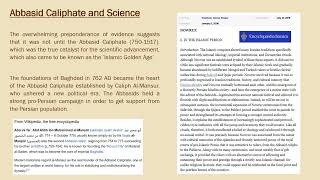 The Golden Age of Islamic
  DEBATE - What is Better for Society, Islam or
  Replace the 'ABRAHAMIC MATRIX' with '
 'Before Israelites Were Canaanites. Why are Zionists so Intolerant?' |