Youtube Description:
UCSD Professor Tom Levy hosts a lively discussion with noted archaeologist and anthropologist William Dever, about the difficulties and rewards of Middle Eastern archaeology. Series: 'Dig This!' [3/2000] [Humanities] [Show ID: 4851]
UCSD Professor Tom Levy hosts a lively discussion with noted archaeologist and anthropologist William Dever, about the difficulties and rewards of Middle Eastern archaeology. Series: 'Dig This!' [3/2000] [Humanities] [Show ID: 4851]
Explore More
 Who is William Dever?
William G. Dever (born 1933, Louisville, Kentucky) is an American archaeologist, specialising in the history of Israel and the Near East in Biblical times. He was Professor of Near Eastern Archaeology and Anthropology at the University of Arizona in
Tucson from 1975 to 2002. Dever is a Distinguished Professor of Near Eastern Archaeology at Lycoming College in Pennsylvania.
 What is Archaeology?
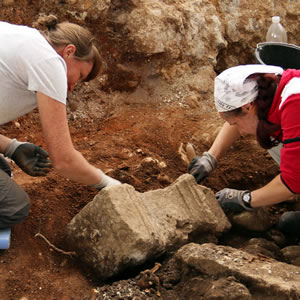
Archaeology or archeology is the study of human activity through the recovery and analysis of material culture. The archaeological record consists of artifacts, architecture, biofacts or ecofacts, sites, and cultural landscapes. Archaeology can be
considered both a social science and a branch of the humanities.
 What is Israel?
Israel, officially the State of Israel, is a country in the Middle East. Located on the southeastern shore of the Mediterranean Sea and the northern shore of the Red Sea. It has land borders with Lebanon to the north, Syria to the northeast, Jordan
on the east, the Palestinian territories of the West Bank and Gaza Strip to the east and west, respectively, and Egypt to the southwest.
 What is Pagan?
Paganism is a term first used in the fourth century by early Christians. It was applied on populations of the Roman Empire who practiced polytheism, either because they were increasingly rural and provincial relative to the Christian population or
because they were not milites Christi (soldiers of Christ). Alternate terms in Christian texts for the same group were hellene, gentile, and heathen. Pagan and paganism were pejorative terms for the same polytheistic group, implying its inferiority. Paganism has broadly connoted the "religion of the peasantry", and for much of its history was a derogatory term. Both during and after the Middle Ages, pagan was a pejorative term that was applied to any non-Abrahamic or unfamiliar religion, and the term presumed a belief in false god(s).
Who is GOD?In monotheism and henotheism, God is conceived as the Supreme Being and principal object of faith. The concept of God as described by theologians commonly includes the attributes of omniscience (infinite knowledge), omnipotence (unlimited power)
omnipresence (present everywhere), omnibenevolence (perfect goodness), divine simplicity, and eternal and necessary existence.
In theism, God is the creator and sustainer of the universe
In deism, God is the creator, but not the sustainer, of the universe
Monotheism is the belief in the existence of one God or in the oneness of God
In pantheism, God is the universe itself
In atheism, God is purported not to exist, while deemed unknown or unknowable within the context of agnosticism.
 Who are TES?