2:14
993 views
·
Last viewed: 3 hrs ago
Uploaded: 17 Dec 2018 (8 years ago) · Shared: 21 Aug 2019
Video Description (from Youtube)
https://trinities.org/blog/podcast-247-kegan-chandler-on-the-term-homoousios/ The famous church historian Eusebius tells us that at the famous 325 council at Nicea, it was the emperor Constantine whosuggested using the word homoousios (variously translated as “consubstantial,” “same esssence,” “same substance”).
Is this plausible? And if so, why would Constantine have done such a thing? What, if anything, in his own religious background would point him towards that term? What was Constantine’s theology, and how might he have understood it?
In this episode Kegan Chandler answers these questions using the latest historical research. He argues that we can go beyond the now widely agreed point that homoousios was employed by this council because it was not then a popular or widely used term, and so it did not have any widely accepted meaning. This enabled the majority of bishops to use the term as a stick with which to drive out Arius and his party, who did not like the term, while various bishops chose to interpret it in various ways, depending on their theological proclivities (e.g. Marcellan neo-monarchianism or Eusebian subordinationism). Whatever the various anti-Arian bishops were thinking, here Chandler ventures an educated guess as to what Constantine was thinking… and it has something to do with Egypt!
Links for this episode @ https://trinities.org/blog/podcast-247-kegan-chandler-on-the-term-homoousios/
The live-streamed version of this lecture.
The God of Jesus in Light of Christian Dogma
his blog Buried Deep
The God of Jesus
@Academia.edu
Rufinus’s corruption of Origen’s On First Principles – Part 1
Rufinus’s corruption of Origen’s On First Principles – Part 2
podcast 30 – The Council of Nicea
podcast 175 – Marcellus of Ancyra
This week’s thinking music is “Again, Once Again” by fluffy.
DISCLAIMER
All videos are shared for educational and information purposes only. All videos are hosted and viewable on Youtube servers. Video titles are generated using the original video title; overall content theme including actual dialogue and speech (Transcript); and A.I-based recommendations with a focus on SEO, keyword density, and internal search functions. The video title does not represent the views held by the Youtube video uploader, or any individual, organisation or business.
If you spot any mistake, omission or give feedback, kindly Contact Us with details
Search Results on 'At Council of Nicaea, Constantine quoted Plato, a Pagan philosopher to justify Homoousios ('same substance') - Kegan Chandler'
SCROLL TO: TOPICS | 6 NEWS | 9 ARTICLES | 9 FAQ | 6 VIDEO | 146 LINKS | 0Topics include Nicaea, Constantine, Pagan, Council of Nicaea, Homoousios, Kegan Chandler (6)
Where is Nicaea?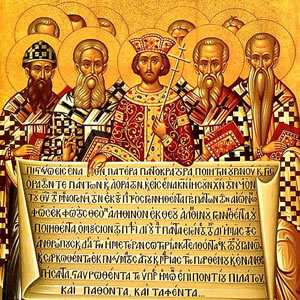 Nicaea or Nicea was an ancient city in northwestern Anatolia. It is primarily known as the site of the First and Second Councils of Nicaea (the first and seventh Ecumenical councils in the early history of the Christian Church), the Nicene Creed (which comes from the First Council), and as the
capital city of the Empire of Nicaea following the Fourth Crusade in 1204, until the recapture of Constantinople by the Byzantines in 1261. |
Who was Constantine? Constantine the Great (27 February 272 AD-22 May 337 AD) was a Roman Emperor who ruled between 306 and 337 AD. Born on the territory now known as Nis, located in Serbia, he was the son of Flavius Valerius Constantius, a Roman Army officer of Illyrian origins. His mother Helena was Greek. His father
became Caesar, the deputy emperor in the west, in 293 AD. Constantine was sent east, where he rose through the ranks to become a military tribune under Emperors Diocletian and Galerius. Constantine was the first Roman emperor to convert to Christianity. Although he lived most of his life as a pagan, he joined the Christian faith on his deathbed, being baptised by Eusebius of Nicomedia. He played an influential role in the proclamation of the Edict of Milan in 313, which declared religious tolerance for Christianity in the Roman empire. He called the First Council of Nicaea in 325 AD that produced the statement of Christian belief known as the Nicene Creed. |
What is Pagan? Paganism is a term first used in the fourth century by early Christians. It was applied on populations of the Roman Empire who practiced polytheism, either because they were increasingly rural and provincial relative to the Christian population or because they were not milites Christi (soldiers of
Christ). Alternate terms in Christian texts for the same group were hellene, gentile, and heathen. Pagan and paganism were pejorative terms for the same polytheistic group, implying its inferiority. Paganism has broadly connoted the "religion of the peasantry", and for much of its history was a derogatory term. Both during and after the Middle Ages, pagan was a pejorative term that was applied to any non-Abrahamic or unfamiliar religion, and the term presumed a belief in false god(s). |
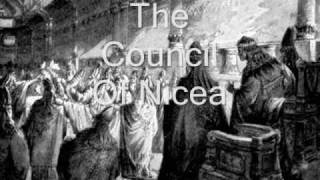
What was the Council of Nicaea?
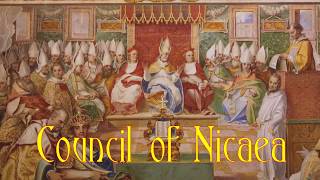
The First Council of Nicaea was a council of Christian bishops convened in the Bithynian city of Nicaea (now ?znik, Bursa province, Turkey) by the Roman Emperor Constantine I in 325 AD. Its main accomplishments were settlement of the Christological issue of the divine nature of God the Son and his
relationship to God the Father, the construction of the first part of the Nicene Creed, establishing uniform observance of the date of Easter, and promulgation of early canon law. |
What is Homoousios?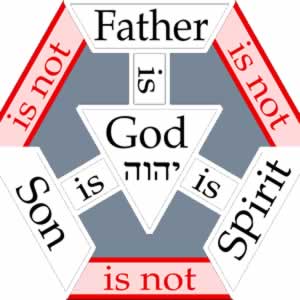 Homoousios or Homoousion ('same in being, same in essence') is a Christian theological term. Homoousios is most notably used in the Nicene Creed in 325 AD, for describing Jesus (God the Son) as "same in being" or "same in essence" with God the Father. The same term was later also applied to the Holy
Spirit in order to designate him as being "same in essence" with the Father and the Son. Those notions became cornerstones of theology in Nicene Christianity, and also represent one of the most important theological concepts within the Trinitarian doctrinal understanding of God. |
Who is Kegan Chandler? Kegan Chandler is a Christian author and researcher of Early Christianity, pagan religion, and Gnosticism. He is an adjunct professor at Atlanta Bible College. Chandler holds a Master of Theology from Campbellsville University's School of Theology, where he studied Church History and Theology, and
is a graduate of SCAD University, where he studied Graeco-Roman drama, medieval literature, and dramatic writing. <br><br> He is the author of the forthcoming book 'Constantine and the Divine Mind' (Wipf and Stock, TBD), and 'The God of Jesus in Light of Christian Dogma' (Restoration Fellowship, 2016). He is also an award-winning screenwriter, and currently writes for his blog on Church history. <br><br> Chandler also sits on the board of directors of the Unitarian Christian Alliance (formed 2019), and New Life Ministries of America, Inc., a small non-profit which has been producing Christian literature and financing overseas missions since 1994. |



 How Christianity Was Invented by Titus Flavius
 At
At  Rome and
 The
The 
 The
The 
 Christianity from Judaism to
 Mithras:
  Arian Controversy and the
  Resurrection was common amongst many
  Serapis Christus, Ptolemy and how
 Christianity Before
 At
At  The Christian Story: Sun God, Horus,
 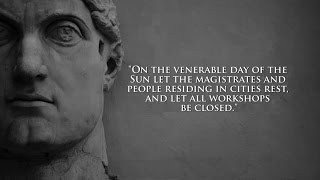 In 321 AD, Emperor
 Halloween: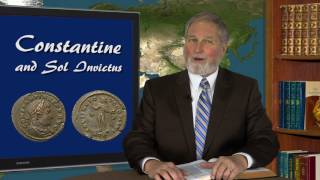
 In 325 AD,
  Early Christianity: Arius, Athanasius and
  Julius Caesar, Romans and
  After the
  Rome:
Rome:  Christianity adopted Graeco-Roman
 Archaeology proves the Israelites worshipped
 The Deception
  Arius, Athanasius &
  Mithraism, like other Ancient Near East
  The Bible is not Scripture. Jesus is modelled on Dying & Rising
  Did the author
  Christmas on 25 December was a
 Origin
 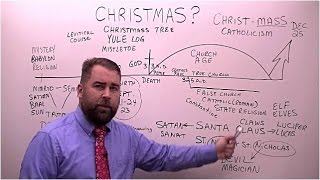 Christmas and
 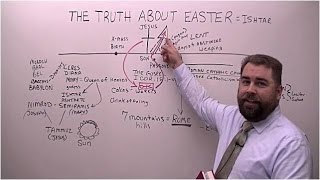 Easter and
  Christianity and its
  Easter Worship is
 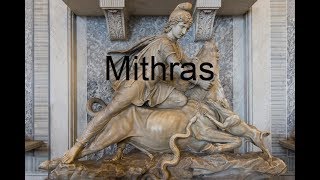 Jesus evolved from Mithras, the Roman
  Did You Know Christmas is
  Mythical Jesus, Catholics and Engineering
  Tertullian (240 AD), first used 'Trinity' to mean 3 distinct persons, influenced by
  Academics acknowledge
  In 325 AD, Trinity became Official Church Doctrine at
  Christian origins in
  Christmas, 25th December was Ancient
 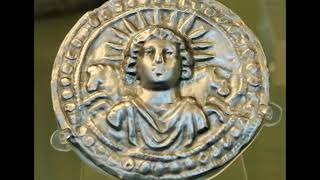 The Christian Church adopted the 'Sun God' Mithras and
  In 601 AD, Pope Gregory I adopted
 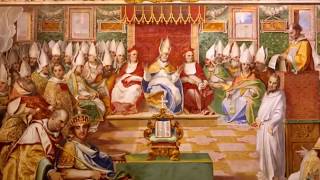 In 325 AD,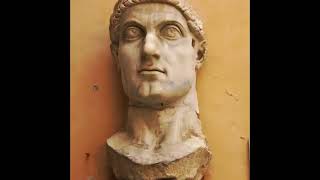
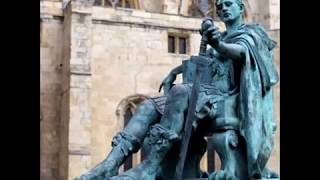 Arguing Bishops at
  Early Christianity developed as a Jewish version
  Emperor
  Emperor
  Christian Gospels are Symbolic Fiction; mythical narratives mined from Jewish texts and
  In 325 AD,
  At
At  After
After  Christianity did not exist until AFTER the
 In 325 AD,
  Did
Did  From 306 AD,
  At
At 
 Nicene Creed (
 Origins
  Easter: A Christian festival or
  Nobody believed Jesus was God, until the
  Christmas, December 25th is under the control
  Jesus Christ: A
  What Happened at the
 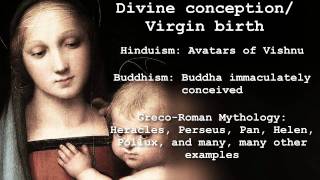 Jesus is too similar to Mythical
  Trinity is 'veiled' Tri-theism (Three Gods). Combining
  The Jesus Story is more
  The Jesus Story is more
  Eusebius, an early Church Father loyal to Philo
  God is One. He moves by Spirit. He creates through Spoken Word (Trinity is from
  Greek Philosophy won at
  Pre-Islam
  Yeshua, Yesous, Iesous, Jesus are not derived from Zeus, the Greek
  Greek philosophy, John's gospel and Philo
  Many Christian rituals have origins in
  The Black Stone and Safa-Marwa 'most likely' originate from pre-Islam,
  In 325 AD, the
  Christianity is primarily based on Gospel


 In 70 AD, Rome destroyed the Jerusalem Church, establishing '
 Virgin Births were common in
 Is the Christmas Tree
  Christianity, a collection
  Pantheon, Roman Temple to the Gods and Idols
  Ancient
  Hajj at Kabah is a
  Christianity is a
  Palestinian Children tortured and sacrificed for a Zionist
  Evolution
  Emperor
  Muslim Leaders promote
  Did Christianity borrow from
  King Cyrus, a