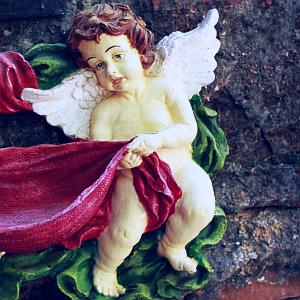
Angels exist in Jewish, Christian and Islamic Scripture
It is believed that God created Angels out of light, before He created humans from earth and clay. Angels are naturally obedient creatures, worshipping God and carrying out His commands. As such, they have no free choice and cannot disobey God.Belief in Angels is one of the six Articles of Faith in Islam. The table below lists a few popular Angels in the Abrahamic religions of Judaism, Christianity and Islam.
1. Angel of Destruction
Apollyon
And they had a king over them, which is the angel of the bottomless pit, whose name in the Hebrew tongue is Abaddon, but in the Greek tongue hath his name Apollyon.
REVELATION 9:11
3. Angel of Death
Azrael
QURAN 32:11
5. Prince of Demons
2 KINGS 1:2
2 KINGS 1:16
It is enough for the disciple that he be as his master, and the servant as his lord. If they have called the master of the house Beelzebub, how much more shall they call them of his household?
MATTHEW 10:25
And the scribes which came down from Jerusalem said, He hath Beelzebub, and by the prince of the devils casteth he out devils.
MARK 3:22
But some of them said, He casteth out devils through Beelzebub the chief of the devils.
LUKE 11:15
8. The Journeyers
9. Angel of Revelation
Jibreel
- Appeared to Daniel as a man and gave him the meaning of a visio
- Appeared to Zechariah who was serving in the temple in order to announce the birth of John the Baptist
- Appeared to Mary, informing her that she would be the mother of Jesus
- In the Quran, God sent Gabriel to Mary, and he came to her in the shape of a man in every respect. God commanded him to blow into a gap of her garment and that breath went into her womb through her private part; this is how Jesus was conceived
- Appeared to Muhammad and taught him the Quran verse by verse
And I heard a man's voice between the banks of Ulai, which called, and said, Gabriel, make this man to understand the vision.DANIEL 8:16Yea, whiles I was speaking in prayer, even the man Gabriel, whom I had seen in the vision at the beginning, being caused to fly swiftly, touched me about the time of the evening oblation.DANIEL 9:21And the angel answering said unto him, I am Gabriel, that stand in the presence of God; and am sent to speak unto thee, and to shew thee these glad tidings.LUKE 1:19And in the sixth month the angel Gabriel was sent from God unto a city of Galilee, named Nazareth,LUKE 1:26QURAN 19:17QURAN 2:97-98QURAN 3:45
10. The Guardian Angels
11. Carriers of The Throne of God (Arsh)
QURAN 40:7
13. Angel of productiveness and profitableness of the Earth
Harut and Marut
QURAN 2:102
14. Angels who helped Muhammad in the battles
15. Honourable Recorders
QURAN 82:11
17. Guardian of Hell
QURAN 43:77
19. Angel of The Military
Mikhail
In Islam, Mikail is often depicted as the archangel of mercy who is responsible for bringing rain and thunder to Earth. He is also responsible for the rewards doled out to good people in this life.
But the prince of the kingdom of Persia withstood me one and twenty days but, lo, Michael, one of the chief princes, came to help me; and I remained there with the kings of Persia.
DANIEL 10:13
And at that time shall Michael stand up, the great prince which standeth for the children of thy people and there shall be a time of trouble, such as never was since there was a nation even to that same time and at that time thy people shall be delivered, every one that shall be found written in the book.
DANIEL 12:1
JUDE 9:1
And there was war in heaven Michael and his angels fought against the dragon; and the dragon fought and his angels, And prevailed not; neither was their place found any more in heaven.
REVELATION 12:7-8
QURAN 2:97-98
20. The Protectors
Angels who keep people from death until its decreed time and who bring down blessings.
QURAN 13:10-11
21. Angels who ask Questions in Grave
Muslims believe the questioning will begin when the funeral and burial is over. Munkar and Nakir will prop the deceased soul upright in the grave and ask three questions:
- Who is your Lord?
- What is your religion?
- Who was this person sent to you (Muhammad)?
QURAN 13:10-11
22. Angel of the Virtues
Israfeel
QURAN 69:13
24. Guardian of Heaven
25. Fallen Angel
Shaitaan
Then saith Jesus unto him, Get thee hence, Satan for it is written, Thou shalt worship the Lord thy God, and him only shalt thou serve.
MATTHEW 4:10
And he was there in the wilderness forty days, tempted of Satan; and was with the wild beasts; and the angels ministered unto him.
MARK 1:13
Then entered Satan into Judas surnamed Iscariot, being of the number of the twelve.
LUKE 22:3
ROMANS 16:20
2 CORINTHIANS 11:14
REVELATIONS 12:9
26. Angel of Death and fetching souls
30. Angels who torment those in Hell
QURAN 66:6
33. Angels of the Seven Heavens
34. Angels who violently pull out the souls of the wicked
QURAN 79:1
35. Angels who gently draw out the souls of the blessed
QURAN 79:2
36. Angels who distribute (provisions, rain, blessings etc.)
QURAN 51:4
37. Angels who drive the clouds
QURAN 37:2
38. Angels who give spirit to the unborn foetus
(Bukhari 1:6:315)
39. Angel of the Mountains
40. Angels accompanying each living thing
41. Angels who praise God
QURAN 21:20
QURAN 41:38
CREDIT
http://carm.org/names-of-angels-in-bible
https://en.wikipedia.org/wiki/List_of_angels_in_theology
https://en.wikipedia.org/wiki/Islamic_view_of_angels
83-angels
| Author: Guest • Updated: 04 Sep 2026 • 32,982 views | 1 hr ago |
Explore More
 What is an Angel?
An angel is generally a supernatural being found in various religions and mythologies. In Abrahamic religions, angels are often depicted as benevolent celestial beings who act as intermediaries between God or Heaven and Humanity. Other roles of angels include protecting and guiding human beings, and
carrying out God's tasks. Within Abrahamic religions, angels are often organized into hierarchies, although such rankings may vary between sects in each religion, and are given specific names or titles, such as Gabriel or 'Destroying angel'.