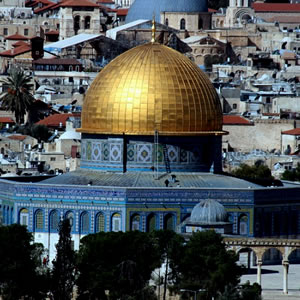
Jeremiah: Classical commentators (including Al-Qurtubi and Ibn Kathir) record that the parable of the man who passed by a city in absolute ruins, wondering "How will God bring this to life after its death?", refers to (Jeremiah) witnessing the devastation of Jerusalem by Babylonian forces.

Centered Image
  Live Screenshot  
Source :   https://quran.com/2/259
0 views  ·  Last view: 57 years ago

Explore More

Where is Jerusalem?
Jerusalem is a city in the Middle East. It is located on a plateau in the Judaean Mountains between the Mediterranean and the Dead Sea. It is one of the oldest cities in the world, and is considered holy to the three major Abrahamic religions: Judaism, Christianity, and Islam. Both Israel and the Palestinian Authority claim Jerusalem as their capital, as Israel maintains its primary governmental institutions there and the State of Palestine ultimately foresees it as its seat of power; however, neither claim is widely recognized internationally.

Where is Babylon?
Babylon was an ancient city located on the lower Euphrates river in southern Mesopotamia, within modern-day Hillah, Iraq. This is about 85 kilometres (53 miles) south of modern-day Baghdad. Babylon functioned as the main cultural and political centre of the Akkadian-speaking region of Babylonia. Its rulers established two important empires in antiquity, the 19th-16th century BC Old Babylonian Empire, and the 7th-6th century BC Neo-Babylonian Empire. Babylon was also used as a regional capital of other empires, such as the Achaemenid Empire. Babylon was one of the most important urban centres of the ancient Near East, until its decline during the Hellenistic period.
Who is GOD?
In monotheism and henotheism, God is conceived as the Supreme Being and principal object of faith. The concept of God as described by theologians commonly includes the attributes of omniscience (infinite knowledge), omnipotence (unlimited power), omnipresence (present everywhere), omnibenevolence (perfect goodness), divine simplicity, and eternal and necessary existence. In theism, God is the creator and sustainer of the universe In deism, God is the creator, but not the sustainer, of the universe Monotheism is the belief in the existence of one God or in the oneness of God In pantheism, God is the universe itself In atheism, God is purported not to exist, while deemed unknown or unknowable within the context of agnosticism.
What is Sin?
In Abrahamic contexts, sin is the act of violating God's will. Sin can also be viewed as anything that violates the ideal relationship between an individual and God; or as any diversion from the ideal order for human living. To sin has been defined as "to miss the mark". Sins fall in a spectrum from minor errors to deadly misdeeds. Catholicism regards the least corrupt sins as venial sins which are part of human living and carry immediate consequences on earth, and, if unrepented for, more painful purgation, assuming the person is destined to heaven, as it is written in the formation letter "Purgatory", "most of the early Fathers of the Church speak of a cleansing fire, though we cannot tell whether this means actual or spiritual fire." Conversely, sins of great evil are mortal sins which bring the consequence of hell if they are not addressed either through an act of perfect contrition or going to confession about them.

Who are FT?


SUBSCRIBE

Receive the latest news and updates by email - Subscribe Now!
About  |  Q&A  |  Contact Us    •    Terms  |  Privacy  |  Disclaimer  |  Sitemap
Connect:      Facebook  |    Twitter  |    Youtube
MuslimProphets.com is an educational website on the Prophets of God: David, Noah, Abraham, Moses, Jesus and Muhammad, who established the Abrahamic faiths of Judaism, Christianity and Islam.

MuslimProphets.com explores contemporary social themes through Scripture, Evidences, Photo, Video, Maps, Current Affairs, Debate and 'alternative' Views held by Theologians, Apologists, Scholars and Street Preachers.

In accordance with Islamic etiquette, all prophet names should be followed with 'Peace Be Upon Him (PBUH)'. This is omitted to minimise text.

DISCLAIMER
The historical information provided on this website is for educational and informational purposes only.
History is an ongoing interpretation of past events. Historical accounts are shaped by the perspectives, biases, and cultural influences of their time; therefore, no content on this website should be taken as absolute, 100% factual truth. We encourage readers to approach historical narratives with a critical mind.

All website content is available in the public domain. While all information is gathered from sources believed to be reliable, its absolute accuracy cannot be guaranteed.

EXTERNAL LINKS & SEO
External links are provided as a convenience and for informational purposes only. They do not constitute an endorsement or approval of any products, services, or opinions of any organization or individual. Title and text links may be edited for external SEO, internal site structure, and keyword search purposes. We bear no responsibility for the accuracy, legality, or content found on any external website or its subsequent links.

MEDIA & SOURCE ATTRIBUTIONS
Unless otherwise indicated, all images and content are licensed under a Creative Commons Attribution License distributed by Wikipedia, Wikimedia Commons, Pixabay, Unsplash, and similar platforms. While every effort is made to accurately source all media, contact us if you believe your copyright has been infringed so we can address and resolve the matter promptly.

All videos are hosted on and viewable via YouTube servers. Video titles are generated based on the original video title, the overall content theme (including actual dialogue and transcripts), and AI-based recommendations optimized for SEO, keyword density, and internal search functions. Video titles do not represent the views held by the YouTube video uploader, or any associated individual, organisation, or business.

All Torah, Psalms, and Old/New Testament Bible quotes are from the King James Version (KJV) Holy Bible, which is in the public domain.
All Quran quotes are from the Taqi-ud-Din al-Hilali / Muhsin Khan English Quran translation.

CORRECTIONS
If you spot a mistake, error, or omission of information, please contact us so we can review and correct it.