ISLAM EARLY ISLAM MUSLIM
What is Early Islam?
Frequently Asked Questions (1) | Early Islam
1.What is Islam?
Islam translates to submission and full surrender to God. Under this core definition, all historical prophets sent to humanity are considered Islamic prophets. This extensive list features prominent figures such as Adam, Abraham, Noah, Moses, David, Jesus, and Muhammad.
2.Who is a Muslim?
A Muslim is a dedicated follower of the religion of Islam. This theological path is defined as a monotheistic Abrahamic faith revealed through the final prophet, Muhammad.
3.Were all Prophets Muslim?
Yes, because they all consistently preached the worship of one absolute God and prohibited the worship of false deities.
4.Do Muslims believe in Prophets?
A Muslim is strictly required to believe in, honour, and respect each and every prophet sent by God without exception.
5.Why choose the name MuslimProphets.com?
The name reflects that all prophets taught monotheism and the worship of one God, making them all "in-essence" considered Muslim.
6.Does Islam promote extremism, terrorism and violence?
No, the platform maintains that Islam is a religion of peace and tolerance, aligning with the message of all prophets.
7.Where can I learn more about Islam?
Various online sources are available.
8.Do Muslims believe in the Bible?
Muslims believe that God originally revealed the Gospel to Jesus as a source of guidance, light, and instruction, as confirmed in Quran 5:46.
9.What is the basic teaching of Islam?
The basic teaching is to make peace with God, which requires a person to submit to Him and obey His commands completely.
10.How did Islam come into the world?
In its present form, Islam was introduced 1,400 years ago in Arabia through the teachings of Prophet Muhammad. However, its core principles were not a new creation, as the exact same foundation was previously preached by Abraham, Moses, Jesus, and every ancient prophet.
11.If all prophets taught Islam, what was so different about Muhammad?
Over time, previous teachings had been altered or lost, so Muhammad was sent as the final prophet to restore, update, and unify the foundational principles of faith into a complete religion.
12.What do I have to do to become a Muslim?
One becomes a Muslim by publicly declaring the shahada, or testimony of faith, acknowledging there is no god but Allah and Muhammad is His messenger.
13.What do Muslims believe?
Core beliefs involve five main aspects: the perfection of God, the role of angels, accepting all prophets and their revelations, and the reality of life after death and its consequences.
14.What is the most important point Islam teaches about belief?
15.What is the basic teaching of Islam about God?
Islam teaches the existence of one, unique Creator who controls the entire universe, possesses absolute power, and is the sole recipient of worship.
16.Does Islam give any arguments to prove the existence of God?
The Quran offers three distinct arguments: the flawless order, beauty, and laws of nature; the innate human instinct to call upon a higher power during hardships; and the historical presence of prophets who proved God's reality through their exemplary lives and miracles.
17.Other religions also teach the existence of God. Is there any difference between their teaching and the Islamic concept of God?
Islam emphasizes absolute oneness, rejecting the idea that any entity can share divinity, that God has limitations, or that any human could be an incarnation of God.
18.Which prophets do Muslims have to believe in?
Muslims are strictly required to maintain belief in every single prophet and messenger sent by God. This belief must be completely equal, meaning no distinctions or hierarchies of validity are made between them. This universal recognition applies regardless of the specific country or historical era in which they appeared.
19.Since Muslims believe in all the Prophets equally, why is Muhammad special?
According to muslim tradition, previous messengers were given temporary teachings limited to their specific nations, whereas Muhammad was sent to unite humanity globally with a perfect, everlasting religion for all time.
20.Do Muslims believe in scripture other than their own Quran?
Muslims believe that previous scriptures given to Moses, David, and Jesus contain elements of truth, but they maintain that the Quran is the final revelation from God and takes absolute precedence.
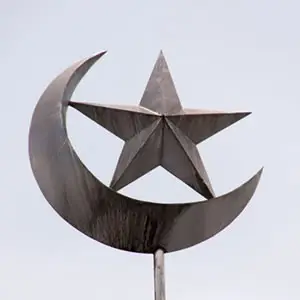
21.Is the Star and Crescent a symbol of Islam?
The crescent is not an original symbol of Islam, but rather a political symbol of the Ottoman Empire, which adopted the lunar calendar and placed the icon on flags and mosques during its rule.
22.How are Noah, Abraham, Moses and Jesus considered Muslim Prophets, when Islam came 600-years after Jesus?
A Muslim is essentially defined as anyone who believes in and submits to one God; because all of these historical prophets consistently preached the message of pure Monotheism and called people to worship the Creator alone, they are considered to be Muslim in-essence regarding their foundational theological beliefs.
23.Can Muslims eat swine and pork?
No, the consumption of pork, bacon, and ham is strictly prohibited by divine law, matching historical restrictions found in the Old Testament followed by Jews and certain Christian groups.
24.Do Muslims believe in a God?
Yes, Muslims believe in Allah as the all-powerful, eternal Creator who is separate from creation, has no partners, no gender, and is the absolute sole entity worthy of human worship.
25.In Islam, can God become a Man?
No, Islamic theology strictly rejects the concept of divine incarnation (Hulul). Islam teaches that God is completely transcendent, unchangeable, and separate from his creation, making it a logical contradiction for the infinite Creator to assume finite human attributes.
26.Does the Quran encourage violence against the disbelievers (non-Muslims)?
Academic Islamic scholarship clarifies that verses in the Quran addressing warfare against non-Muslims were historically revealed during active, state-level conflicts with the pagan tribes of Mecca and their military allies. Mainstream historians emphasize that these specific martial passages must be read within their situational context of self-defence and treaty violations, rather than as an open-ended command to attack peaceful non-Muslims.
27.Does Islam encourage violence?
From an objective theological perspective, standard Islamic jurisprudence explicitly prohibits unprovoked violence, aggression, and the targeting of civilians, defining warfare strictly under defensive parameters. While fringe extremist groups frequently misinterpret isolated text to justify modern terrorism, mainstream Islamic law actively prioritizes peace, diplomacy, and the protection of religious minorities.
28.Why should non-Muslims pay the Jizya (tax)?
In classical Islamic law, the Jizya was a poll tax levied annually on adult, able-bodied non-Muslim male subjects (Dhimmi) living under an Islamic state. Historically, this tax served a dual purpose: it exempted non-Muslims from mandatory military service (which was required of Muslims) and acted as a financial contribution for state-provided security and the protection of their property, life, and religious freedom.
29.Are Muslims told to kill polytheists in the Quran?
Academic, context-based interpretations of the Quran indicate that verses regarding fighting (e.g., 9:5, 2:190) are historically situated within specific conflicts or treaty breaches rather than universal commands, emphasizing that the text generally prohibits indiscriminate violence, defends the sanctity of life (5:32), and allows for positive relations with peaceful non-Muslims (60:8).
30.Can the Muslims have non-Muslim friends?
31.Does the Quran encourage Muslims to kill non-Muslims?
32.Why should non-Muslims pay a Jizyah tax?
Historically, the Jizya functioned as a protection tax, exempting non-Muslim subjects (dhimmi) from military service in exchange for state security, as established in the legal frameworks of early Islamic states.
33.Can the Muslims be harsh to non-Muslims?
Mainstream Islamic scholarship and textual analysis indicate that passages mentioning sternness or fighting (such as Surah At-Tawbah 9:123) specifically target active combatants, political subversives, and hypocrites who worked internally to destabilise the community from within. Objective historians emphasize that these verses do not prescribe a universal template for daily interactions, which are otherwise commanded to be characterized by justice, kindness, and respectful coexistence.
34.Does the Quran encourage ill-treatment of non-Muslims?
No, orthodox Islamic theology strictly prohibits the unprovoked abuse, exploitation, or mistreatment of peaceful non-Muslims, explicitly warning in the Hadith literature that anyone who oppresses a religious minority will face divine complaints from the Prophet himself on the Day of Judgment. Scriptural texts command Muslims to uphold agreements, demonstrate broad compassion to all of creation, and engage in respectful theological dialogue.
35.Why do Muslims say non-Muslims will go to Hell?
In Islamic soteriology, the ultimate destination of any human soul is believed to rest exclusively with the judgment of God, who balances absolute justice with infinite mercy. While standard Islamic theology asserts that intentionally rejecting monotheism and the finality of Prophet Muhammad after clearly understanding the message leads to spiritual loss in the afterlife, the Quran explicitly states that individuals will only be held accountable based on their unique capacity, opportunities, and exposure to the truth, meaning no person can definitively declare the eternal fate of another.
36.Why do Muslims sacrifice livestock (goat, sheep, cow etc.) on Eid Al-Adha?
This annual global ritual commemorates the absolute devotion of Abraham, who was commanded by God in a vision to offer his eldest son as a sacrifice. Mainstream Islamic tradition identifies this son as Ishmael, noting that when Abraham demonstrated his complete willingness to obey, God miraculously substituted a ram in the boy's place. The meat from the sacrificed livestock is systematically divided into three equal parts to be shared with family, neighbors, and the impoverished.
Video on Early Islam (16)
VIDEO OPTIONS: Latest Uploads Watching Now Popular Least Views
 53:10
53:10
392
1490659200
1787035888
Early Islamic Civilizations - Adnan Rashid vs Sceptic
003190
1
 21:16
21:16
289
1501545600
1787035786
Jews in the Early Islamic Period (7-10th Century) - Henry Abramson
001276
2

520
1619471032
1787036204
Early Islam was influenced by Sabians on Worship, Ramadan and Hajj pilgrimage | Tony Costa | DCCI
006157
3
 1:48
1:48
732
1744073039
1786988190
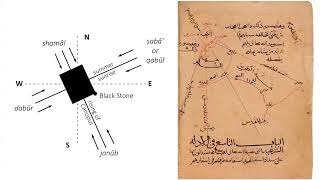
Kabah in The Early Islamic Period | Sean Anthony
000108
4
 43:29
43:29
588
1749561935
1786571906
Conflicting Views on Early Islamic History | Usuli Institute
002609
5
 1:54:04
632
1755735316
1786971969
Believer (Mumin) vs Submitter (Muslim) - Early Islam was Inclusive, Multi-Faith Community of Jews, Christians, and Believers | Javad Hashmi
006844
6
 23:50
23:50
172
1770947281
1787036258
Chronology of Early Islam was constructed by Abbasid Astrologers | Antoine Borrut | Medieval Institute
001430
7
 46:36
46:36
255
1774232553
1786610592
Evolution of Early Islam, 'Believers' and Perennialism under Caliph Abd al-Malik (d.705 AD) | Lets Talk Religion
002796
8
 18:10
18:10
1388
1776117199
1786911976
Early Islamic History Is Controversial | Al-Muqaddimah
001090
9
 34:14
34:14
180
1778083262
1786905069
Muhammad's Night Journey and Early Islam's Jerusalem connection | Gabriel Reynolds
002054
10
 45:30
45:30
919
1778084927
1786987367
Early Islam focused on GOD, not Muhammad or The Quran | Fred Donner
002730
11
 1:14:16
212
1778352441
1787068401
Rome-Persia War (602-628 AD) set the context for Early Islam to emerge in Arabia | James Howard-Johnston | MythVision
004456
12
 2:02:28
279
1782176189
1786946376
Did Early Islam emerge from Petra or Mecca? | Peter Von Sivers | MythVision
007348
13
 45:57
45:57
129
1784594649
1787016229
Criticisms of Early Islam and Christianity | Gabriel Reynolds
002757
14
 1:02:42
72
1785165750
1787070445
Influence of Christan Sects over Early Islam in Arabia, 600 AD | Peter Von Sivers | BYU Kennedy Center
003762
15
 36:17
36:17
88
1785252233
1786976241
History of Early Islam and the Umayyad Caliphate (661-750 AD) | Mustafa Kaya
002177
16