844 views
·
Last viewed: 17 hrs ago
Uploaded: 19 Oct 2021 (5 years ago) · Shared: 13 Jun 2025
Duration: 1:58:18
Uploaded: 19 Oct 2021 (5 years ago) · Shared: 13 Jun 2025
Duration: 1:58:18
Youtube Description
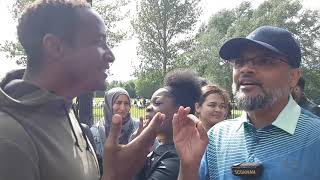
This is a must watch show for anyone interested in getting to the bottom of the Historical Muhammad question. His book is a gold mine of informationabout the earliest history of Islam.
In Muhammad and the Empires of Faith, Sean W. Anthony demonstrates how critical readings of non-Muslim and Muslim sources in tandem can breathe new life into the historical study of Muhammad and how his message transformed the world. By placing these sources within the intellectual and cultural world of Late Antiquity, Anthony offers a fresh assessment of the earliest sources for Muhammad’s life, taking readers on a grand tour of the available evidence, and suggests what new insights stand to be gained from the techniques and methods pioneered by countless scholars over the decades in a variety of fields. Muhammad and the Empires of Faith offers both an authoritative introduction to the multilayered traditions surrounding the life of Muhammad and a compelling exploration of how these traditions interacted with the broader landscape of Late Antiquity.
GET THE BOOK HERE: 👉 https://amzn.to/35FqNYf
=================================
MythVision Website: 🔥 https://mythvisionpodcast.com/
MythVision Patreon 👉 https://www.patreon.com/mythvision
MythVision Paypal. 👉 https://www.paypal.me/dereklambert7
Cashapp: 👉 $rewiredaddiction
Venmo: 👉 @Derek-Lambert-9
Recommeded books 👉 https://amzn.to/35FqNYf
Email MythVision 👉 mythvisionpodcast@gmail.com
Facebook page: 👉 https://www.facebook.com/MythVision/
Facebook group: 👉 https://www.facebook.com/groups/TheWaterBoyZRadio/
Twitter: 👉 @DerekPodcast
Instagram: 👉 @dereklambert_7
MythVision Discord: https://discord.gg/dRQXdZBq6E
0:00 Introductions
4:08 Was there a Muhammad?
7:08 Non-Muslim sources that speak to the existence of a historical Muhammad.
18:40 Evidence of Muhammad’s existence from the Arabic side - the Hijri calendar and Muhammad’s Hijra to Medina.
27:30 Was there an eschatological motivation in the Arab conquest? Apocalyptic literature in the 7th century.
33:58 The compilation of the Quran, how early was the Quran compiled?
41:43 Is the Quran preserved word for word?
44:50 Doctrina Jacobi
53:22 Jesus in the Quran - ‘Isa’, the hostility towards the iconography of the cross in the early Muslim communities.
1:03:42 How did the hadith corpus develop?
1:13:53 Was Muhammad a shepherd or a merchant?
1:20:20 Traditions and legends common to all Abrahamic religions, the Kaaba.
1:28:04 The origins of the name ‘Allah’
1:33:45 The Petra theory, Dhul al-Qarnayn/ Alexander the Great
1:38:20 The sleepers of Ephesus.
1:40:24 Apocalypticism in the Quran
1:47:40 Dr. Sean Anthony’s hopes for the future of scholarship of Islam and the Muslim community in general.
1:55:20 Final remarks.
#MythVision #Muhammad #SeanWAnthony #Islam
Explore More
Search Google Search Explore Topics Sean Anthony MythVision Prophet Islam Who is Sean Anthony?
Sean W. Anthony is a historian of early Islamic history and Arabic literature. After receiving his doctorate from the University of Chicago in 2009, Anthony taught at the University of Oregon (Eugene) and the Ohio State University, where he is currently professor of Near Eastern Languages and Cultures.
 Who is MythVision?
MythVision Podcast (MVP) brings you some of the finest information surrounding Mythology. Knowledge from a variety of people in search of a better understanding of ancient text. We discuss mythology, syncretism, astrotheology, gematria, sacred geometry, secret societies, ancient languages, history, prophecy, scholarship, conspiracies, heretical ideas, myth interpretations and much more.
 What is a Prophet?
In religion, a prophet is an individual who is regarded as being in contact with a divine being and is said to speak on that entity's behalf. They claim to be serving as an intermediary with humanity by delivering messages or teachings from the supernatural source to other people. The message that the prophet conveys is called a prophecy. In Islam, all prophetic messengers are prophets (such as Adam, Noah, Abraham, Moses, Jesus, and Muhammad) though not all prophets are prophetic messengers. The primary distinction is that a prophet is required to demonstrate God's law through his actions, character, and behavior without necessarily calling people to follow him, while a prophetic messenger is required to pronounce God's law (i.e. revelation) and call his people to submit and follow him.
 What is Islam?
One of the major religions of the world, Islam literally translates to "submission," as a follower of Islam (Muslims) devotes their life to that of their God. The religion began with the teachings of Muhammad in the 7th century. The theology of Islam is based on the Qur'an, which was given to Muhammad by God. Some of the major fundamental principles of Islam include the Five Pillars, which hope to unite all Muslims into a community. Two different factions of Muslims exist - the majority are known as Sunni, with a small percentage known as Shi'a - both predominantly reside throughout the Middle East. Muhammad died in 632 AD and the religion of Islam formally started after his death. The Quran was formally compiled and finalised in 650 AD, prior to which it was 'memorised' and written across many parchments.