729 views
·
Last viewed: 5 days ago
Uploaded: 27 Jun 2018 (8 years ago) · Shared: 04 Jan 2019
Duration: 18:25
Uploaded: 27 Jun 2018 (8 years ago) · Shared: 04 Jan 2019
Duration: 18:25
Youtube Description
From ancient aliens to grand conspiracies, there is a lot of bad history out there. It seems this is becoming more and more prevalent within thecircles I'm ostensibly in. So this video will be addressing some of the bad history I've been seeing. Evidently, there are many people who think Jesus was invented at the council of Nicaea or that the council decided on the final state of the biblical canon. Both of these things are false. One would have to pass over a lot of history to make these claims. The first council of Nicaea in 325 was definitely a defining moment in the history of Christianity, but not in the way some people may think. So today, I will be exploring what really happened at the council of Nicaea.
Make sure to like and Subscribe!
Follow us on Facebook to see what we're up to: https://www.facebook.com/AtheistCommunityOfMilwaukee/
Follow us on Twitter: https://twitter.com/MKEAtheists
Support us on Patreon: https://www.patreon.com/MKEAtheists
Check out our new website: https://www.MilwaukeeAtheists.com
Milwaukee Atheists Official Merchandise: https://teespring.com/stores/milwaukee-atheists
Sources:
Lee Martin McDonald - The Biblical Canon
Philip Jenkins - Jesus Wars
Bart Ehrman - Lost Christianities
Bart Ehrman - The Triumph of Christianity
Burton L. Mack - Who Wrote The New Testament?
Diarmaid MacCulloch - Christianity: The First Three Thousand Years
Aloys Grillmeier - Christ in Christian Tradition V.1
Leo Donald Davis - The First Seven Ecumenical Councils
William G. Rusch - The Trinitarian Controversy
20 Canons of Nicaea: http://www.newadvent.org/fathers/3801.htm
Explore More
Council of Nicaea Atheism NicaeaSearch Google Search Explore Topics
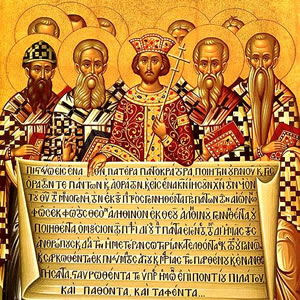 What was the Council of Nicaea?
The First Council of Nicaea was a council of Christian bishops convened in the Bithynian city of Nicaea (now ?znik, Bursa province, Turkey) by the Roman Emperor Constantine I in 325 AD. Its main accomplishments were settlement of the Christological issue of the divine nature of God the Son and his relationship to God the Father, the construction of the first part of the Nicene Creed, establishing uniform observance of the date of Easter, and promulgation of early canon law.
 What is Atheism?
Atheism is, in the broadest sense, the absence of belief in the existence of deities. Less broadly, atheism is the rejection of belief that any deities exist. In an even narrower sense, atheism is specifically the position that there are no deities. Atheism is contrasted with theism, which, in its most general form, is the belief that at least one deity exists.
Where is Nicaea?Nicaea or Nicea was an ancient city in northwestern Anatolia. It is primarily known as the site of the First and Second Councils of Nicaea (the first and seventh Ecumenical councils in the early history of the Christian Church), the Nicene Creed (which comes from the First Council), and as the capital city of the Empire of Nicaea following the Fourth Crusade in 1204, until the recapture of Constantinople by the Byzantines in 1261.