771 views
·
Last viewed: 15 hrs ago
Uploaded: 13 Oct 2011 (15 years ago) · Shared: 10 Oct 2018
Duration: 9:28
Uploaded: 13 Oct 2011 (15 years ago) · Shared: 10 Oct 2018
Duration: 9:28
Youtube Description
For more on the Pagan Roots of Easter, see: http://truthbeknown.com/easter.htm Acharya S is a scholar classically educated in archaeology, historymythology and languages. Acharya specializes in religion and mythology, critiquing and comparing them, and providing unique insights into their origins. Although born into a Christian (Congregationalist Protestant) family, Acharya does not subscribe to any particular religion, nor is she a hardcore 'atheist.'
Acharya is the author of the controversial books 'The Christ Conspiracy: The Greatest Story Ever Sold'; 'Suns of God: Krishna, Buddha and Christ Unveiled'; 'Who Was Jesus? Fingerprints of The Christ'; and 'Christ in Egypt: The Horus-Jesus Connection.' Among other less flattering things, Acharya S has been called 'the ranking religious philosopher of our era' and 'the voice of reason amidst global chaos.' Her web site contains a wealth of information about: religion spirituality mythology archaeology history astrotheology archaeoastronomy ...
http://www.StellarHousePublishing.com
http://www.freethoughtnation.com
http://www.TruthBeKnown.com
Explore More
Search Google Search Explore Topics DM Murdock Easter Pagan Who is DM Murdock? (MEMBER OF Truth Be Known)
Dorothy Milne Murdock (or DM Murdock) (March 27, 1960-December 25, 2015) was an American writer. She supported the Christ myth theory, the theory according to which Jesus never existed as a historical person and was rather a figure fabricated by commingling the mythologies of various pre-Christian Sun deities and dying-and-rising deities. Murdock received a Bachelor of Liberal Arts degree in Classics, Greek Civilization, from Franklin and Marshall College, after which she spent a year at the American School of Classical Studies at Athens, Greece.
 What is Easter?
Easter, or Resurrection Sunday is a festival and holiday celebrating the resurrection of Jesus from the dead. This event is described in the New Testament as having occurred on the third day of his burial after his crucifixion by the Romans at Calvary c. 30 AD. It is the culmination of the Passion of Jesus, preceded by Lent (or Great Lent), a forty-day period of fasting, prayer, and penance. Easter customs vary across the Christian world, and include sunrise services, exclaiming the Paschal greeting, clipping the church, and decorating Easter eggs (symbols of the empty tomb). The Easter lily, a symbol of the resurrection, traditionally decorates the chancel area of churches on this day and for the rest of Eastertide. Additional customs that have become associated with Easter and are observed by both Christians and some non-Christians include egg hunting, the Easter Bunny, and Easter parades.
 What is Pagan?
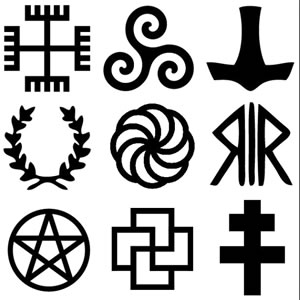
Paganism is a term first used in the fourth century by early Christians. It was applied on populations of the Roman Empire who practiced polytheism, either because they were increasingly rural and provincial relative to the Christian population or because they were not milites Christi (soldiers of Christ). Alternate terms in Christian texts for the same group were hellene, gentile, and heathen. Pagan and paganism were pejorative terms for the same polytheistic group, implying its inferiority. Paganism has broadly connoted the "religion of the peasantry", and for much of its history was a derogatory term. Both during and after the Middle Ages, pagan was a pejorative term that was applied to any non-Abrahamic or unfamiliar religion, and the term presumed a belief in false god(s).