497 views
·
Last viewed: 1 day ago
Uploaded: 08 Jul 2012 (14 years ago) · Shared: 05 Dec 2017
Duration: 1:13:09
Uploaded: 08 Jul 2012 (14 years ago) · Shared: 05 Dec 2017
Duration: 1:13:09
Youtube Description
'I am one priest and bishop in the church who is no longer willing to read [the Bible] through stained glass lenses,' Bishop John Shelby Spong saidThat might as well be the man's mantra, and this lecture exemplifies why. Spong's idea of 'reclaiming the Bible' refers to putting its words into context and highlighting its inconsistencies. In this lecture, he does so by tracing some biblical 'facts' and addressing their validity.
Read Mary Desmond's recap for The Chautauquan Daily here: http://chqny.in/LA3wNw.
Explore More
Judeo-Christian John Spong The BibleSearch Google Search Explore Topics
 What is Judeo-Christian?
Judeo-Christian is used to group Christianity and Judaism together. This is either in reference to a shared history before Christianity split from Judaism, Christianity's recognition of Jewish scripture (constituting the Old Testament of the Christian Bible), or values supposed to be shared between them. The term Judeo-Christian first appeared in the 19th century as a word for Jewish converts to Christianity. In the United States, the term was widely used during the Cold War in an attempt to invoke a unified American identity that stood opposed to communism. The term has received criticism, largely from Jewish thinkers, as relying on supersessionism, which is not a tenet of Judaism, as well as glossing over fundamental differences between Jewish and Christian thought, theology, culture and practice. Even using the more inclusive term "Abrahamic religions" to refer to the common grouping of faiths which are attributed to Abraham - Islam, the Bahai Faith, Samaritanism, Druzism, and other faiths (in addition to Judaism and Christianity) is sometimes seen as problematic.
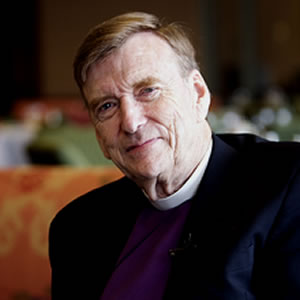 Who is John Spong?
John Shelby "Jack" Spong (born 1931) is a retired American bishop of the Episcopal Church. From 1979 to 2000 he was Bishop of Newark. He is a liberal Christian theologian, religion commentator and author. He calls for a fundamental rethinking of Christian belief away from theism and traditional doctrines. Spong attended the University of North Carolina at Chapel Hill, where he was elected to the Phi Beta Kappa honor society and graduated with a Bachelor of Arts degree in 1952. He received his Master of Divinity degree from the Virginia Theological Seminary in 1955. He has had honorary Doctor of Divinity degrees conferred on him by Virginia Theological Seminary and Saint Paul's College, Virginia, as well as an honorary Doctor of Humane Letters conferred by Muhlenberg College in Pennsylvania. Spong has also been a strong proponent of the church reflecting the changes in society at large. Towards these ends, he calls for a new Reformation, in which many of Christianity's basic doctrines should be reformulated.
What is The Bible?The Bible is a canonical collection of texts sacred in Judaism and Christianity. There is no single "Bible" and many Bibles with varying contents exist. The term Bible is shared between Judaism and Christianity, although the contents of each of their collections of canonical texts is not the same. Different religious groups include different books within their Biblical canons, in different orders, and sometimes divide or combine books, or incorporate additional material into canonical books. The Hebrew Bible, or Tanakh, contains 24 books. Christian Bibles range from the 66 books of the Protestant canon to the 81 books of the Ethiopian Orthodox Church canon. The first part of Christian Bibles is the Old Testament, which contains, at minimum, the 24 books of the Hebrew Bible divided into 39 books and ordered differently from the Hebrew Bible. The Catholic Church and Eastern Christian churches also hold certain deuterocanonical books and passages to be part of the Old Testament canon. The second part is the New Testament, containing 27 books: the 4 Canonical gospels, Acts of the Apostles, 21 Epistles or didactic letters, and the Book of Revelation.