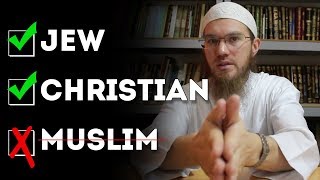
Uploaded: 17 Sep 2017 (9 years ago) · Shared: 01 Oct 2017
Duration: 23:54
Video Description
In the video titled "Jewish view of the Prophet Jesus ' Resurrection Myth - Peleh Ben Avraham," Peleh Ben Avraham offers a compelling exploration of the Jewish perspective on one of Christianity's most central tenets. This insightful discussion delves into the early history and theological interpretations that shape Jewish and Christian beliefs. By examining the Torah and the Bible, Peleh provides a nuanced understanding of the resurrection narrative, offering spiritual reminders and fostering interfaith dialogue. This video is a must-watch for anyone seeking a deeper understanding of the intersection between Judaism, Christianity, and the historical context of religious texts. Whether you are a follower of Islam, Judaism, Christianity, or any other faith, this engaging content will enrich your knowledge and promote mutual respect.
Explore More
Search Google Search Explore Topics Peleh Ben Avraham Resurrection Jewish Myth Who is Peleh Ben Avraham?
Teacher of Karaite Judaism Hakham. Israelite, Married, Children
 What is Resurrection?
Resurrection is the concept of coming back to life after death. In a number of ancient religions, a dying-and-rising god is a deity which dies and resurrects. The death and resurrection of Jesus, an example of resurrection, is the central focus of Christianity. As a religious concept, it is used in two distinct respects: a belief in the resurrection of individual souls that is current and ongoing (Christian idealism, realized eschatology), or else a belief in a singular resurrection of the dead at the end of the world. The resurrection of the dead is a standard eschatological belief in the Abrahamic religions.
 What is Jewish?
Judaism encompasses the religion, philosophy, culture and way of life of the Jewish people. Judaism is a monotheistic religion, with the Torah as its foundational text (part of the larger text known as the Tanakh or Hebrew Bible), and supplemental oral tradition represented by later texts such as the Midrash and the Talmud. Judaism is considered by religious Jews to be the expression of the covenantal relationship that God established with the Children of Israel. Judaism includes a wide corpus of texts, practices, theological positions, and forms of organization. Within Judaism there are a variety of movements, most of which emerged from Rabbinic Judaism, which holds that God revealed his laws and commandments to Moses on Mount Sinai in the form of both the Written and Oral Torah. The Jews are an ethnoreligious group and include those born Jewish and converts to Judaism. In 2012, the world Jewish population was estimated at about 14 million, or roughly 0.2% of the total world population. About 42% of all Jews reside in Israel and about 42% reside in the United States and Canada, with most of the remainder living in Europe.
What is Myth?Mythology refers to a collection of sacred, traditional tales from a specific culture that explain natural phenomena, world origins, and cultural values. This often featuring gods, goddesses, and heroes. It serves as a lens for interpreting shared human experiences through stories, rituals, and art. Myth is a genre of folklore consisting primarily of narratives that play a fundamental role in a society. For scholars, this is totally different from the ordinary sense of the term myth, meaning a belief that is not true, as the veracity of a piece of folklore is entirely irrelevant to determining whether it constitutes a myth. Myths are often endorsed by religious and secular authorities, and may be natural or supernatural in character. Many societies group their myths, legends, and history together, considering myths and legends to be factual accounts of their remote past. In particular, creation myths take place in a primordial age when the world had not achieved its later form. Origin myths explain how a society's customs, institutions, and taboos were established and sanctified. National myths are narratives about a nation's past that symbolize the nation's values. There is a complex relationship between recital of myths and the enactment of rituals.