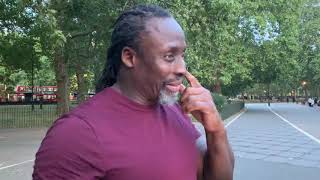
For popularity, Christianity required less work, more faith. Everyone and every Sin was forgiven - EP Sanders

Video Description:

In this insightful video, EP Sanders explores the historical and theological dynamics that shaped Christianity's growth, highlighting how it emphasized faith over rigorous practices, making it more accessible to a broader audience. Sanders delves into the early history of Christianity, discussing how the message of universal forgiveness and the promise of salvation resonated deeply with people, fostering widespread acceptance. This analysis offers valuable insights for followers of Christianity, Judaism, and Islam, encouraging a deeper understanding of the spiritual and cultural contexts that influenced these faiths. Whether you're interested in the Bible, the Quran, or the Torah, this video provides a thoughtful examination of religious evolution and the role of faith in shaping religious practices.

687 views  ·  Last viewed: 23 hrs ago
Uploaded: 06 Jan 2009   (18 years ago)  ·  Shared: 01 Aug 2017
Duration: 8:54

Explore More

What is Christianity?
Christianity is a global religion centered on the life and teachings of Jesus Christ, who followers believe is the Son of God. It's a monotheistic faith, meaning Christians believe in one God who exists in three co-equal persons: God the Father, God

the Son (Jesus Christ), and the Holy Spirit. Christianity is based on the Bible, with the Old Testament and New Testament serving as sacred texts.

Who is EP Sanders?
Ed Parish Sanders "EP Sanders", (born 1937) is a New Testament scholar. He is one of the principal proponents of the "New Perspective on Paul". Sanders is a major scholar in contemporary scholarship on the historical Jesus, and he contributed to the

view that Jesus was part of a renewal movement within Judaism. He has been Arts and Sciences Professor of Religion at Duke University, North Carolina, since 1990. He retired in 2005. Sanders is a Fellow of the British Academy. In 1966 he received a Th.D. from Union Seminary in NYC. In 1990 he received a D. Litt. from the University of Oxford and a Th.D. from the University of Helsinki. He has authored, co-authored or edited 13 books and numerous articles.

What is Sin?
In Abrahamic contexts, sin is the act of violating God's will. Sin can also be viewed as anything that violates the ideal relationship between an individual and God; or as any diversion from the ideal order for human living. To sin has been defined

as "to miss the mark".

Sins fall in a spectrum from minor errors to deadly misdeeds. Catholicism regards the least corrupt sins as venial sins which are part of human living and carry immediate consequences on earth, and, if unrepented for, more painful purgation, assuming the person is destined to heaven, as it is written in the formation letter "Purgatory", "most of the early Fathers of the Church speak of a cleansing fire, though we cannot tell whether this means actual or spiritual fire."

Conversely, sins of great evil are mortal sins which bring the consequence of hell if they are not addressed either through an act of perfect contrition or going to confession about them.

SUBSCRIBE

Receive the latest news and updates by email - Subscribe Now!
About  |  Q&A  |  Contact Us    •    Terms  |  Privacy  |  Disclaimer  |  Sitemap
Connect:      Facebook  |    Twitter  |    Youtube
MuslimProphets.com is an educational website on the Prophets of God: David, Noah, Abraham, Moses, Jesus and Muhammad, who established the Abrahamic faiths of Judaism, Christianity and Islam.

MuslimProphets.com explores contemporary social themes through Scripture, Evidences, Photo, Video, Maps, Current Affairs, Debate and 'alternative' Views held by Theologians, Apologists, Scholars and Street Preachers.

In accordance with Islamic etiquette, all prophet names should be followed with 'Peace Be Upon Him (PBUH)'. This is omitted to minimise text.

DISCLAIMER
The historical information provided on this website is for educational and informational purposes only.
History is an ongoing interpretation of past events. Historical accounts are shaped by the perspectives, biases, and cultural influences of their time; therefore, no content on this website should be taken as absolute, 100% factual truth. We encourage readers to approach historical narratives with a critical mind.

All website content is available in the public domain. While all information is gathered from sources believed to be reliable, its absolute accuracy cannot be guaranteed.

EXTERNAL LINKS & SEO
External links are provided as a convenience and for informational purposes only. They do not constitute an endorsement or approval of any products, services, or opinions of any organization or individual. Title and text links may be edited for external SEO, internal site structure, and keyword search purposes. We bear no responsibility for the accuracy, legality, or content found on any external website or its subsequent links.

MEDIA & SOURCE ATTRIBUTIONS
Unless otherwise indicated, all images and content are licensed under a Creative Commons Attribution License distributed by Wikipedia, Wikimedia Commons, Pixabay, Unsplash, and similar platforms. While every effort is made to accurately source all media, contact us if you believe your copyright has been infringed so we can address and resolve the matter promptly.

All videos are hosted on and viewable via YouTube servers. Video titles are generated based on the original video title, the overall content theme (including actual dialogue and transcripts), and AI-based recommendations optimized for SEO, keyword density, and internal search functions. Video titles do not represent the views held by the YouTube video uploader, or any associated individual, organisation, or business.

All Torah, Psalms, and Old/New Testament Bible quotes are from the King James Version (KJV) Holy Bible, which is in the public domain.
All Quran quotes are from the Taqi-ud-Din al-Hilali / Muhsin Khan English Quran translation.

CORRECTIONS
If you spot a mistake, error, or omission of information, please contact us so we can review and correct it.