Youtube Description:
The attempted unification of church doctrine by Constantine through the Council of Nicaea. Especially resolving the Arian Controversy (based on the views of Arius of Alexandria). The Nicene Creed. Seeds of eventual schism in the church.
Missed the previous lesson? Watch here:
World History on Khan Academy: From the earliest civilizations to the modern world, geography, religion, trade, and politics have bound peoples and nations together — and torn them apart. Take a journey through time and space and discover the fascinating history behind the complex world we inhabit today.
About Khan Academy: Khan Academy offers practice exercises, instructional videos, and a personalized learning dashboard that empower learners to study at their own pace in and outside of the classroom. We tackle math, science, computer programming, history, art history, economics, and more. Our math missions guide learners from kindergarten to calculus using state-of-the-art, adaptive technology that identifies strengths and learning gaps. We've also partnered with institutions like NASA, The Museum of Modern Art, The California Academy of Sciences, and MIT to offer specialized content.
For free. For everyone. Forever. #YouCanLearnAnything
Subscribe to KhanAcademy:
The attempted unification of church doctrine by Constantine through the Council of Nicaea. Especially resolving the Arian Controversy (based on the views of Arius of Alexandria). The Nicene Creed. Seeds of eventual schism in the church.
Missed the previous lesson? Watch here:
World History on Khan Academy: From the earliest civilizations to the modern world, geography, religion, trade, and politics have bound peoples and nations together — and torn them apart. Take a journey through time and space and discover the fascinating history behind the complex world we inhabit today.
About Khan Academy: Khan Academy offers practice exercises, instructional videos, and a personalized learning dashboard that empower learners to study at their own pace in and outside of the classroom. We tackle math, science, computer programming, history, art history, economics, and more. Our math missions guide learners from kindergarten to calculus using state-of-the-art, adaptive technology that identifies strengths and learning gaps. We've also partnered with institutions like NASA, The Museum of Modern Art, The California Academy of Sciences, and MIT to offer specialized content.
For free. For everyone. Forever. #YouCanLearnAnything
Subscribe to KhanAcademy:
Explore More
 What is the Arian Controversy?
The Arian controversy was a series of Christian theological disputes that arose between Arius and Athanasius of Alexandria, two Christian theologians from Alexandria, Egypt. The most important of these controversies concerned the substantial
relationship between God the Father and God the Son. The deep divisions created by the disputes were an ironic consequence of Emperor Constantine's efforts to unite Christianity and establish a single, imperially approved version of the faith during his reign. These disagreements divided the Church into two opposing theological factions for over 55 years, from the time before the First Council of Nicaea in 325 AD until after the First Council of Constantinople in 381 AD.
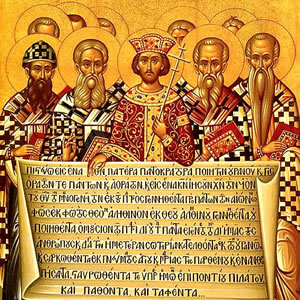 What was the Council of Nicaea?
The First Council of Nicaea was a council of Christian bishops convened in the Bithynian city of Nicaea (now ?znik, Bursa province, Turkey) by the Roman Emperor Constantine I in 325 AD. Its main accomplishments were settlement of the Christological
issue of the divine nature of God the Son and his relationship to God the Father, the construction of the first part of the Nicene Creed, establishing uniform observance of the date of Easter, and promulgation of early canon law.
Who are Khan Academy?Khan Academy is a non-profit educational organization. Created in 2006 by educator Salman Khan with the goal of creating a set of online tools that help educate students. The organization produces short lessons in the form of YouTube videos. Its
website also includes supplementary practice exercises and materials for educators. All resources are available to users of the website.