1127 views
·
Last viewed: 11 hrs ago
Uploaded: 30 May 2008 (18 years ago) · Shared: 01 Aug 2017
Duration: 9:05
Uploaded: 30 May 2008 (18 years ago) · Shared: 01 Aug 2017
Duration: 9:05
Youtube Description
This video is for those Christians who dare to deny any similarities between Christianity and pagan religions that predate Christianity. Watch thenext part about Osiris by clicking the following link: http://www.youtube.com/watch?v=xHoDpQaYXw4
Taken from the documentary 'The Hidden Story of Jesus' by Robert Beckford. Find it in google video.
Explore More
Robert Beckford Christianity Mithras PaganSearch Google Search Explore Topics
 Who is Robert Beckford?
Robert Beckford (born 1965) is a British academic theologian and currently a professor in theology at Canterbury Christ Church University, whose documentaries for both the BBC and Channel 4 have caused debate among the Christian and British religious community. Professionally, Beckford has spent his career in academia, beginning in 1999 as a research fellow at Birmingham University, then becoming a lecturer in African Diasporan Religions & Cultures. For two years he was Reader in Black Theology and Popular Culture at Oxford Brookes University and then a visiting Professor of Sociology at Goldsmiths, University of London. Beckford is currently Professor of Theology and Culture in the African Diaspora at Canterbury Christ Church University.
 What is Christianity?
Christianity is a global religion centered on the life and teachings of Jesus Christ, who followers believe is the Son of God. It's a monotheistic faith, meaning Christians believe in one God who exists in three co-equal persons: God the Father, God the Son (Jesus Christ), and the Holy Spirit. Christianity is based on the Bible, with the Old Testament and New Testament serving as sacred texts.
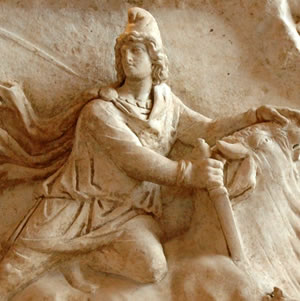 Who was Mithras?
Mithraism, was a mystery religion centered on the god Mithras that was practised in the Roman Empire from about the 1st to the 4th century CE. The religion was inspired by Persian worship of the god Mithra (Proto-Indo-Iranian/Vedic Mitra), though the Greek Mithras was linked to a new and distinctive imagery, and the level of continuity between Persian and Greco-Roman practice is debated. Worshippers of Mithras had a complex system of seven grades of initiation and communal ritual meals. Initiates called themselves syndexioi, those "united by the handshake". They met in underground temples, called mithraea, which survive in large numbers. The cult appears to have had its centre in Rome.
 What is Pagan?
Paganism is a term first used in the fourth century by early Christians. It was applied on populations of the Roman Empire who practiced polytheism, either because they were increasingly rural and provincial relative to the Christian population or because they were not milites Christi (soldiers of Christ). Alternate terms in Christian texts for the same group were hellene, gentile, and heathen. Pagan and paganism were pejorative terms for the same polytheistic group, implying its inferiority. Paganism has broadly connoted the "religion of the peasantry", and for much of its history was a derogatory term. Both during and after the Middle Ages, pagan was a pejorative term that was applied to any non-Abrahamic or unfamiliar religion, and the term presumed a belief in false god(s).