900 views
·
Last viewed: 1 hr ago
Uploaded: 22 Jun 2016 (10 years ago) · Shared: 07 Jun 2017
Duration: 5:37
Uploaded: 22 Jun 2016 (10 years ago) · Shared: 07 Jun 2017
Duration: 5:37
Video Description
In this insightful video, Dale Tuggy delves into the historical and theological contributions of Irenaeus, a prominent Church Father from 202 AD. Explore how Irenaeus's teachings and writings challenged and shaped early Christian doctrine, particularly his views on the Trinity. This exploration offers valuable insights into the early history of the Church and its development, making it a must-watch for those interested in the intersection of Christian, Jewish, and Islamic faiths. Discover the profound impact of Irenaeus's work on religious discourse and how his perspectives continue to influence spiritual discussions today.
Explore More
Church Father Dale Tuggy Irenaeus Trinity ChurchSearch Google Search Explore Topics
 What is Church Father?
The Church Fathers, Early Church Fathers, Christian Fathers, or Fathers of the Church are ancient and influential Christian theologians and writers. There is no definitive list. The era of these scholars who set the theological and scholarly foundations of Christianity largely ended by AD 700. In the past, the Church Fathers were regarded as authoritative, and more restrictive definitions were used which sought to limit the list to authors treated as such.
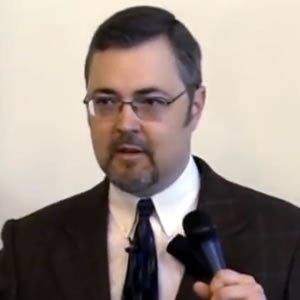 Who is Dale Tuggy?
Dale Tuggy (PhD, Brown University) is Professor of Philosophy at the State University of New York at Fredonia. He has authored about two dozen peer-reviewed articles and book chapters relating to the Trinity and other topics in analytic theology and philosophy of religion. Tuggy takes an interest in World Religions, Philosophy of Religion courses, the history of Philosophy, Eastern philosophies and religions, and Introduction to Philosophy.
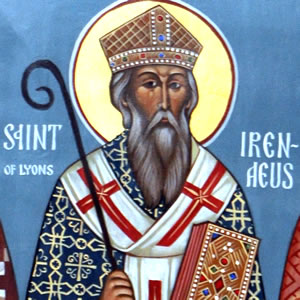 Who was Irenaeus?
Irenaeus (130-202 AD) was a Greek bishop. He is noted for his role in guiding and expanding Christian communities in what is now the south of France and, more widely, for the development of Christian theology by combating heresy and defining orthodoxy. Originating from Smyrna, now Izmir in Turkey, he had heard the preaching of Polycarp, who in turn was said to have heard John the Evangelist.
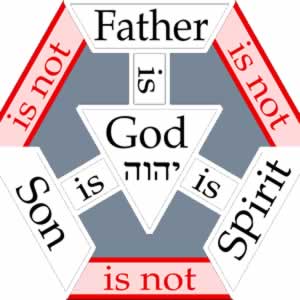 What is Trinity?
The Christian doctrine of the Trinity (Latin: trinus "threefold") holds that God is one God, but three coeternal consubstantial persons or hypostases. These being the Father, the Son (Jesus Christ), and the Holy Spirit - as "one God in three Divine Persons". The three Persons are distinct, yet are one "substance, essence or nature" (homoousios).
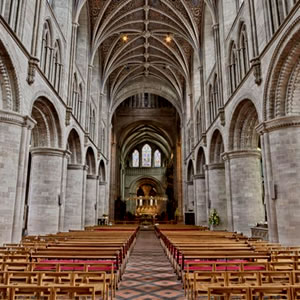 What is the Church?
A church is a building used for Christian worship services and Christian activities. The earliest identified Christian church is a house church founded between 233 AD and 256 AD. The word church also describes a body or assembly of Christian believers, while "the Church" refers to the worldwide Christian religious community.