Explore More
 Who is Subboor Ahmad?
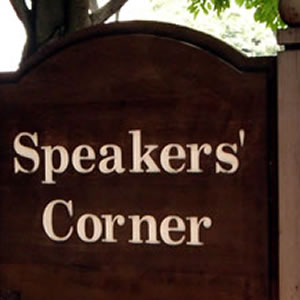
A Speakers' Corner is an area where open-air public speaking, debate, and discussion are allowed. The original and most noted is in the north-east corner of Hyde Park in London, England. Speakers here may talk on any subject, as long as the police
consider their speeches lawful, although this right is not restricted to Speakers' Corner only. Contrary to popular belief, there is no immunity from the law, nor are any subjects proscribed, but in practice the police intervene only when they receive a complaint. Speakers' Corner is often held up to demonstrate freedom of speech, as anyone can turn up unannounced and talk on almost any subject, although always at the risk of being heckled by regulars.
 What is Atheist?
Atheism is, in the broadest sense, the absence of belief in the existence of deities. Less broadly, atheism is the rejection of belief that any deities exist. In an even narrower sense, atheism is specifically the position that there are no deities
Atheism is contrasted with theism, which, in its most general form, is the belief that at least one deity exists.
 What is Science?
Science is a systematic enterprise that builds and organizes knowledge in the form of testable explanations and predictions about the universe. The earliest roots of science can be traced to the works of Ancient Egyptians and Mesopotamians, whose
contributions entered and shaped Greek natural philosophy of classical antiquity. After the fall of the Western Roman Empire, knowledge of Greek science deteriorated in Western Europe during the Middle Ages but flourished in the Islamic Golden Age. Modern science is typically divided into three major branches that consist of the natural sciences (e.g. biology, chemistry, physics), which study nature in the broadest sense; the social sciences (e.g. psychology, sociology, economics), which study individuals and societies; and the formal sciences (e.g. mathematics, logic, theoretical computer science), which study abstract concepts.