0:57
504 views
·
Last viewed: 11 mins ago
Uploaded: 20 Jun 2018 (8 years ago) · Shared: 21 Jun 2018
Video Description (from Youtube)
Link to the original video: https://www.youtube.com/watch?v=tr0D7W6zPSs DISCLAIMER We do NOT own the video materials and all credits belong to the respectful owners. In case of copyright issuesplease contact us immediately for further credits or clip delete.
COPYRIGHT
Under Section 107 of the Copyright Act 1976, allowance is made for 'fair use' for purposes such as criticism, comment, news reporting, teaching, scholarship and research. Fair use is a use permitted by copyright statute that might otherwise be infringing. Non-profit, educational or personal use tips the balance in favour of fair use.
DISCLAIMER
All videos are shared for educational and information purposes only. All videos are hosted and viewable on Youtube servers. Video titles are generated using the original video title; overall content theme including actual dialogue and speech (Transcript); and A.I-based recommendations with a focus on SEO, keyword density, and internal search functions. The video title does not represent the views held by the Youtube video uploader, or any individual, organisation or business.
If you spot any mistake, omission or give feedback, kindly Contact Us with details
Overview & Key Concepts
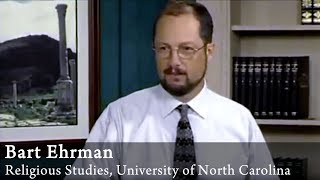
Who is Bart Ehrman?
 Bart Ehrman (born 1955) is an American New Testament scholar focusing on textual criticism of New Testament, historical Jesus, and development of
early Christianity. Ehrman has written and edited 30 books, including three college textbooks. He has also authored six New York Times bestsellers. He is currently the James A. Gray Distinguished Professor of Religious Studies at the University of North Carolina at Chapel Hill.
Who is GOD?
 In monotheism and henotheism, God is conceived as the Supreme Being and principal object of faith. The concept of God as described by theologians
commonly includes the attributes of omniscience (infinite knowledge), omnipotence (unlimited power), omnipresence (present everywhere), omnibenevolence (perfect goodness), divine simplicity, and eternal and necessary existence.
<ul>
<li>In theism, God is the creator and sustainer of the universe</li>
<li>In deism, God is the creator, but not the sustainer, of the universe</li>
<li>Monotheism is the belief in the existence of one God or in the oneness of God</li>
<li>In pantheism, God is the universe itself</li>
<li>In atheism, God is purported not to exist, while deemed unknown or unknowable within the context of agnosticism. </li>
</ul>
What is Sin?
In Abrahamic contexts, sin is the act of violating God's will. Sin can also be viewed as anything that violates the ideal relationship between an
individual and God; or as any diversion from the ideal order for human living. To sin has been defined as "to miss the mark".
<br><br>
Sins fall in a spectrum from minor errors to deadly misdeeds. Catholicism regards the least corrupt sins as venial sins which are part of human living and carry immediate consequences on earth, and, if unrepented for, more painful purgation, assuming the person is destined to heaven, as it is written in the formation letter "Purgatory", "most of the early Fathers of the Church speak of a cleansing fire, though we cannot tell whether this means actual or spiritual fire."
<br><br>
Conversely, sins of great evil are mortal sins which bring the consequence of hell if they are not addressed either through an act of perfect contrition or going to confession about them.
Frequently Asked Questions
1.Did a prophet ever commit a sin?
Islam teaches all prophets were of high moral character and did not succumb to the sins their people committed. Although prophets were humans and capable of human errors of judgment, but such errors does not diminish their superiority or the respect Muslims are obliged to have for them
2.Since Muslims believe in all the Prophets equally, why is Muhammad special?
All Prophets were equally from God, and equally true, but the scope of their missions varied. The messengers before Muhammad were each given teachings limited to their respective nations, because in those times a nation did not have much to do with other nations.
Furthermore, the teachings of each Prophet applied for a limited period of time only, after which God would raise another Prophet to revise some of the teachings for the new circumstances.
The time came to unite all the nations upon a single religion so that mankind may live in peace as one nation. Muhammad, to whom God gave teachings for the whole world for all time to come fulfilled this purpose.
3.What is the Codex Sinaiticus?
The Codex Sinaiticus is one of the most important books in the world. Handwritten well over 1600 years ago, the manuscript contains the Christian Bible in Greek, including the oldest complete copy of the New Testament
It is a fact of Christian history that the earliest Gospels did not record a resurrection of Jesus Christ, and this fact is supported in the Codex Sinaiticus.
Called the Codex Sinaiticus, or Sinai Bible, the oldest known complete Bible available to mankind today, was named after Mt. Sinai, the location of St. Catherine’s Monastery where it was discovered in 1859 by Dr Constantine Von Tischendorf (1815-1874).
The discovery of the Sinai Bible provided biblical scholars with irrefutable evidence of wilful falsifications in all modern-day Gospels, and a comparison identified a staggering 14,800 later editorial alterations in modern Bibles.
4.I am a Christian and I know my sins are forgiven and I am going to Heaven. Is this OK to believe?
5.Did Jesus wipe away our sins?
Only God could take on the sins of the world, die, and be resurrected, proving His victory over sin and death.
6.Can Jesus wipe away our sins?
Only God could take on the sins of the world, die, and be resurrected, proving His victory over sin and death.
7.Jesus was God as he had the power to forgive sin. Was he God?
8.How did Jacob deceive Isaac to steal the blessing?
Jacob deceived his blind, aging father Isaac by impersonating his older brother Esau. Orchestrated by his mother Rebecca, the scheme involved dressing Jacob in Esau’s clothing and covering his smooth arms and neck with hairy goat skins to mimic Esau's rugged texture. Jacob then brought Isaac a meal of goat meat prepared to taste like wild game, looked directly into his father's face, and explicitly lied about his identity to secure the primary family blessing of dominion and covenant succession.