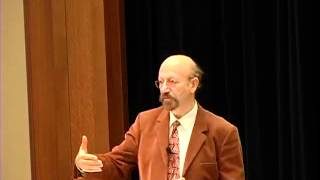
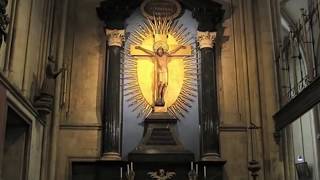
Bible Scholars acknowledge the different versions of Old Testament Canon and Text - Emanuel Tov

   26:21
419 views  ·  Last viewed: 1 week ago
Uploaded: 18 May 2015   (11 years ago)  ·  Shared: 04 May 2017

Video Description (from Youtube)


Overview & Key Concepts


What is Old Testament?
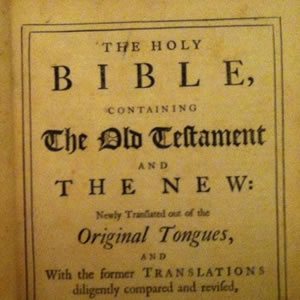
The Old Testament (OT) is the first part of Christian Bibles. This is based primarily upon the Hebrew Bible (or Tanakh), a collection of ancient

religious writings by the Israelites believed by most Christians and religious Jews to be the sacred Word of God. The second part of the Christian Bible is the New Testament.
<br><br>
The books that comprise the Old Testament canon, as well as their order and names, differ between Christian denominations. The Catholic canon comprises 46 books, and the canons of the Eastern Orthodox and Oriental Orthodox Churches comprise up to 51 books and the most common Protestant canon comprises 39 books.

Who is Emanuel Tov?
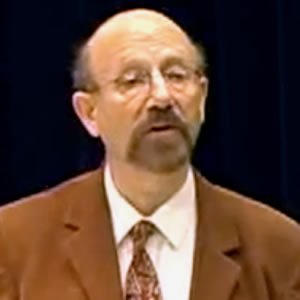
Emanuel Tov (born 1941) is emeritus Professor in the Department of Bible at the Hebrew University of Jerusalem. In 1986, he was appointed Professor at

the Hebrew University and in 1990 he became the J. L. Magnes Professor of Bible Studies. Served as visiting Professor at the Universities of Oxford, Uppsala, Doshisha (Kyoto), Macquarie and Sydney (Australia), Stellenbosch (South Africa), Vrije Universiteit (Amsterdam), University of Pennsylvania (Philadelphia), the Pontifical Gregorian University (Rome), and Halle (Germany). From 1990-2009 Tov served as the Editor-in-Chief of the international Dead Sea Scrolls Publication Project, which during those years produced 33 volumes of the series Discoveries in the Judean Desert as well as two concordances.

Frequently Asked Questions


1.What is the God of the Old Testament like?

The God of the Old Testament is a jealous, bloodthirsty, vicious God that mercilessly commanded horrific attrocities like, for example:

Killing every human on the planet except the handful that went with Noah.

Moses commanding his people to shed each others blood as atonement for creating and worshiping the golden calf

The genocide of the people in the promised land when the Hebrews finally ended their 40-year stay in the dessert. Under the command of God, they wiped out whole cities, killing every man, woman and child.


2.Is the Old Testament historically authentic?

Mainstream biblical scholarship clarifies that the Old Testament is an anthology of ancient texts compiled, edited, and transmission-copied by diverse authors over more than a millennium. While archaeological discoveries like the Dead Sea Scrolls confirm that the texts have been preserved with high fidelity for over 2,000 years, comparative textual analysis reveals localized spelling updates, minor scribal variations, and stylistic expansions common to ancient Near Eastern manuscript traditions.


3.Did Jesus abolish the Old Testament Law?

In the Synoptic Gospels, Jesus explicitly states in Matthew 5:17 that he did not come to abolish the Law or the Prophets, but to fulfill them. Mainstream Christian theology interprets this 'fulfillment' as Jesus perfectly satisfying the legal and sacrificial requirements of the Mosaic covenant, thereby inaugurating a New Covenant where specific ritual laws are no longer binding on believers. Secular historians and Islamic scholars emphasize that during his life, Jesus operated firmly within first-century Judaism, actively practicing and teaching obedience to the commandments of the Torah.


4.What did James say of the Old Testament Law?

In the New Testament Epistle of James, the author strongly emphasizes that faith without accompanying righteous deeds is dead and notes that stumbling at just one point makes a person guilty of breaking the entire Law (James 2:10). Early church records and historical scholarship depict James the Just (the brother of Jesus) as a deeply traditional, law-observant leader of the Jerusalem Church. He maintained that Jewish believers should strictly adhere to traditional Mosaic customs, which later created a significant theological tension with Apostle Paul's ministry to the Gentiles.


5.What is the punishment for apostasy in The Bible (Old Testament)?

In the legal codes of the Old Testament, most notably Deuteronomy 13:6-11, the prescribed statutory punishment for an Israelite who entices others to worship foreign gods is death by public stoning. While historical narratives like Exodus 32 document severe executions for national apostasy (such as the incident with the Golden Calf), biblical scholars note that this capital penalty was legally designed to protect the monotheistic identity of ancient Israel.


6.What was the foundation of the Old Testament?

The foundational belief of the Old Testament is strict monotheism, epitomized by the Shema (Deuteronomy 6:4): 'Hear, O Israel: The Lord our God is one Lord.' This faith was maintained in opposition to surrounding polytheistic practices.


7.Does the Old Testament teach the Christian Trinity?

Mainstream biblical scholars and historians agree that the Old Testament does not explicitly teach the doctrine of the Trinity, nor did ancient Jewish communities possess a concept of a triune Godhead. There is no historical evidence in pre-Christian Jewish literature including the Hebrew text, the Dead Sea Scrolls, or ancient commentaries of a belief in a plurality of divine Persons. While Christian theologians retrospectively interpret certain plural expressions (such as 'Let us make man' in Genesis 1:26) as hints of the Trinity, ancient Judaism strictly maintained a unitarian monotheistic understanding of God.


8.What do Christian 'Trinity' scholars say about the Old Testament?

Many theologians, including this analysis of Trinity dogma, note that the Old Testament does not explicitly contain the Trinity, which they believe was only fully revealed later.

The distinguished Trinitarian scholar Bertrand de Margerie in his book The Christian Trinity in History writes:

'Contemporary exegetes [Bible teachers] affirm unanimously that the Old Testament did not bring to the Jewish people a clear and distinct Revelation of the existence of a plurality of persons in God. In this they agree with the clear and frequent affirmation of Fathers such as Irenaeus, Hilary, and Gregory of Nazianzus: that the doctrine of the Trinity is revealed only in the New Testament.'

So any person who lived before Jesus' ministry did not have to believe in the Trinity to be saved because the Trinity is not mentioned in the Old Testament.


9.Many Christians believe that Jesus abolished the Old Testament dietary laws

Many Christians believe that Jesus abolished the Old Testament dietary laws. The dietary interpretation of Jesus' words (i.e. swine pig consumption) does not exist in the Textus Receptus Bible, the authoritative Greek New Testament text that was accepted by the Christian Church until about 100 years ago.

This parenthetic interpretation of Jesus words was obviously a comment that some Bible scribe wrote in the margin of the text. Later scribes accidentally or deliberately incorporated the marginal comment into the text itself, so the statement appears only in corrupted texts.

But the statement does not appear in the Textus Receptus, so the KJV says nothing about Jesus 'declaring all foods clean.'

God had clearly prohibited pig, swine and pork in the Old Testament. This verse was over whether or not 'unwashed hands' caused clean food to become unclean.

'Thus he declared all foods clean' is completely missing from the Textus Receptus, the authoritative Greek New Testament line used for centuries. It claims this widespread dietary interpretation was likely a later scribal note added to the margins of the text, which was subsequently mistaken for Jesus' actual words in corrupted versions.


10.How did Early Christians view the Old Testament?

Early Christians considered the Old Testament 'God-breathed' and authoritative, but believed its ultimate meaning was only revealed through its connection to Jesus Christ, who fulfilled Israel's prophetic history.


Videos on Emanuel Tov (2)

Video: Bible Scholars acknowledge the different versions of Old Testament Canon and Text - Emanuel Tov 26:21
Video: Textual Corruption in the Old Testament and Hebrew Bible - Emanuel Tov 54:28

EXPLORE TOPICS : EMANUEL TOV | 2 OLD TESTAMENT | 57

Latest videos  •  6,061 videos  •  0 viewed/24 hour

SUBSCRIBE

Receive the latest news and updates by email - Subscribe Now!
About  |  Q&A  |  Contact Us    •    Terms  |  Privacy  |  Disclaimer  |  Sitemap
Connect:      Facebook  |    Twitter  |    Youtube
MuslimProphets.com is an educational website on the Prophets of God: David, Noah, Abraham, Moses, Jesus and Muhammad, who established the Abrahamic faiths of Judaism, Christianity and Islam. MuslimProphets.com explores contemporary social themes through Scripture, Evidences, Photo, Video, Maps, Current Affairs, Debate and 'alternative' Views held by Theologians, Apologists, Scholars and Street Preachers. Take a Site Tour

In accordance with Islamic etiquette, all prophet names should be followed with 'Peace Be Upon Him (PBUH)'. This is omitted to minimise text.

DISCLAIMER: All website content is for general information and educational purposes only and available in the public domain. Whilst all information comes from sources believed to be reliable, this cannot be guaranteed. External links are provided as a convenience and for informational purposes only. They do not constitute endorsement or approval for any products, services or comments by organizations or individuals. Title and Text links may be edited for external SEO, internal site and keyword search purposes. We bear no responsibility for the accuracy, legality, or content found on any external website or its subsequent links. Unless indicated, all images and content is licensed under a Creative Commons Attribution License distributed by Wikipedia, Wikimedia Commons, Pixabay, Pxhere, Pexels, Unsplash, Flickr and others. All Torah, Psalms, Old and New Testament Bible quotes are from the King James Version (KJV) Holy Bible in the public domain. All Quran quotes are from Taqi-ud-Din al-Hilali/Muhsin Khan English Quran translation.

ALWAYS DO YOUR OWN RESEARCH. If you spot any mistake, error or omission of information, contact us so we can correct it.