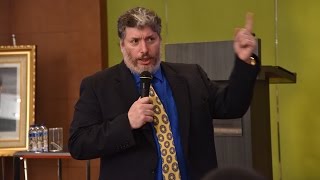
In Hebrews 9:22, is Blood necessary for Atonement of Sin? - Tovia Singer

   30:50
526 views  ·  Last viewed: 1 day ago
Uploaded: 16 Mar 2016   (10 years ago)  ·  Shared: 28 Mar 2017

Video Description (from Youtube)

Christians are surprised to discover their church’s cornerstone creed, “without the shedding of blood there is no atonement,” which famously appears in Hebrews 9:22, is not found anywhere in the

Jewish Scriptures. Although the footnote for Hebrews 9:22 in every annotated Christian Bible references Leviticus 17:11 as the source and authority for this doctrine, this idea is unbiblical and denounced by the Jewish prophets.

In this lively broadcast, Rabbi Singer points to the Bible and demonstrates that there is no Christian voice in the Jewish Scriptures. Singer illustrates this point by probing the Guilt Offering and shows that the Christian doctrine of substitutionary atonement—the notion that only unblemished sacrificial blood can propitiate God’s wrath and atone for sin—has no greater foes than the prophets of Israel.
https://outreachjudaism.org/ http://www.toviasinger.tv/

DISCLAIMER
All videos are shared for educational and information purposes only. All videos are hosted and viewable on Youtube servers. Video titles are generated using the original video title; overall content theme including actual dialogue and speech (Transcript); and A.I-based recommendations with a focus on SEO, keyword density, and internal search functions. The video title does not represent the views held by the Youtube video uploader, or any individual, organisation or business.

If you spot any mistake, omission or give feedback, kindly Contact Us with details

Overview & Key Concepts


Who is Tovia Singer?

Tovia Singer (born 1960) is a Jewish rabbi. Singer is the founder and director of Outreach Judaism, Indonesia.

What is Atonement?

Atonement (also atoning, to atone) is the concept of a person taking action to correct previous wrongdoing on their part. This is through direct

action to undo the consequences of that act, equivalent action to do good for others, or some other expression of feelings of remorse. Atonement 'is closely associated to forgiveness, reconciliation, sorrow, remorse, repentance, reparation, and guilt'. It can be seen as a necessary step on a path to redemption.

What is Hebrew?

Hebrew is a Northwest Semitic language within the Afroasiatic language family. A regional dialect of the Canaanite languages, it was natively spoken

by the Israelites and remained in regular use as a first language until after 200 CE and as the liturgical language of Judaism (since the Second Temple period) and Samaritanism. The language was revived as a spoken language in the 19th century, and is the only successful large-scale example of linguistic revival. It is the only Canaanite language still spoken today. It is also one of the only two Northwest Semitic languages with contemporary speakers, the other being Aramaic.

Nearly all of the Hebrew Bible is written in Biblical Hebrew, with much of its present form in the dialect that scholars believe flourished around the 6th century BCE, during the time of the Babylonian captivity.

Frequently Asked Questions


1.Did a prophet ever commit a sin?

Islam teaches all prophets were of high moral character and did not succumb to the sins their people committed. Although prophets were humans and capable of human errors of judgment, but such errors does not diminish their superiority or the respect Muslims are obliged to have for them.


2.Since Muslims believe in all the Prophets equally, why is Muhammad special?

All Prophets were equally from God, and equally true, but the scope of their missions varied. The messengers before Muhammad were each given teachings limited to their respective nations, because in those times a nation did not have much to do with other nations.

Furthermore, the teachings of each Prophet applied for a limited period of time only, after which God would raise another Prophet to revise some of the teachings for the new circumstances.

The time came to unite all the nations upon a single religion so that mankind may live in peace as one nation. Muhammad, to whom God gave teachings for the whole world for all time to come fulfilled this purpose.


3.What is the Codex Sinaiticus?

The Codex Sinaiticus is one of the most important books in the world. Handwritten well over 1600 years ago, the manuscript contains the Christian Bible in Greek, including the oldest complete copy of the New Testament

It is a fact of Christian history that the earliest Gospels did not record a resurrection of Jesus Christ, and this fact is supported in the Codex Sinaiticus.

Called the Codex Sinaiticus, or Sinai Bible, the oldest known complete Bible available to mankind today, was named after Mt. Sinai, the location of St. Catherines Monastery where it was discovered in 1859 by Dr Constantine Von Tischendorf (1815-1874).

The discovery of the Sinai Bible provided biblical scholars with irrefutable evidence of wilful falsifications in all modern-day Gospels, and a comparison identified a staggering 14,800 later editorial alterations in modern Bibles.


4.I am a Christian and I know my sins are forgiven and I am going to Heaven. Is this correct?

Mainstream Christian theology teaches that a believer can have absolute assurance of salvation and the forgiveness of sins through personal faith in the sacrificial death and resurrection of Jesus Christ.

In contrast, Islamic theology emphasizes that definitive assurance of entering Heaven remains unknown during worldly life, as final judgment belongs entirely to God, who balances infinite mercy with a strict accountability of an individual's faith and actions.


5.Did Jesus wipe away our sins?

In mainstream Christian theology, Jesus' death on the cross serves as the ultimate, substitutionary atonement that completely forgives and wipes away the sins of all who believe. Conversely, Islamic theology states that no individual can bear the spiritual burden or sins of another, maintaining that forgiveness is granted directly by God through personal, sincere repentance.


6.Can Jesus wipe away our sins?

During the 4th and 5th centuries, the early church held historic councils (such as Nicaea and Chalcedon) to legally resolve intense theological disputes regarding how Jesus could be both human and divine. These imperial debates aimed to establish a unified orthodoxy and eliminate alternative theological views that threatened the political and religious cohesion of the Roman Empire.


7.Jesus was God as he had the power to forgive sin. Was he God?

Historical-critical scholars note that in 1st-century Jewish thought, a prophet or messianic figure could act as a uniquely authorized agent of the divine king, possessing the delegated authority to declare God's forgiveness on Earth without being God Himself.

Islamic theology maintains that the absolute power to forgive sins belongs exclusively to the Creator; therefore, any historical accounts of a prophet pronouncing forgiveness are understood as an announcement of God's mercy rather than a claim to personal divinity.


8.How did Jacob deceive Isaac to steal the blessing?

Jacob deceived his blind, aging father Isaac by impersonating his older brother Esau. Orchestrated by his mother Rebecca, the scheme involved dressing Jacob in Esaus clothing and covering his smooth arms and neck with hairy goat skins to mimic Esau's rugged texture. Jacob then brought Isaac a meal of goat meat prepared to taste like wild game, looked directly into his father's face, and explicitly lied about his identity to secure the primary family blessing of dominion and covenant succession.


Videos on Atonement (1)

Video: In Hebrews 9:22, is Blood necessary for  Atonement of Sin? - Tovia Singer 30:50

EXPLORE TOPICS : ATONEMENT | 2 TOVIA SINGER | 145 HEBREW | 45 SIN | 0

Latest videos  •  6,061 videos  •  0 viewed/24 hour

SUBSCRIBE

Receive the latest news and updates by email - Subscribe Now!
About  |  Q&A  |  Contact Us    •    Terms  |  Privacy  |  Disclaimer  |  Sitemap
Connect:      Facebook  |    Twitter  |    Youtube
MuslimProphets.com is an educational website on the Prophets of God: David, Noah, Abraham, Moses, Jesus and Muhammad, who established the Abrahamic faiths of Judaism, Christianity and Islam. MuslimProphets.com explores contemporary social themes through Scripture, Evidences, Photo, Video, Maps, Current Affairs, Debate and 'alternative' Views held by Theologians, Apologists, Scholars and Street Preachers. Take a Site Tour

In accordance with Islamic etiquette, all prophet names should be followed with 'Peace Be Upon Him (PBUH)'. This is omitted to minimise text.

DISCLAIMER: All website content is for general information and educational purposes only and available in the public domain. Whilst all information comes from sources believed to be reliable, this cannot be guaranteed. External links are provided as a convenience and for informational purposes only. They do not constitute endorsement or approval for any products, services or comments by organizations or individuals. Title and Text links may be edited for external SEO, internal site and keyword search purposes. We bear no responsibility for the accuracy, legality, or content found on any external website or its subsequent links. Unless indicated, all images and content is licensed under a Creative Commons Attribution License distributed by Wikipedia, Wikimedia Commons, Pixabay, Pxhere, Pexels, Unsplash, Flickr and others. All Torah, Psalms, Old and New Testament Bible quotes are from the King James Version (KJV) Holy Bible in the public domain. All Quran quotes are from Taqi-ud-Din al-Hilali/Muhsin Khan English Quran translation.

ALWAYS DO YOUR OWN RESEARCH. If you spot any mistake, error or omission of information, contact us so we can correct it.