Uploaded: 29 Aug 2011 (15 years ago) · Shared: 04 Jan 2019
Video Description
Watch bossman103's response:
http://www.youtube.com/watch?v=HhyiBbOOoiU
Check out bossman103's channel:
http://www.youtube.com/user/bossman103
Sources for the Raglan scores of Jesus I cite:
Thomas J. Sienkewicz:
http://department.monm.edu/classics/Courses/Clas230/MythDocuments/HeroPattern/JesusPattern.htm
Abigail Acland:
http://tam-lin.org/abby/raglan.html
Alan Dundes:
http://www.religioustolerance.org/chr_jcpa4.htm
Bernard Muller:
http://historical-jesus.info/
And for a contrary opinion, see this article from tektonics.org:
http://www.tektonics.org/copycat/raglan.html
Finally, read and see more from me at:
http://www.stevelikestocurse.comDISCLAIMER
All videos are shared for educational and information purposes only. All videos are hosted and viewable on Youtube servers. Video titles are generated using the original video title; overall content theme including actual dialogue and speech (Transcript); and A.I-based recommendations with a focus on SEO, keyword density, and internal search functions. The video title does not represent the views held by the Youtube video uploader, or any individual, organisation or business.
If you spot any mistake, omission or give feedback, kindly Contact Us with details
Overview & Key Concepts
What is Mythical?
 Mythical is a person or something occurring in or characteristic of myths or folk tales. It is something existing only in the imagination, described in a myth especially as contrasted with history.
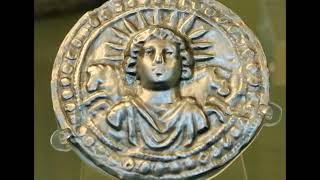
Who was Mithras?
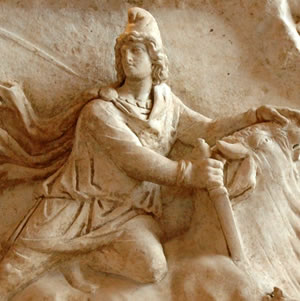 Mithraism, was a mystery religion centered on the god Mithras that was practised in the Roman Empire from about the 1st to the 4th century CE. The religion was inspired by Persian worship of the god Mithra (Proto-Indo-Iranian/Vedic Mitra), though the Greek Mithras was linked to a new and distinctive imagery, and the level of continuity between [...]
What is Pagan?
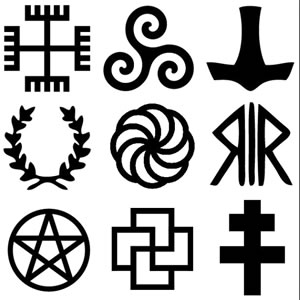 Paganism is a term first used in the fourth century by early Christians. It was applied on populations of the Roman Empire who practiced polytheism, either because they were increasingly rural and provincial relative to the Christian population or because they were not milites Christi (soldiers of Christ). Alternate terms in Christian texts for [...]
Frequently Asked Questions
1.How was Christianity made appealing to pagan idol worshippers?
In order to increase the number of Christian converts, Christian
missionaries deliberately adopted pre-existing pagan holy places,
shrines, special days and even pagan statues of God.
Pope Gregory I (540-604 CE), a famous Christian leader encouraged
accomodating pagan customs and beliefs. So if pagans worshipped a
Tree or Spirit abiding in it, rather than shun the pagan worship,
he urged priests to somehow link the worship to Jesus Christ, and
allow them to continue their Tree or pagan idol worship.
2.How was 25th December celebrated by pagans?
December 25th was the most important of Sun Festivals, the new
birth of the God, rising three days after 'dying' at the winter
solstice. Today, the celebration continues and its many features
can be witnessed. A few of these include:
* Excessive eating, drinking and merry was commin in Saturnalia
festival
* Father Christmas (Red Man) - who was originally Apollo, the
Sun-God or Thor God depicted as an elderly man, jovial or
friendly, of heavy build with a long white beard who drove a
chariot through the sky
* Fireplace - the fireplace in pagan homes was sacred to Thor
God which he would descend though the chimney
* Giving of gifts - a feature of Saturnalia festival
* Christmas card bearing the cheeky robin bird (with its chest
bearing the flame symbol)
* Snowman - who melts when the Sun comes out (is defeated by
the Sun)
* Fir-tree trinkets and decorations, symbolising life in the
'dead' parts of the world
* Holly - to deflect evil goblins in winter solstice
* Ivy - the female version of the 'male' holly
* Mistletoe - used by pagan druids in their worship
* Yule Log - sacred to the Thor God which is symbolised today
as a chocolate cake
3.How were the Triadic or 'Trinity-like' Pagan Gods presented?
The pagan Triadic dieties were shown as a single-head with 3 faces, 3 mouths but only 4 mouths. Such images were preserved across the Roman Empire.
4.Does the Christian Trinity come from pagan Triadic dieties?
Does the Christian Trinity come from pagan Triadic dieties?
Yes. The core teachings of the Trinitarian Christian churches
today do not come from Jesus.
The three-in-one Gods are pagan concepts that existed long before
Jesus arrived. Later on, Christians adopted this concept and
instantly made Christian doctrine an appealing alternative to the
pagan God worshipping masses.
5.Why are their so many similarities between Jesus Christ and all the pagan Gods?
It is highly likely the reason why the Church priests burned and destroyed the earlier records of pagan Gods was to hide the evidence for the real origins of their own Christian mythology.
6.Who was Mithras, the Sun-God?
Long before Jesus arrived, the Sun-God Mithras was worshipped.
* Mithras was said to have been a great mediator between God and
humanity
* Mithras was born of a virgin in a cave on December 25th
* Mithras travelled far and wide with 12 disciples
* Mithras died in the service of humanity.
* Mithras rose again from the tomb, and his resurrection was
celebrated with great rejoicing.
* His great festivals were the Winter Solstice and the Vernal
Equinox.
* Mithras was called Saviour and sometimes figures as a lamb.
People were initiated into the cult through the baptism of blood