Jesus was a dying & rising God similar to Pagan Gods before him?
Jesus Mythicism (or 'Jesus Myth Theory') is the belief that Jesus Christ had no historical existence. If he did exist, he had no involvement in the founding of modern Christianity.Was Jesus just another pagan God, modelled on previously worshipped dying and rising pagan Gods?
Dying & Rising Gods
- They are saviour gods
- They are a son of God (or daughter), but subordinate to God
- They undergo a passion (or suffering)
- They obtain victory over death, which they share with their followers through baptism, sacred meal etc.
- There stories are known amongst earthly men
- They are all invented myths. None of them actually existed.
| 1. Osiris |
Pagan GodOsiris is an Egyptian god, identified as the god of the afterlife, the underworld, and the dead, but more appropriately as the god of transition, resurrection and regeneration. Osiris was widely worshipped until the suppression of the Egyptian religion during the rise of Christianity in the Roman Empire.Dying & Rising GodThe Kings of Egypt were associated with Osiris in death. As Osiris rose from the dead, they would unite with him, and inherit eternal life through a process of imitative magic. Through the hope of new life after death, Osiris began to be associated with the cycles observed in nature, in particular vegetation and the annual flooding of the Nile.FamilyOsiris was the eldest son of the god Geb, though other sources state his father is the sun-god Ra, and sky goddess Nut, as well as being brother and husband of Isis, with Horus being considered his begotten son.PeriodThe first evidence of the worship of Osiris was found in the middle of the 5th Dynasty of Egypt (2513-2374 BC). |
| 2. Adonis |
Pagan GodIn Greek mythology, Adonis was the god of beauty and desire. Originally, he was a god worshipped in the area of Phoenicia (modern – day Lebanon), but was later adopted by the Greeks.Dying & Rising GodAdonis died when he was attacked by a wild boar that was sent by Ares, as he was the lover of Aphrodite. When he died, Aphrodite poured nectar over his blood, and the flower anemone emerged. In 20th century scholarship of religion, Adonis was widely seen as a prime example of the archetypal dying-and-rising god.FamilyAdonis was the mortal lover of the goddess Aphrodite in Greek mythology. In Ovid's first-century AD telling of the myth, he was conceived after Aphrodite cursed his mother Myrrha to lust after her own father, King Cinyras of Cyprus. Myrrha had sex with her father in complete darkness for nine nights, but he discovered her identity and chased her with a sword.PeriodThe earliest known Greek reference to Adonis comes from a fragment of a poem by the Lesbian poetess Sappho, dating to the 7th century BC. |
| 3. Romulus |
Pagan GodRomulus, the Savior-God of Rome whose worshipers could be found throughout the Roman sphere of influence. Romulus' mythology followed a general oft-repeated theme throughout the Mediterranean and Near East; that of a dying and rising savior-deity.Dying & Rising GodRomulus appeared to Julius Proculus and proclaimed: "It pleased the gods, O Proculus, that we [half-gods], who come from them, should remain so long a time amongst men as we did; and having built a city to be the greatest in the world for empire and glory, should return again to heaven "- Life of Romulus.The date of July 7th (the Nones of July) was established as a date of worship in celebration of Romulus' formal rise to godhood. FamilyOvid gives a description of the deification of Romulus and his wife Hersilia, who are given the new names of Quirinus and Hora respectively. Mars, the father of Romulus, is given permission by Jupiter to bring his son up to Olympus to live with the Olympians.PeriodSeveral ancient sources record the mythology of Romulus such as the writings of Lucius Calpurnius Piso, Quintus Aelius Tubero, Diocles of Peparethus and Fabius Pictor in the 1st century BC. |
| 4. Zalmoxis |
Pagan GodZamolxis was the Supreme God of the Getae (or Dacians), a Thracian people inhabiting a territory including today's Romania, but also extending farther cast and northeast. The scholars have interpreted Zamolxis as a Sky-god, a god of the dead and a mystery-god.Dying & Rising GodSimilar to other myths, one version has Zalmoxis as a Christ-like figure who dies and is resurrected. This position was defended by Jean (Ioan) Coman, a professor of patristics and Orthodox priest in the 1930s.Strabo (63 BC-21 AD) in his work 'The Geography': "At first he [Zalmoxis] was only made a priest of the god who was most honoured in their country, yet after a while he [Zalmoxis] was given the title of god, spending his life in a cave only he had the right to enter". FamilyZalmoxis was a slave of Pythagoras, son of Mnesarchos, on the island of Samos. After being liberated, he gathered huge wealth and, once rich, went back to his homeland. Zalmoxis had lived among the wisest of Greeks, such as Pythagoras.PeriodIt is difficult to define the time when a cult to Zalmoxis may have existed. It is only certain that it antecedes Herodotus. Zalmoxis is a supposed divinity of the Getae and Dacians (a people of the lower Danube), mentioned by Herodotus in his Histories Book IV, 93-96, written before 425 BC. |
| 5. Inanna |
Pagan GodInanna was the ancient Sumerian goddess of love, beauty, sex, desire, fertility, war, combat, justice, and political power. She was later worshipped by the Akkadians, Babylonians, and Assyrians under the name Ishtar.Dying & Rising GodInanna was associated with the planet Venus as "the morning and evening star". Theology professor Jeffrey Cooley argued, Inanna may correspond with the movements of the planet Venus in the sky. The planet Venus appears to make a similar descent, setting in the West and then rising again in the East.FamilyAs Inanna-Ishtar became more prominent, several lesser deities were assimilated into her, including Aya (wife of Utu), Anatu (a Semitic warrior goddess), Anunitu (an Akkadian light goddess), Agasayam (warrior goddess), Irnini (goddess of cedar forests in the Lebanese mountains), Kilili (symbol of desirable women), Sahirtu (messenger of lovers), Kir-gu-lu (bringer of rain) and Sarbanda (personification of sovereignty).PeriodInanna was worshipped in Sumer at least as early as the Uruk period (c. 4000 BC-3100 BC). |
| 6. Jesus Christ |
Pagan GodIt is unlikely the authors of Mark, Matthew, Luke or John based their writings on pagan God mythology. However, they may have copied popular Greek stories and myths prevalent at the time, i.e. miracles of Asclepius, god of healing and medicine.Dying & Rising GodIn Matthew 12:40, Jesus said he would be in the grave 3 days and 3 nights. Christians observe Good Friday at Jesus' dying and Easter Sunday as his rising up or resurrection.The concept of a dying-and-rising god was first proposed in comparative mythology by James Frazer's seminal The Golden Bough. Frazer associated the motif with fertility rites surrounding the yearly cycle of vegetation. Frazer cited the examples of Osiris, Tammuz, Adonis and Attis, Dionysus and Jesus Christ. Frazer, quoted in Mettinger 2001:18, cited after Garry and El-Shamy, p. 19 FamilyThe New Testament describes James, Joseph (Joses), Judas (Jude), and Simon as brothers of Jesus. Also mentioned, but not named, are sisters of Jesus.PeriodThe majority of New Testament scholars place Jesus' birth in 4 BC or before. The crucifixion of Jesus occurred in 1st-century Judea, most likely between 30 and 33 AD (4 BC-33 AD) |
Mythicist Viewpoint
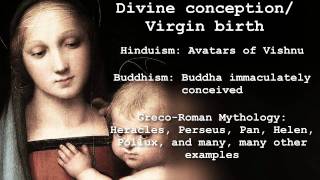
Today, it is acknowledged that Osiris, Adonis, Romulus, Zalmoxis, or Inanna never existed. They are invented myths. Why is Jesus Christ any different given the similar narratives of dying, rising, salvation and resurrection?The 'Muslim' Jesus
Islam teaches that Yeshua was a righteous Jewish prophet who claimed to be a Prophet sent by God ('the Father').Many years after Yeshua's crucifixion, the Roman authorities invented a fictitious diety, namely Jesus Christ, who was a replacement for the historical Yeshua.
Jesus Christ was elevated to the status of God ('the Father'), and thereafter worshiped as a God.
CREDIT
https://en.wikipedia.org/wiki/Dying-and-rising_deity
https://en.wikipedia.org/wiki/Jesus_in_comparative_mythology
https://www.richardcarrier.info/archives/13890
http://www.wikiwand.com/en/Christ_myth_theory
https://discoveringancienthistory.wordpress.com/2017/01/15/romulus-the-savior-god-of-rome/
134-jesus-dying-rising-god
| Author: Guest • Updated: 04 Sep 2026 • 25,972 views | 8 hrs ago |
Explore More
 Who is GOD?
In monotheism and henotheism, God is conceived as the Supreme Being and principal object of faith. The concept of God as described by theologians commonly includes the attributes of omniscience (infinite knowledge), omnipotence (unlimited power), omnipresence (present everywhere), omnibenevolence
(perfect goodness), divine simplicity, and eternal and necessary existence.
In theism, God is the creator and sustainer of the universe
In deism, God is the creator, but not the sustainer, of the universe
Monotheism is the belief in the existence of one God or in the oneness of God
In pantheism, God is the universe itself
In atheism, God is purported not to exist, while deemed unknown or unknowable within the context of agnosticism.
What is Sin?In Abrahamic contexts, sin is the act of violating God's will. Sin can also be viewed as anything that violates the ideal relationship between an individual and God; or as any diversion from the ideal order for human living. To sin has been defined as "to miss the mark". Sins fall in a spectrum
from minor errors to deadly misdeeds. Catholicism regards the least corrupt sins as venial sins which are part of human living and carry immediate consequences on earth, and, if unrepented for, more painful purgation, assuming the person is destined to heaven, as it is written in the formation letter "Purgatory", "most of the early Fathers of the Church speak of a cleansing fire, though we cannot tell whether this means actual or spiritual fire."
Conversely, sins of great evil are mortal sins which bring the consequence of hell if they are not addressed either through an act of perfect contrition or going to confession about them.