Comparing the Synoptic gospels of Mark, Matthew & Luke

The similarities between the Synoptic Gospels have caused the 'Synoptic Problem'. The solution lies in the numerous theories and hypothesis

Matthew, Mark and Luke are commonly called the Synoptic Gospels. The Synoptic Gospels are very similar to each other. In fact, their similarities have led to one of the most debated subjects amongst New Testament Bible scholars - 'The Synoptic Problem' (i.e. who copied who?)

Mark Matthew Luke John
60-80 AD 70-100 AD 93 AD 125 AD

Winged Lion

Winged Man

Winged Ox

Eagle
Synoptic Problem
Synoptic
Synoptic
Synoptic
Not Synoptic
  • Mark's Gospel is almost universally accepted as the first gospel to be written
  • Mark is the shortest and simplest of the three Synoptic gospels
  • Large portions of Mark are found in Matthew and Luke
  • Matthew and Luke share over 200 verses not found in Mark
  • Shared content includes stories, wording, and chronology of events
  • Triple tradition - Text found in all three Synoptic Gospels
  • Double tradition, or "Q" Source - Text found in both Matthew and Luke
  • M tradition - Text found exclusively in Matthew
  • L tradition - Text found exclusively in Luke   Blueletterbible.org/The Synoptic Problem and Q
  • John's content, chronology and wording is distinctly different to the Synoptics.
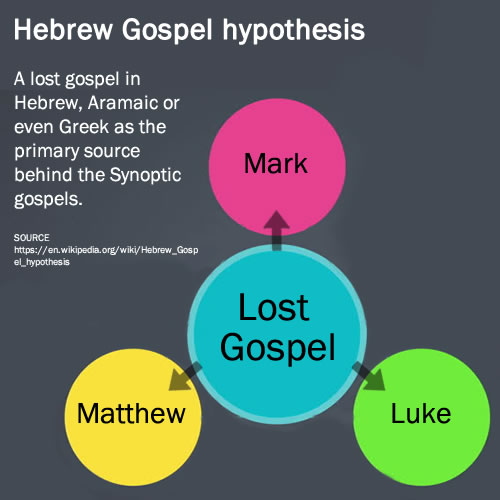
    Hebrew Gospel Hypothesis
    Hebrew Gospel Hypothesis involves a lost gospel in Hebrew, Aramaic or even Greek as the primary source behind the Synoptic gospels.   Bible.org/synoptic-problem   Ehrmanblog.org

    * Stein, Synoptic Problem, p.48
    ** Evidence suggests Matthew and Luke did not copy from each other
    Other Hypothesis'
    1.   Augustinian Hypothesis
    Both Irenaeus and Origen, predecessors of Augustine, also held to the same order of composition. Later advocates of this theory include Hugo Grotius, HG Jameson, Basil Christopher Butler and John Wenham.
    2.   Two-Gospel Hypothesis (Griesbach)
    This theory is supported by Henry Owen, JJ Griesbach, William R Farmer, and TRW Longstaff et al.
    3.   Two-Source Hypothesis
    This theory is supported by the majority of New Testament scholars today.
    4.   Three-Source Hypothesis
    This theory is supported by Heinrich Julius Holtzmann, Eduard Simons, Hans Hinrich Wendt, Edward Y Hincks, Robert Morgenthaler and Robert H. Gundry.
    5.   Four-Document Hypothesis
    This is a variation of the Two-Source Hypothesis and so is highly favored among Bible scholars today.
    6.   Farrer Hypothesis (Mark without Q)
    This theory is supported by JH Ropes, AM Farrer, MD Goulder and Mark Goodacre
    7.   Hebrew Gospel Hypothesis (or Proto-Gospel)
    This theory is based on the proposition that a lost gospel in Hebrew or Aramaic lies behind the Synoptic gospels. (outlined above)

    CREDIT
    http://www.humanreligions.info/gospels.html
    http://www.bowness.demon.co.uk/gosp1.htm
    http://megasociety.org/noesis/138/synoptic.html
    https://www.tms.edu/m/tmsj13b.pdf
    https://en.wikipedia.org/wiki/Hebrew_Gospel_hypothesis
    Author: Guest   •   Updated: 11 Jun 2019
    ALL ARTICLES ARE INTENDED FOR GENERAL EDUCATIONAL PURPOSES ONLY. ALL INFORMATION IS BELIEVED TO BE CORRECT, ACCURATE AND TRUTHFUL. YOU ARE ADVISED TO DO YOUR OWN RESEARCH. ARTICLES ARE LIVE DOCUMENTS AND MAY BE UPDATED WITH NEW CONTENT AT ANY TIME. WHERE AVAILABLE, SOURCES AND REFERENCES ARE CREDITED. IF YOU SPOT ANY ERRORS, OMISSIONS OR GIVE FEEDBACK KINDLY CONTACT US WITH DETAILS
    113-bible-synoptic-problem


    Videos on 'Synoptic Problem' (0)


    News on "Synoptic+problem"


    Latest videos  •  5,866 videos  •  0 viewed/24 hour
    About  |  Q&A  |  Contact    •    Terms  |  Privacy  |  Disclaimer  |  Sitemap
    Connect:      Facebook  |    Twitter  |    Youtube
    MuslimProphets.com is an educational website on the Prophets of God: David, Noah, Abraham, Moses, Jesus and Muhammad, who established the Abrahamic faiths of Judaism, Christianity and Islam. MuslimProphets.com explores contemporary social themes through Scripture, Evidences, Photo, Video, Maps, Current Affairs, Debate and 'alternative' Views held by Theologians, Apologists, Scholars and Street Preachers. Take a Site Tour

    In accordance with Islamic etiquette, all prophet names should be followed with 'Peace Be Upon Him (PBUH)'. This is omitted to minimise text.

    DISCLAIMER: All website content is for general information and educational purposes only and available in the public domain. Whilst all information comes from sources believed to be reliable, this cannot be guaranteed. External links are provided as a convenience and for informational purposes only. They do not constitute endorsement or approval for any products, services or comments by organizations or individuals. Title and Text links may be edited for external SEO, internal site and keyword search purposes. We bear no responsibility for the accuracy, legality, or content found on any external website or its subsequent links. Unless indicated, all images and content is licensed under a Creative Commons Attribution License distributed by Wikipedia, Wikimedia Commons, Pixabay, Pxhere, Pexels, Unsplash, Flickr and others. All Torah, Psalms, Old and New Testament Bible quotes are from the King James Version (KJV) Holy Bible in the public domain. All Quran quotes are from Taqi-ud-Din al-Hilali/Muhsin Khan English Quran translation.

    ALWAYS DO YOUR OWN RESEARCH. If you spot any mistake, error or omission of information, contact us so we can correct it.