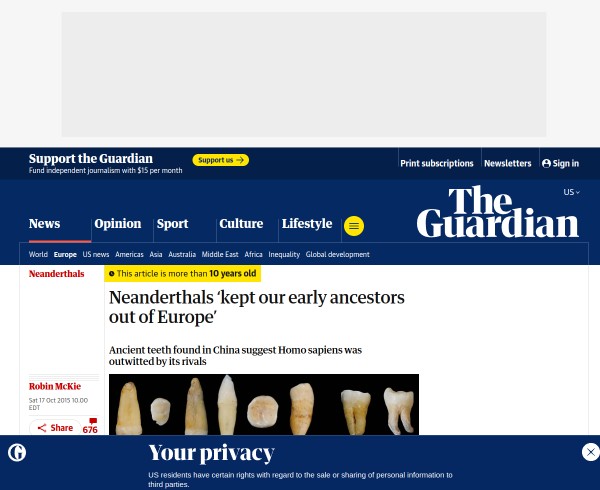
Live Screenshot
Source link:
https://www.theguardian.com/science/2015/oct/17/neanderthals-kept-early-homo-sapiens-out-of-europe?CMP=fb_guPublished by: THE GUARDIAN on 17 Oct 2015
1645 views · Last view: 1 day ago
News Text (from THE GUARDIAN)
The discovery of a hoard of ancient human teeth in a Chinese cave has forced scientists to reconsider our species’ relations with our closest evolutionary cousins, the Neanderthals. The find, revealed in the science journal Nature, shows modern humans must have left their African homeland andreached southern China more than 80,000 years ago.
This unexpectedly early date contrasts with our ancestors’ far more recent arrival in Europe - about 45,000 years ago – and suggests Homo sapiens was prevented, for some reason, from moving there for tens of thousands of years. Anthropologist María Martinón-Torres, from University College London – a member of the team that made the discovery – is confident of the reason. She blames the Neanderthals.
“Homo sapiens evolved in Africa and emerged from the continent about 100,000 years ago and swept eastward with little apparent resistance from other hominid species they encountered. But when they headed north, they reached the Levant [...]
To view the original News article, click here
DISCLAIMER All news articles are shared for educational purposes only. The news content is hosted on the external news website. News articles titles are derived from the original news title, news content, dialogue, speech or general content theme. The news title may be edited and optimized for SEO, keyword density, information and internal website search purposes. You are advised to view the original news article for a better understanding. If you spot any mistakes, errors or omissions kindly contact us.
Search Results on 'Neanderthals kept our early ancestors out of Europe - The Guardian'
SCROLL TO: TOPICS | 1 NEWS | 102 ARTICLES | 0 FAQ | 0 VIDEO | 10 LINKS | 0Topics include The Guardian (1)
Who are The Guardian? The Guardian is a British daily newspaper. It was founded in 1821 as The Manchester Guardian, and changed its name in 1959. Along with its sister papers The Observer and The Guardian Weekly, The Guardian is part of the Guardian Media Group, owned by the Scott Trust. The trust was created in 1936 to
"secure the financial and editorial independence of The Guardian in perpetuity and to safeguard the journalistic freedom and liberal values of The Guardian free from commercial or political interference". |
 Pretty Radical: Inside Poland's Far-Right -
  Battle For Mosul, Iraq -
  Coronavirus leads to violence against 'Tablighi Jamaat' Muslims in divided India -
  'Palestinian Lives Matter' to
  'God gave us Israel. All of Jerusalem is Jewish' |
  'Even Refugee Camps are not safe from Israeli soldiers' |
  'I gave you Life, you chose Death', Israeli settler claims |
  Extremist Israeli settlers make living in Gaza impossible |
  Israeli Settlers destroy what
  Lebanon pays 'a big price' for resisting Israel |