Live Screenshot
Source link:
https://www.theguardian.com/world/2017/apr/14/what-is-the-historical-evidence-that-jesus-christ-lived-and-diedPublished by: THE GUARDIAN on 14 Apr 2017
1494 views · Last view: 13 hrs ago
News Text (from THE GUARDIAN)
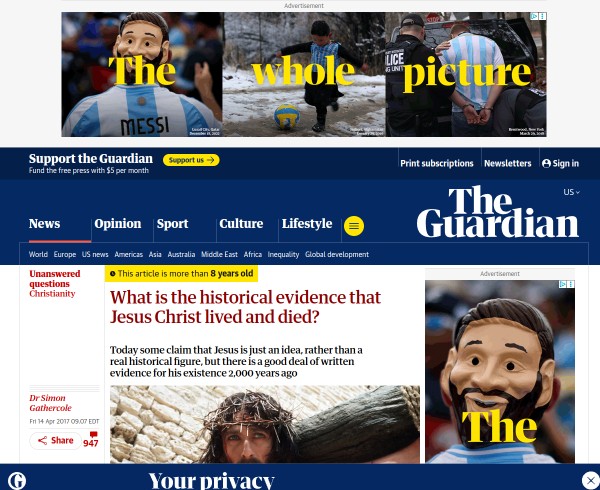
Today some claim that Jesus is just an idea, rather than a real historical figure, but there is a good deal of written evidence for his existence 2,000 years ago The historical evidence for Jesus of Nazareth is both long-established and widespread. Within a few decades of his supposed lifetime, heis mentioned by Jewish and Roman historians, as well as by dozens of Christian writings. Compare that with, for example, King Arthur, who supposedly lived around AD500. The major historical source for events of that time does not even mention Arthur, and he is first referred to 300 or 400 years after he is supposed to have lived. The evidence for Jesus is not limited to later folklore, as are accounts of Arthur.
The value of this evidence is that it is both early and detailed. The first Christian writings to talk about Jesus are the epistles of St Paul, and scholars agree that the earliest of these letters were written within 25 years of Jesus’s death at the very latest, while the [...]
To view the original News article, click here
DISCLAIMER All news articles are shared for educational purposes only. The news content is hosted on the external news website. News articles titles are derived from the original news title, news content, dialogue, speech or general content theme. The news title may be edited and optimized for SEO, keyword density, information and internal website search purposes. You are advised to view the original news article for a better understanding. If you spot any mistakes, errors or omissions kindly contact us.
Search Results on 'What is the historical evidence that Jesus Christ lived and died? - The Guardian'
SCROLL TO: TOPICS | 1 NEWS | 102 ARTICLES | 0 FAQ | 0 VIDEO | 10 LINKS | 0Topics include The Guardian (1)
Who are The Guardian? The Guardian is a British daily newspaper. It was founded in 1821 as The Manchester Guardian, and changed its name in 1959. Along with its sister papers The Observer and The Guardian Weekly, The Guardian is part of the Guardian Media Group, owned by the Scott Trust. The trust was created in 1936 to
"secure the financial and editorial independence of The Guardian in perpetuity and to safeguard the journalistic freedom and liberal values of The Guardian free from commercial or political interference". |
 Pretty Radical: Inside Poland's Far-Right -
  Battle For Mosul, Iraq -
  Coronavirus leads to violence against 'Tablighi Jamaat' Muslims in divided India -
  'Palestinian Lives Matter' to
  'God gave us Israel. All of Jerusalem is Jewish' |
  'Even Refugee Camps are not safe from Israeli soldiers' |
  'I gave you Life, you chose Death', Israeli settler claims |
  Extremist Israeli settlers make living in Gaza impossible |
  Israeli Settlers destroy what
  Lebanon pays 'a big price' for resisting Israel |